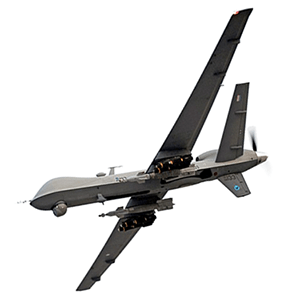
The US government, led by the CIA’s Special Activities Division, has made a series of attacks on targets in northwest Pakistan since 2004 using drones (unmanned aerial vehicles). These attacks are part of the US’ War on Terrorism campaign, seeking to defeat Taliban and Al-Qaeda militants in Pakistan. Most of these attacks are on targets in the Federally Administered Tribal Areas along the Afghan border in Northwest Pakistan. These strikes have increased substantially under the Presidency of Barack Obama. Generally the UAVs used are MQ-1 Predator and more recently MQ-9 Reaper firing AGM-114 Hellfire missiles. The drones have become a weapon of choice for the United States in the fight against al-Qaeda. Some media refer to the series of attacks as a ‘drone war.’ The US defence budget for 2011 asked for a 75% increase in funds to enhance the drone operations.
There is tremendous debate over the civilian casualty ratio of drone strikes. The CIA claims very few civilians are killed in relation to militants. Pakistan’s government, on the other hand publicly condemns these attacks; its Interior Minister has said ‘Drone missiles cause collateral damage. A few militants are killed, but the majority of victims are innocent citizens.’ The strikes are often linked to Anti-American sentiment in Pakistan and the growing unease with the scope of CIA activity there. However, in secret cables leaked by Wikileaks, Pakistan’s Army Chief not only tacitly agreed to the drone flights but in 2008 requested Americans to increase them.
In 2009 Barack Obama authorized the continuation of these strikes after he became US president. Top US officials consider these strikes very successful and believe that the senior al-Qaeda leadership has been ‘decimated’ by them. Obama has broadened these attacks to include targets seeking to destabilize Pakistani civilian government.
Former CIA officials state that the agency uses a careful screening process in making decisions on which individuals to kill via drone strikes. The process, carried out at the agency’s counterterrorist center, involves up to 10 lawyers who write briefs justifying the targeting of specific individuals. According to the former officials, if the briefs’ arguments are weak, the request to target the individual is denied.
Since 2008 the CIA has relied less on its list of individuals and increasingly targeted ‘signatures,’ or suspect behavior. This change in tactics has resulted in more deaths of lower-level fighters, or ‘mere foot soldiers.’ US military reports asserted that al-Qaeda is being slowly but systematically routed because of these attacks, and that they have served to sow the seeds of uncertainty and discord among their ranks. They also claimed that the drone attacks have addled and confused the Taliban, and have led them to turn against each other.
Some US politicians and academics have condemned the drone strikes. Congressman Dennis Kucinich asserted that the United States was violating international law by carrying out strikes against a country that never attacked the United States. Georgetown University professor Gary D. Solis asserts that since the drone operators at the CIA are civilians directly engaged in armed conflict, this makes them ‘unlawful combatants’ and possibly subject to prosecution. US State Department legal advisor Harold Koh stated in 2010 that the drone strikes were legal because of the right to self-defense. According to Koh, the US is involved in an armed conflict with al-Qaida, the Taliban, and their affiliates and therefore may use force consistent with self-defense under international law.
The US increased strikes against the Pakistani Taliban, which earned favor from the Pakistani government, resulting in increased cooperation from Pakistani intelligence services. Also, the Obama administration toned down the US government’s public rhetoric against Islamic terrorism, garnering better cooperation from other Islamic governments. Furthermore, with the drawdown of the war in Iraq, more drones, support personnel, and intelligence assets became available for the campaigns in Afghanistan and Pakistan.
Since Obama took office the number of drones operated by the CIA over Afghanistan and Pakistan doubled. Counterterrorism officials have speculated that the Obama administration’s closure of the secret CIA interrogation centers and intent to close the Guantanamo Bay prison was a direct influence on the expansion of the drone targeted killings. According to the officials, the killings are necessary because there is no longer any place to put captured terrorists.
Messages recovered from Osama bin Laden’s home after his death in 2011, including one from then al Qaeda No. 3, Atiyah Abd al-Rahman reportedly expressed frustration with the drone strikes in Pakistan. According to an unnamed U.S. Government official, in his message al-Rahman complained that drone-launched missiles were killing al Qaeda operatives faster than they could be replaced.
Surveys of locals in the tribal areas disproved the notion (outside the Pakhtun belt) that a large majority of the local population supports the Taliban movement. Most people thought that the drone attacks were accurate and did not lead to anti-American sentiment and were effective in damaging the militants. In addition the locals wanted the Pakistani forces to also target the militants. Some people in Waziristan compare the drones to Ababils, the holy swallows sent by God to avenge Abraha.
According to unnamed counterterrorism officials, in 2009 or 2010 CIA drones began employing smaller missiles in airstrikes in Pakistan in order to reduce civilian casualties. The new missiles, called the Small Smart Weapon or Scorpion, are reportedly about the size of a violin case (21 inches long) and weigh 16 kg. The missiles are used in combination with new technology intended to increase accuracy and expand surveillance, including the use of small, unarmed surveillance drones to exactly pinpoint the location of targets.
These ‘micro-UAVs’ can be roughly the size of a pizza platter and meant to monitor potential targets at close range, for hours or days at a time. One former U.S. official who worked with micro-UAVs said that they can be almost impossible to detect at night. ‘It can be outside your window and you won’t hear a whisper,’ the official said. The drone operators also have changed to trying to target insurgents in vehicles rather than residences to reduce the chances of civilian casualties.


 The Daily Omnivore
Leave a comment