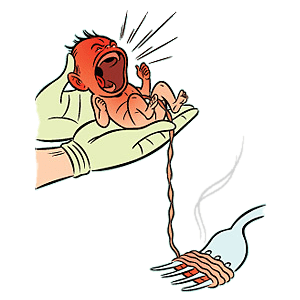
Placentophagy [pluh-sen-tof-uh-jee] is the act of mammals eating the placenta of their young after childbirth. The placenta contains high levels of prostaglandin which stimulates shrinking or return to a former size of the uterus. The placenta also contains small amounts of oxytocin which eases birth stress and causes the smooth muscles around the mammary cells to contract and eject milk. Although the placenta is revered in many cultures, very few customarily eat the placenta after the newborn’s birth. Those who advocate placentophagy in humans believe that eating the placenta prevents postpartum depression and other pregnancy complications. The Royal College of Obstetricians and Gynaecologists states that there is no medical reason to eat the placenta: ‘Animals eat their placenta to get nutrition – but when people are already well-nourished, there is no benefit, there is no reason to do it.’ Human placenta has also been an ingredient in some traditional Chinese medicines.
There is a school of thought that holds that placentophagy naturally occurred to hide any trace of childbirth from predators in the wild, though the fact that amniotic fluid is not similarly ingested by the mother seems to discredit this theory. Most placental mammals participate in placentophagy, including, surprisingly, herbivorous ones. Whales and seals are exceptions to mammalian placentophagy, as is the camel. Marsupials (pouched mammals) resorb rather than deliver the placenta, and therefore cannot engage in placentophagia; they do, however, vigorously lick birth fluids as they are excreted.


 The Daily Omnivore