September 20, 2011

Bless you, or God bless you, is a common English expression addressed to a person after they sneeze. In non-English-speaking cultures, words referencing good health or a long life are often used instead of ‘bless you,’ though some also use references to God. English speakers also respond to sneezing with the German word Gesundheit, which means ‘health.’
The origin of the custom and its original purpose is unknown. Several possible origins are commonly given. The practice of blessing someone who sneezes, dating as far back as at least 77 CE, however, is far older than most specific explanations can account for.
read more »
Posted in Health, Language, Philosophy |
1 Comment »
September 20, 2011

Superstition is a belief in a non-physical (i.e. supernatural) causality: that one event causes another without any physical process linking the two events. The word is often used pejoratively to refer to practices (e.g. Voodoo) other than the one prevailing in a given society (e.g. Christianity in western culture), although the prevailing religion may contain just as many supernatural beliefs.
It is also commonly applied to beliefs and practices surrounding luck, prophecy and spiritual beings, particularly the belief that future events can be foretold by specific unrelated prior events.
read more »
Posted in Language, Philosophy, Science |
Leave a Comment »
September 19, 2011

Trichomes [trik-ohm] (from the Greek word ‘trikhoma’ meaning ‘growth of hair’) are structures on plants that look like hairs. Glandular trichomes have chemicals in them. They break when the plant is touched. For example, trichomes on poison ivy leaves have a chemical that causes a rash. Cannabis trichomes produce a psychoactive resin. It is likely that in many cases, plant hairs interfere with the feeding of herbivores. Hairs on plants growing in areas subject to frost keep the frost away from the living surface cells. In windy locations, hairs break-up the flow of air across the plant surface, reducing evaporation. Dense coatings of hairs reflect solar radiation, protecting the more delicate tissues underneath in hot, dry, open habitats. And in locations where much of the available moisture comes from cloud drip, hairs appear to enhance this process.
They occur only on plants and certain protists (a type of single-celled organism). Certain algae, have their terminal cell shaped into an elongate ‘hair-like’ structure called a trichome. The same term is applied to such structures in some cyanobacteria (bacterium which rely on photosynthesis). Trichomes on plants are epidermal outgrowths of various kinds. The terms ’emergences,’ ‘thorns,’ ‘spines,’ and ‘prickles’ refer to outgrowths that involve more than the epidermis (the outermost layer of the plant). See for example, the ‘wait-a-minute tree,’ which has numerous hooked thorns with the shape and size of a cat’s claw, that tend to hook onto passers-by; the hooked person must stop (‘wait a minute’) to remove the thorns carefully to avoid injury.
Posted in Drugs, Language, Science |
Leave a Comment »
September 16, 2011

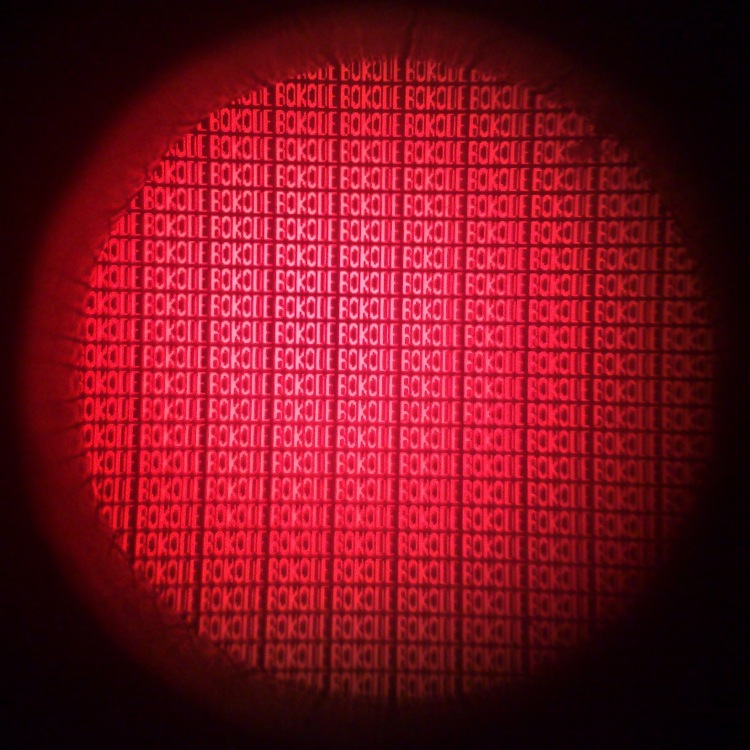
A bokode is a type of data tag which holds thousands of times more information than a barcode. They were developed by a team at the MIT Media Lab. The bokode pattern is a tiled series of Data Matrix codes. The name is a portmanteau of the words bokeh (a photographic term) and barcode – rewritable bokodes are called bocodes. They are much smaller than a barcode and are circular in shape with a diameter of 3mm. A bokode consists of an LED covered with a mask and a lens. They are readable from different angles and from 4 meters (13 feet) away by an SLR camera.
Currently they are expensive to produce as the LED requires power, but there are prototypes which manage with reflected light. Bokodes represent a privacy advantage compared to Radio-frequency identification tags (RFID): bokodes can be covered up, whereas active as well as passive RFID tags can be read from a distance with equipment that can receive radio signals.
Posted in Money, Technology |
Leave a Comment »
September 16, 2011

In photography, bokeh [boh-kay] is the blur, or the aesthetic quality of the blur, in out-of-focus areas of an image, or ‘the way the lens renders out-of-focus points of light.’ Differences in lens aberrations and aperture shape cause some lens designs to blur the image in a way that is pleasing to the eye, while others produce blurring that is unpleasant or distracting—’good’ and ‘bad’ bokeh, respectively. Bokeh occurs for parts of the scene that lie outside the depth of field. Photographers sometimes deliberately use a shallow focus technique to create images with prominent out-of-focus regions.
Bokeh is often most visible around small background highlights, such as specular reflections and light sources, which is why it is often associated with such areas. However, bokeh is not limited to highlights; blur occurs in all out-of-focus regions of the image.
read more »
Posted in Art, Language, Technology |
2 Comments »
September 15, 2011

Lewis Hine (1874 – 1940) was an American sociologist and photographer. Hine used his camera as a tool for social reform. His photographs were instrumental in changing the child labor laws in the United States. Born in Oshkosh, Wisconsin in 1874. After his father died in an accident, he began working and saved his money for a college education.
Hine studied sociology at the University of Chicago, Columbia University and New York University. He became a teacher in New York City at the Ethical Culture School, where he encouraged his students to use photography as an educational medium. The classes traveled to Ellis Island in New York Harbor, photographing the thousands of immigrants who arrived each day. Between 1904 and 1909, Hine took over 200 plates (photographs), and eventually came to the realization that his vocation was photojournalism.
read more »
Posted in Money, Politics, Science |
Leave a Comment »
September 13, 2011

Steatopygia [stee-at-uh-pahy-jee-uh] is a high degree of fat accumulation in and around the buttocks. The deposit of fat is not confined to the gluteal regions, but extends to the outside and front of the thighs, forming a thick layer reaching sometimes to the knee. This development constitutes a genetic characteristic of the Khoisan, an African ethnic group, where it is regarded as a sign of feminine beauty: it begins in infancy and is fully developed by the time of the first pregnancy. It is often accompanied by the formation known as elongated labia (labia minora that may extend as much as 4 inches outside the vulva). This was historically known as the ‘hottentot apron’ — now deemed a very offensive term.
It has been suggested that this feature was once more widespread. Paleolithic Venus figurines, sometimes referred to as ‘steatopygian Venus’ figures, discovered from Europe to Siberia and presenting a remarkable development of the thighs, and even the prolongation of the labia minora, have been used to support this theory. Whether these were intended to be lifelike or exaggeratory, even idealistic, is unclear. However, these figures do not strictly qualify as steatopygian, since they exhibit an angle of approximately 120 degrees between the back and the buttocks, while steatopygia is diagnosed at an angle of about 90 degrees only.
Posted in Health, Sex, World |
Leave a Comment »
September 13, 2011

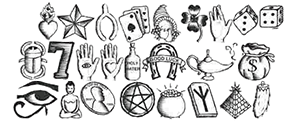
Apotropaic [ap-uh-truh-pey-ik] magic is the use of rituals to ward off harmful influences like the ‘evil eye’ or invidia (jealous or hostile gazes). This can be a long ritual, or it can take the form of simply wearing an amulet or other token, against bad luck, or gestures such as fingers crossed or knocking on wood. When faced with a bad omen the Greeks made offerings to the Averting Gods, underworld deities and heroes who might offer them protection Apotropaic rituals were practiced throughout the ancient Near East and Egypt. Fearsome deities were invoked to ward away evil spirits.
In ancient Egypt, these household rituals were embodied by the deity who personified magic itself, Heka. Other gods invoked include the hippopotamus-like fertility goddess, Taweret, and the lion-demon, Bes (who developed from the early apotropaic dwarf demon-god, Aha, literally meaning ‘fighter’). In the region today, symbol of an eye is common to represent apotropaic intentions. A Turkish airline has adopted the symbol (known as ‘Nazar bonjuk’) as a motif for its planes. The Yiddish expression, ‘Kain ein horeh’ is apotropaic in nature, and literally translates to ‘no evil eye,’ somewhat equivalent to the expression, ‘Knock on wood.’
read more »
Posted in Philosophy, World |
Leave a Comment »
September 13, 2011
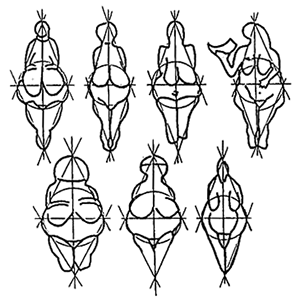
Venus figurines is an umbrella term for a number of prehistoric statuettes of women portrayed with similar physical attributes from the Upper Palaeolithic (between 40,000 and 10,000 years ago), mostly found in Europe, but with finds as far east as Siberia, extending their distribution to much of Eurasia.
These figurines were carved from soft stone (such as steatite, calcite or limestone), bone or ivory, or formed of clay and fired. The latter are among the oldest ceramics known. In total, over a hundred such figurines are known; virtually all of modest size, between 4 cm and 25 cm in height. They are some of the earliest works of prehistoric art.
read more »
Posted in Art, Sex, World |
Leave a Comment »
September 13, 2011
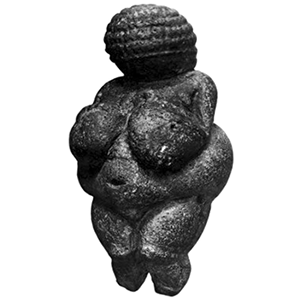
The Venus of Willendorf, also known as the ‘Woman of Willendorf,’ is an 11 cm (4.3 in) high statuette of a female figure estimated to have been made between 24,000 and 22,000 BCE. It was discovered in 1908 by archaeologist Josef Szombathy at a paleolithic site near Willendorf, a village in Lower Austria. It is carved from an oolitic limestone that is not local to the area, and tinted with red ochre. Several similar statuettes and other forms of art have been discovered, and they are collectively referred to as ‘Venus figurines,’ although they pre-date the mythological figure of Venus by millennia. The Willendorf figure was named following a model already over fifty years old, and shares many characteristics with other figures.
After a wide variety of proposed dates, following a revised analysis of the stratigraphy of its site in 1990, the figure has been estimated to have been carved 24,000–22,000 BCE. Very little is known about its origin, method of creation, or cultural significance. The Venus of Willendorf was recovered in a site that also contained a few amulets of Moldavite. The purpose of the carving is the subject of much speculation. It never had feet and does not stand on its own. The apparent large size of the breasts and abdomen, and the detail put into the vulva, have led scholars to interpret the figure as a fertility symbol. The figure has no visible face, her head being covered with circular horizontal bands of what might be rows of plaited hair, or a type of headdress. She was thought to be very healthy given her weight and size.
Posted in Art, Sex |
Leave a Comment »
September 12, 2011


A cheesesteak, also known as a Philly cheesesteak or a steak and cheese, is a sandwich made from thinly sliced pieces of steak and melted cheese in a long roll. A popular regional fast food, it has its roots in the city of Philadelphia. The cheesesteak was developed in the early 20th century ‘by combining frizzled beef, onions, and cheese in a small loaf of bread,’ according to the Historical Society of Pennsylvania.
Philadelphians Pat and Harry Olivieri are often credited with inventing the sandwich by serving chopped steak on hoagie rolls in the early 1930s. They began selling this variation of steak sandwiches at their hot dog stand near south Philadelphia’s Italian Market. They became so popular that Pat opened up his own restaurant which still operates today as Pat’s King of Steaks at the intersection of 9th Street and Passyunk Avenue in South Philly.
read more »
Posted in Food |
Leave a Comment »
September 12, 2011

Cheez Whiz is a thick processed cheese sauce or spread sold by Kraft Foods. It was developed by a team led by food scientist Edwin Traisman and was first marketed in 1953. The bright orange, viscous paste usually comes in a glass jar and is used as a topping for celery, cheesesteaks, corn chips, hot dogs and other foods. It is marketed in Canada, México, the Philippines, the United States and Venezuela.
Cheez Whiz is one of a number of ‘processed cheese foods,’ a category including some types of individually-wrapped cheese slices. These products contain regular cheese that has been reprocessed along with additional ingredients such as emulsifiers and stabilizing agents, such as xanthan gum or carrageenan. These products derive their tanginess and flavor from additional ingredients such as citric acid and flavoring compounds. Annatto is used for coloring. In some markets, the product has been sold in a narrow jar that tapered towards the base when sold as a spread. When Cheez Whiz is advertised as a dip or a sauce, the jars are larger and more of a squat cylindrical shape.
Posted in Food, Money |
Leave a Comment »





 The Daily Omnivore