November 22, 2011

Beer pong, also known as Beirut [bey-root], is a drinking game in which players throw a ping pong ball across a table with the intent of landing the ball in a cup of beer on the other end. The game typically consists of two two-to-four-player teams and multiple cups set up, in triangle formation, on each side. There are no official rules, and rules may vary widely, though usually there are six or ten plastic cups on each side. Each side then takes turns attempting to shoot ping pong balls into the opponent’s cups. If a ball lands in a cup, then the contents of that cup are consumed, and the cup is either placed aside or reinserted into the triangle. If the cup is reinserted and the other team knocks the cup over, it is removed. If the opposing team throws the ball into an empty cup, they must consume the contents of one of their cups. The first side to eliminate all of the opponent’s cups is the winner.
The order of play varies—both players on one team shoot followed by both players on the other team, or players on opposite teams can alternate back and forth. Beer pong is played at parties, North American colleges and universities, bars, and elsewhere, such as tailgating or other sporting events.
read more »
Posted in Food, Games, Health |
Leave a Comment »
November 22, 2011
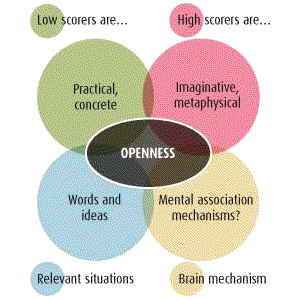
In contemporary psychology, the ‘Big Five’ are five broad domains or dimensions of personality which are used to describe human personality: openness, conscientiousness, extraversion, agreeableness, and neuroticism. Openness involves active imagination, aesthetic sensitivity, attentiveness to inner feelings, preference for variety, and intellectual curiosity.
A great deal of psychometric research has demonstrated that these qualities are statistically correlated. Thus, openness can be viewed as a global personality trait consisting of a set of specific traits, habits, and tendencies that cluster together.
read more »
Posted in Drugs, Health |
Leave a Comment »
November 22, 2011

In psychology, novelty seeking (NS) is a personality trait associated with exploratory activity in response to novel stimulation, impulsive decision making, extravagance in approach to reward cues, and quick loss of temper and avoidance of frustration. It is considered one of the temperament dimensions of personality. Like the other temperament dimensions, it has been found to be highly heritable.
High NS has been suggested to be related to high dopaminergic activity (which plays a major role in reward-motivated behavior). When novelty seeking is defined as a decision process (i.e in terms of the tradeoff between foregoing a familiar choice option in favor of deciding to explore a novel choice option), dopamine is directly shown to increase novelty seeking behavior. Specifically, blockade of the dopamine transporter, causing a rise in extracelluar dopamine levels, increases the propensity of monkeys to select novel over familiar choice options.
read more »
Posted in Health |
1 Comment »
November 22, 2011

Confabulation [kuhn-fab-yuh-ley-shuhn] is the process in which a memory is remembered falsely. Confabulations are indicative of a complicated and intricate process that can be led astray at any given point during encoding, storage, or recall of a memory. Two distinct types of confabulation are often distinguished. Spontaneous, or primary, confabulations do not occur in response to a cue and seem to be involuntary.
Provoked, or secondary, confabulations occur in response to something external, like a memory test. Another distinction found in confabulations is that between verbal and behavioral. Verbal confabulations are spoken false memories and are more common, while behavioral confabulations occur when an individual acts on their false memories. Confabulated memories of all types most often occur in autobiographical memory. A final characteristic of confabulations is the genuine confidence people have in their false memory, despite evidence contradicting its truthfulness.
read more »
Posted in Health, Science |
Leave a Comment »
November 22, 2011
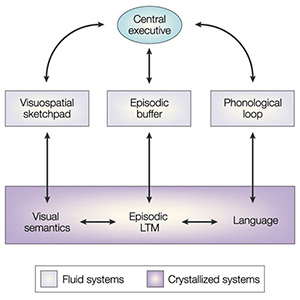
Dysexecutive [dis-ig-zek-yuh-tiv] syndrome (DES) consists of a group of symptoms, usually resulting from brain damage, that fall into cognitive, behavioral and emotional categories and tend to occur together. The term was introduced by British psychologist Alan Baddeley to describe a common pattern of dysfunction in executive functions, such as planning, abstract thinking, flexibility and behavioral control.
It is thought to be Baddeley’s theory of working memory and the central executive that are the hypothetical systems impaired in DES. The syndrome was once known as frontal lobe syndrome, however dysexecutive syndrome is preferred because it emphasizes the functional pattern of deficits (the symptoms) over the location of the syndrome in the frontal lobe, which is often not the only area affected.
read more »
Posted in Health, Science |
Leave a Comment »
November 22, 2011
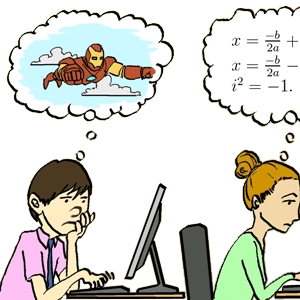
Sluggish Cognitive Tempo (SCT) is an unformalized descriptive term which is used to better identify a subgroup within the formal subgroup ‘ADHD-PI predominantly inattentive.’ SCT is not recognized in any standard medical manuals such as the DSM-IV or the ICD-10. In many ways, those who have an SCT profile have the opposite symptoms of those with classic ADHD: instead of being hyperactive, extroverted, obtrusive, and risk takers, those with SCT are drifting, introspective and daydreamy, and feel as if ‘in the fog’ (although in excited states, an SCT patient behaves very similarly to a traditional ADHD patient). They also don’t have the same risk factors and outcomes.
A key behavioral characteristic of those with SCT symptoms is that they are more likely to appear to be lacking motivation. They lack energy to deal with mundane tasks and will consequently seek things that are mentally stimulating because of their underaroused state, an intense craving for emotional and intellectual stimulation. Those with SCT symptoms show a qualitatively different kind of attention deficit that is more typical of a true information input-output problem, such as memory retrieval and active working memory, and display a wavering ‘up and down’ mental pattern with extremely variable levels of intense thought, hyperactivity, failing memory, and sexual appetite. Conversely, those with the other two subtypes of ADHD are characteristically excessively energetic and have no difficulty processing information.
read more »
Posted in Education, Health |
1 Comment »


 The Daily Omnivore