December 23, 2011

Market failure occurs in economics when the allocation of goods and services by a free market is not efficient. In such cases the pursuit of pure self-interest leads to results that can be improved upon from the societal point-of-view. The first known use of the term by economists was in 1958, but the concept has been traced back to the Victorian philosopher Henry Sidgwick.
A market failure can occur for three main reasons: if the market is monopolized (a small group of businesses hold significant market power), if production of the good or service results in an externality (a cost or benefit that affects an unaffiliated third party), or if the good or service is a ‘public good’ (a non-excludable good like air).
read more »
Posted in Money, Politics |
Leave a Comment »
December 21, 2011

Aaron Koblin is an American digital media artist best known for his innovative uses of data visualization and crowdsourcing. He is currently Creative Director of the Data Arts Team at Google Creative Lab in San Francisco.
Koblin’s projects have been shown at international festivals including Ars Electronica, TED, and are part of the permanent collections at the Museum of Modern Art (MoMA) in New York and the Centre Georges Pompidou in Paris.
Posted in Art, Technology |
1 Comment »
December 21, 2011

A digital native is a person who was born during or after the general introduction of digital technology, and through interacting with digital technology from an early age, has a greater understanding of its concepts.
Alternatively, this term can describe people born in the latter 1960s or later, as the Digital Age began at that time; but in most cases the term focuses on people who grew up with the technology that became prevalent in the latter part of the 20th century, and continues to evolve today.
read more »
Posted in Language, Technology |
2 Comments »
December 21, 2011

net.art refers to a group of artists who have worked in the medium of Internet art from 1994 on. The main members of this movement are Vuk Ćosić, Jodi.org, Alexei Shulgin, Olia Lialina, and Heath Bunting. Although this group was formed as a parody of avant garde movements by writers such as Tilman Baumgärtel, Josephine Bosma, Hans Dieter Huber and Pit Schultz, their individual works have little in common.
The term ‘net.art’ is also used as a synonym for net art or Internet art and covers a much wider range of artistic practices. In this wider definition, net.art means art that uses the Internet as its medium and that cannot be experienced in any other way. Often net.art has the Internet as (part of) its subject matter but it is not a requirement.
read more »
Posted in Art, Politics, Technology |
Leave a Comment »
December 20, 2011

Nettime is an internet mailing list that was founded in 1995 during the second meeting of the Medien Zentral Kommittee at the Venice Biennale. Founded by Geert Lovink and Pit Schultz, the list was meant to provide a space for a new form of critical discourse on and with the nets. Since 1995, Nettime has been recognized for building up the discourse of Netzkritik or Net Critique, providing a backdrop and context for the emergence of net.art and influencing critical net culture in general.
Often understood as a European ‘online salon,’ Nettime was initially a pre-publishing platform for international critical thinkers. Originally a mainly English language mailing list, other lists have been created for other languages. While the subscribers have changed over time, the list and lists have had the regular participation of such notable figures as: American poet John Perry Barlow, political writer Hakim Bey, art professor Ricardo Dominquez, Russian artist Alexei Shulgin, and DJ Spooky, among others. The lists has around 3500 subscribers.
Posted in Language, Politics, Technology |
Leave a Comment »
December 20, 2011
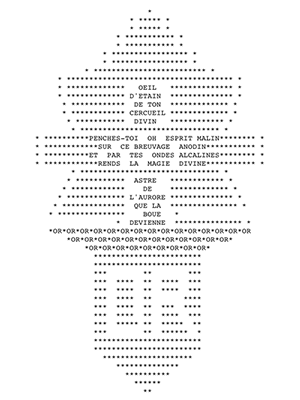
Internet art (often referred to as net art) is a form of digital artwork distributed via the Internet. Artists working in this manner are sometimes referred to as net artists. Internet art can happen outside the technical structure of the Internet, such as when artists use specific social or cultural Internet traditions in a project outside of it. Internet art is often—but not always—interactive, participatory, and multimedia-based. Internet art can be used to spread a message, either political or social, using human interactions.
The term Internet art typically does not refer to art that has been simply digitized and uploaded to be viewable over the Internet. Rather, this genre relies intrinsically on the Internet to exist, taking advantage of such aspects as an interactive interface and connectivity to multiple social and economic cultures and micro-cultures. Theoriest and curator Jon Ippolito defines it as distinct from commercial web design, and touching on issues of permanence, archivability, and collecting in a fluid medium.
read more »
Posted in Art, Technology |
Leave a Comment »
December 20, 2011

Tradigital art most commonly refers to art (including animation) that combines both traditional and computer-based techniques to implicate an image.
Artist and teacher Judith Moncrieff first coined the term in the early 1990s, while an instructor at the Pacific Northwest College of Art. The school held a competition of Moncrieff’s students, who used the medium to electronically combine everything from photographs of costumes to stills from videotapes of performing dancers.
read more »
Posted in Art, Language, Technology |
Leave a Comment »
December 20, 2011

Bulletism is an artistic process that involves shooting ink at a blank piece of paper. The result is a type of ink blot. The artist can then develop images based on what is seen.
Salvador Dalí claimed to have invented this technique. Leonardo da Vinci, however, suggested that ‘just as one can hear any desired syllable in the sound of a bell, so one can see any desired figure in the shape formed by throwing a sponge with ink against the wall.’
Posted in Art, Language |
1 Comment »
December 20, 2011

‘Series of tubes‘ is a phrase coined originally as an analogy by then Senator Ted Stevens (R-Alaska) to describe the Internet in the context of opposing network neutrality.
In 2006, he used this metaphor to criticize a proposed amendment to a committee bill that would have prohibited Internet service providers such as AT&T and Verizon Communications from charging fees to give some companies higher priority access to their networks or their customers. This metaphor has been widely ridiculed as demonstrating Stevens’s poor understanding of the Internet, despite the fact that he was in charge of regulating it.
read more »
Posted in Humor, Politics, Technology |
1 Comment »
December 20, 2011

Ram Dass (b. 1931) is an American contemporary spiritual teacher, originally named Richard Alpert, and the author of the seminal 1971 book ‘Be Here Now.’
He is known for his personal and professional associations with Timothy Leary at Harvard University in the early 1960s, for his travels to India and his relationship with the Hindu guru Neem Karoli Baba, and for founding the charitable organizations Seva Foundation and Hanuman Foundation.
read more »
Posted in Drugs, Language, Philosophy |
Leave a Comment »
December 20, 2011
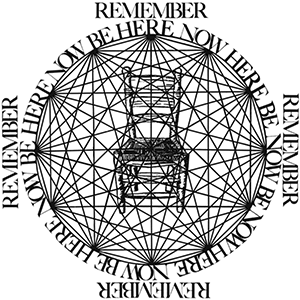
Be Here Now is a seminal 1971 book on spirituality, yoga and meditation by the Western born yogi and spiritual teacher Ram Dass. The title comes from a statement his guide, Bhagavan Das, made during Ram Dass’s journeys in India. The cover features a Mandala incorporating the title, a chair, radial lines, and the word ‘remember.’
It is one of the first guides, for those not born as Hindus, to becoming a yogi, by a person himself not born a Hindu. For its influence on the Hippie movement and subsequent spiritual movements, it has been described as a ‘countercultural bible.’ In addition to introducing its title phrase into common use, the book has influenced numerous other writers and yoga practitioners, including Wayne Dyer and Michael Crichton.
read more »
Posted in Language, Philosophy |
1 Comment »
December 20, 2011
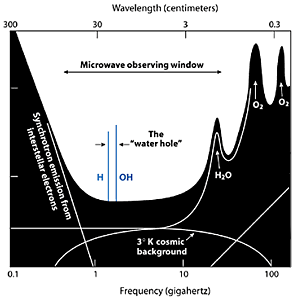
The waterhole refers to an especially quiet band of the electromagnetic spectrum between 1,420 and 1,666 megahertz, corresponding to wavelengths of 21 and 18 centimeters respectively. The term was coined by American scientist Bernard Oliver. The strongest hydroxyl radical spectral line radiates at 18 centimeters, and hydrogen at 21 centimeters. These two combined form water, and water is currently thought to be essential to extraterrestrial life advanced enough to generate radio signals.
Bernard M. Oliver theorized that the waterhole would be a good, obvious band for communication with extraterrestrial intelligence, hence the pun, in English a watering hole is a vernacular reference to a common place to meet and talk. Several programs involved in the search for extraterrestrial intelligence, including SETI@home, search in the waterhole.
Posted in Science, Technology |
Leave a Comment »


 The Daily Omnivore