March 6, 2012
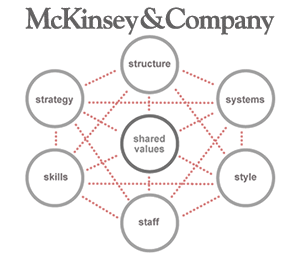

Management consulting refers to both the industry and the practice of helping organizations to improve their performance, primarily through the analysis of existing organizational problems and development of plans for improvement.
Organizations may draw upon the services of management consultants for a number of reasons, including gaining external (and presumably objective) advice and access to the consultants’ specialised expertise. As a result of their exposure to and relationships with numerous organizations, consulting firms are also said to be aware of industry ‘best practices,’ although the transferability of such practices from one organization to another may be limited by the specific nature of situation under consideration.
read more »
Posted in Money, Technology, World |
Leave a Comment »
March 6, 2012

Martin Kihn (b. 1950) is an American writer and digital marketer. Martin Kihn was born in Zambia, where his parents met while working in a hospital. His South African-born father is a doctor, and his Scottish mother, a former actress, is now a drama teacher. He grew up in Michigan. He has earned a BA in Theater Studies from Yale, and in the late 1990s was Head Writer for the popular television program ‘Pop-Up Video’ on MTV Networks and was nominated for an Emmy for Writing. He lost to ‘Win Ben Stein’s Money,’ decided to quit writing and got into business school. He received an MBA from Columbia Business School.
Kihn’s first book was an expose of the consulting agencies called ‘House of Lies: How Management Consultants Steal Your Watch and Then Tell You the Time’ (2005), based on the three years he spent working for a large consultancy, Booz Allen. It was adapted by Showtime as a series with Don Cheadle playing Marty Kaan, an ‘outside the box’ management consultant, loosely based on Marty Kihn himself. Kihn reemerged a few years later with a satirical memoir called ‘Asshole: How I Got Rich and Happy by Not Giving a Shit About You’ (2008).
Posted in Art, Language, Money |
Leave a Comment »
March 5, 2012

The Avedis Zildjian [zil-jin] Company is a cymbal manufacturer founded in Istanbul by Armenian Avedis Zildjian in the 17th century during the Ottoman Empire. At nearly 400 years old, Zildjian is one of the oldest companies in the world. The first Zildjian cymbals were created in 1623 by Avedis, an alchemist who was looking for a way to turn base metal into gold; he created an alloy combining tin, copper, and silver into a sheet of metal that could make musical sounds without shattering.
Avedis was given the name of Zildjian by the Sultan Osman II (from the Turkish word ‘zil’ – ‘cymbal,’ ‘dji’ – ‘maker-seller,’ ‘ian’ – a common suffix used in Armenian last names which means ‘son of’). The details of the company’s main product remained secret for generations. It became family tradition that only the company’s heirs would know the manufacturing process. The Zildjian Company moved from manufacturing noisemakers to frighten the enemies of the Ottoman Empire to manufacturing its cymbals as musical instruments in the 19th century.
read more »
Posted in Art, Money |
Leave a Comment »
March 5, 2012

In political jargon, useful idiot is a pejorative term used to describe people perceived as propagandists for a cause whose goals they do not understand, who are used cynically by the leaders of the cause. The term was originally used to describe Soviet sympathizers in Western countries. The implication is that although the people in question naively thought of themselves as an ally of the Soviet Union, they were actually held in contempt and were being used.
The use of the term in political discourse has since been extended to other propagandists, especially those who are seen to unwittingly support a malignant cause which they naively believe to be a force for good. The earliest known usage in Western media is in a 1948 article in the social-democratic Italian paper ‘L’Umanita’ – as cited in a ‘New York Times’ article on Italian politics of the same year. Despite often being attributed to Lenin, in 1987, Grant Harris, senior reference librarian at the Library of Congress, declared that ‘We have not been able to identify this phrase among [Lenin’s] published works.’
Posted in Politics, War, World |
Leave a Comment »
March 5, 2012
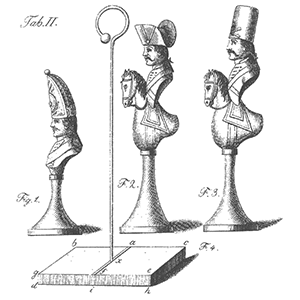
Kriegsspiel [kreeg-speel] (German: ‘wargame’) was a system used for training officers in the Prussian army. The first set of rules was created in 1812 and named ‘Instructions for the Representation of Tactical Maneuvers under the Guise of a Wargame.’ It was originally produced and developed further by Lieutenant Georg Leopold von Reiswitz and his son Georg Heinrich Rudolf von Reiswitz of the Prussian Army. Their system for simulating war was initially based around a specially designed table created for King Friedrich Wilhelm III.
The table divided the game field into a grid system, a core element of many later wargame and roleplaying systems, and included different pre-cast terrain types used in modular combinations, as well as making use of special gaming pieces and dice. The system also included a position called ‘confidant,’ an impartial third party calculating and assessing the moves, analogous to the modern gamemaster or dungeon master.
read more »
Posted in Games, War, World |
Leave a Comment »
March 5, 2012

The urban survival syndrome in United States jurisprudence, can be used either as a defense of justification or of excuse. The first case using the defense was the 1994 Fort Worth, Texas murder trial of Daimion Osby. The use of the ‘urban survival syndrome’ as a defense to criminal charges followed the success of the battered woman syndrome defense in State v. Kelly (1984), which was based on the acceptance that the presence of such a syndrome may cause the defendant, a victim of domestic violence, to reasonably believe she was in peril and was therefore justified in using deadly force, given the circumstances.
According to the defense, an individual experiencing the daily life of racial segregation and violence common in many inner cities in the United States causes a subjective state equivalent to that caused by survival in a violent battleground of war. As such it leads to a condition similar to a syndrome already recognized in both psychological and psychiatric practices, that is, post-traumatic stress disorder (PTSD).
read more »
Posted in Death, Politics |
Leave a Comment »
March 5, 2012

Not safe for work (NSFW) is Internet slang or shorthand to mark URLs or hyperlinks which contain material such as pornography or profanity, which the viewer may not want to be seen accessing in a public or formal setting such as at work. Determining a site to be NSFW is invariably subjective. The less frequently used warnings PNSFW (Probably/Possibly Not Safe for Work), LSFW (Less Safe for Work), TSFW (Technically Safe for Work), and PNFO (Probably Not for the Office) are sometimes used to indicate content possibly considered salacious (lustful) by certain censors, such as images of underwear or swimwear models, or a news story about sexual issues that does not contain explicit images.
NSFW is also sometimes used to refer to any media that produces sound, such as a game or video file; the implication being that the noises may alert others in the vicinity that the user is taking a break with entertainment materials instead of working. An alternative abbreviation is NSFL, meaning not safe for lunch or not safe for life – this indicates subject matter too grim, shocking, stark, or frank to be recommended without a disclaimer.
Posted in Money, Sex, Technology |
Leave a Comment »
March 5, 2012


A shock site is a website that is intended to be offensive, disgusting and/or disturbing to its viewers, containing materials of high shock value which is also considered distasteful and crude, and is generally of a pornographic, scatological, violent, insulting, painful, profane, or otherwise provocative nature. Some shock sites display a single picture, animation, video clip or a small gallery, and are often passed around via e-mail or online forums as a bait and switch hoax.
Some have gained their own subcultures and become internet memes. Goatse.cx was one of the best-known shock sites, featuring an image of a man stretching his anus with his hands. The site featured a page devoted to fan-submitted artwork and tributes to the site, and a parody of the image was also shown by a BBC newscast as an alternative for the then recently unveiled logo for the 2012 Summer Olympics. The site was shut down in 2004; however, various mirror sites featuring the image still exist.
Posted in Death, Humor, Sex |
Leave a Comment »
March 5, 2012

A viral video is one that becomes popular through the process of Internet sharing, typically through video sharing websites, social media and email. Viral videos often contain humorous content and include televised comedy sketches, such as The Lonely Island’s ‘Lazy Sunday’ and ‘Dick in a Box,’ amateur video clips like ‘Star Wars Kid,’ the ‘Numa Numa’ videos, ‘The Evolution of Dance,’ and ‘Chocolate Rain,’ and web-only productions such as ‘I Got a Crush… on Obama.’ Some eyewitness events have also been caught on video and have ‘gone viral’ such as the ‘Battle at Kruger.’
The proliferation of camera phones and inexpensive video editing and publishing tools credited with fueling phenomena. These consumer-shot videos are typically non-commercial, intended for viewing by friends or family. A video becoming viral is often unexpected, and an accident, and therefore a video cannot be called viral purely in the creator’s intention at the time of recording.
read more »
Posted in Humor, Money, Technology |
Leave a Comment »
March 5, 2012

The Narwhal is a rarely seen Arctic whale known for the very long tooth that males have. The tusk’s function is uncertain, perhaps used as a formidable jousting weapon in courtship and dominance rivalry, in getting food, and/or for channeling and amplifying sonar pulses (which they emit), however the tusk is not used in hunting. Long ago, narwhal sightings probably reinforced (or started) the unicorn legends. At times, people found the horn of a dead narwhal washed up on shore and thought that they had found the horn of a unicorn. Narwhal can dive up to 1,500 meters; this makes them one of the deepest diving sea mammals.
Narwhals live in the icy waters of the Arctic seas. They do not go far away from ice and migrate in the summer closer to land where they can sometimes be seen in the estuaries, deep fjords, and bays of Greenland and Northern Canada. These groups can be as big as 10 or even as big as 100 sometimes. But when Winter comes around again, they move back to the icy waters, where they breath from small holes in the ice. Narwhals eat cod, shrimp and squid, and are hunted by polar bears and killer whales. The native Inuit people who are sometimes called the Eskimos, are allow to hunt the Narwhals for food.
Posted in Science |
Leave a Comment »
March 5, 2012

Active camouflage is camouflage which adapts to the actual surroundings of an object such as an animal or military vehicle. It is used in several groups of animals including cephalopods (e.g. squid, octopus) and flatfish in the sea, and reptiles on land (e.g. chameleon). Some sea creatures can counterilluminate (emit light to match the background) because in the sea, light comes down from the surface, so animals tend to appear dark when seen from below. Bioluminescence and color change also have other functions in animals including attracting prey and signalling mates.
In military usage, counterillumination camouflage was first investigated during the WWII for marine use. Current research aims at achieving crypsis (avoidance of detection) using cameras to sense the visible background, and panels or coatings which can vary their appearance. Military active camouflage has its origins in the diffused lighting camouflage tested on Canadian Navy corvettes during WWII. Later, a US Air Force program placed low-intensity blue lights on aircraft as counterillumination camouflage. As night skies are not pitch black, a 100 percent black-colored aircraft might be rendered visible.
Posted in Science, Technology, War |
1 Comment »
March 5, 2012
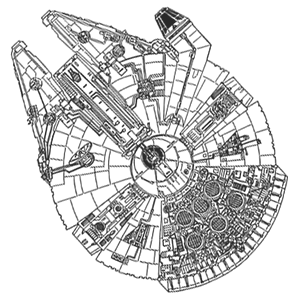
Kitbashing is a practice whereby a new scale model is created by taking pieces out of commercial kits. These pieces may be added to a custom project or to another kit. For professional modelmakers, kitbashing is popular to create concept models for detailing movie special effects. Professionals often kitbash to build prototype parts which are then recreated with lightweight materials. Although it has a long history, kitbashing came to the attention of a wider public via the fine modelwork seen in TV series such as ‘Thunderbirds’ and the films ‘2001: A Space Odyssey’ and ‘Star Wars.’ Many of the spaceship models created for these programs incorporated details from tank, speedboat and car kits. Another example is the Tumbler from the 2005 film ‘Batman Begins.’
An important aspect of kitbashing in model railroading is the reconfiguration of structure kits, most often to fit the geometry of a specific space. Walls can be shortened or lengthened, and/or corner angles changed to fit a given location on the layout. Another application is to use the wall parts to create a ‘flat,’ or shallow relief model to be displayed against the backdrop. For example, since it isn’t needed in this case, the rear wall can be abutted to the front to double the length of the building; usually, but not exclusively, done with industrial structures. Plain sheet styrene or other material is typically added to the rear to strengthen the resulting model.
Posted in Art, Games, Money |
Leave a Comment »




 The Daily Omnivore