May 25, 2012

‘There are no atheists in foxholes‘ is an aphorism used to argue that in times of extreme stress or fear, such as when participating in warfare, all people will believe in or hope for a higher power. The precise origin of the phrase is uncertain.
While primarily used to comment on the specific experiences faced by combat soldiers, the statement is often adapted to other perilous situations such as ‘there are no atheists in Probate Court.’
read more »
Posted in Death, Philosophy, War |
Leave a Comment »
May 25, 2012
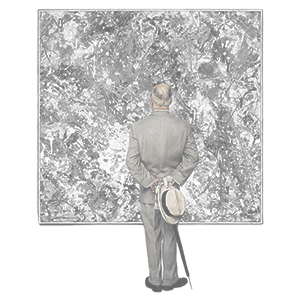
A connoisseur [kon-uh-sur] (meaning ‘to be acquainted with’ or ‘to know somebody/something’) is a person who has a great deal of knowledge about the arts and is an expert judge in matters of taste.
Internationally, the term is also used in gastronomy (in connection with fine food, beer, wine, tea, and many other products whose consumption can be pleasing to the senses). The ability to tell almost instinctively who painted a picture is defined as connoisseurship. Modern connoisseurship must be seen in context with museums, art galleries, and ‘the cult of originality.’
read more »
Posted in Art, Language |
Leave a Comment »
May 24, 2012

Cornershop is a British indie rock band formed in 1991 by Tjinder Singh, his brother Avtar, David Chambers, and Ben Ayres. The band name originated from a stereotype referring to British Asians often owning street corner stores. Their music is a fusion of Indian music, Britpop, and electronic dance music.
Their debut release, the ‘In The Days of Ford Cortina’ EP, pressed on ‘curry-colored vinyl,’ contained a blend of Indian-tinged noise pop. The sound mellowed somewhat with the release of debut album ‘Hold On It Hurts’ in 1994. The album impressed David Byrne sufficiently for him to sign the band to his Luaka Bop label. Although David Chambers left, replaced by Nick Simms, the band re-emerged in 1995.
read more »
Posted in Art, World |
1 Comment »
May 24, 2012

CFCF is the stage name of Canadian electronic musician Michael Silver. Based in Montreal, Silver took the name CFCF from the call sign of the city’s CFCF-TV.
Silver has released an album and several EPs, independently and on Paper Bag Records, and Rvng Intl.
Posted in Art |
Leave a Comment »
May 24, 2012

3DMark is a computer benchmarking tool created and developed by Futuremark Corporation to determine the performance of a computer’s 3D graphic rendering and CPU workload processing capabilities. Running the application produces a 3DMark score, with higher numbers indicating better performance.
The 3DMark measurement unit is intended to give a normalized mean for comparing different PC hardware configurations (mostly graphics processing units and central processing units), which proponents such as gamers and overclocking enthusiasts assert is indicative of end-user performance capabilities. Founded in 1997 as ‘Futuremark’ by members of the former demoscene group ‘Future Crew,’ the company is the leading producer of computer benchmark applications in the world.
Posted in Money, Technology |
Leave a Comment »
May 24, 2012

Frame rate is the frequency (rate) at which an imaging device produces unique consecutive images called frames. The term applies equally well to computer graphics, video cameras, film cameras, and motion capture systems. Frame rate is most often expressed in frames per second (FPS), and is also expressed in progressive scan monitors as hertz (Hz).
The human visual system can process 10 to 12 separate images per second, perceiving them individually. The visual cortex holds onto one image for about one-fifteenth of a second, so if another image is received during that period an illusion of continuity is created, allowing a sequence of still images to give the impression of motion.
read more »
Posted in Art, Money, Technology |
Leave a Comment »
May 24, 2012
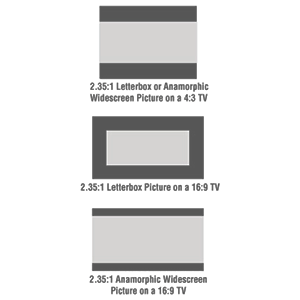
Letterboxing is the practice of transferring film shot in a widescreen aspect ratio to standard-width video formats while preserving the film’s original aspect ratio. The resulting videographic image has mattes (black bars) above and below it; these mattes are part of the image (i.e., of each frame of the video signal). LTBX is the identifying abbreviation for films and images so formatted. The term refers to the shape of a letter box, a slot in a wall or door through which mail is delivered, being rectangular and wider than it is high.
Letterboxing is used as an alternative to a full-screen, pan-and-scan transfer of a widescreen film, in which the original image is cropped to the narrower aspect ratio of the destination format, usually the 1.33:1 (4:3) ratio of the standard television screen, whereas letterboxing preserves the film’s original image composition as seen in the cinema. Letterboxing was developed for use in 4:3 television displays before widescreen television screens were available, but it is also necessary to represent on a 16:9 widescreen display the unaltered original composition of a film with a wider aspect ratio, such as Panavision’s 2.35:1 ratio.
read more »
Posted in Art, Money, Technology |
5 Comments »
May 23, 2012

A retronym [re-truh-nim] is a type of neologism that provides a new name for something to differentiate the original version from a more recent one. The original name is most often augmented with an adjective (rather than being completely displaced) to account for later developments of the object or concept itself. Much retronymy is driven by advances in technology.
Examples of retronyms are ‘acoustic guitar’ (coined when electric guitars appeared), and ‘analog watch’ to distinguish from a digital watch. In the entertainment industry, this can manifest itself as calling a movie ‘Part 1’ once sequels are released or by slightly altering the title (e.g. ‘Star Wars: A New Hope’ or ‘Indiana Jones and the Raiders of the Lost Ark’) to emphasize its connection with the sequel(s), or by referring to a television series as ‘the original,’ as in ‘Star Trek: The Original Series.’
read more »
Posted in Language, Money, Technology |
Leave a Comment »
May 22, 2012

A 4th Dimension roller coaster is a type of steel roller coaster whereby riders are rotated independently of the orientation of the track, generally about a horizontal axis that is perpendicular to the track. The cars do not necessarily need to be fixed to an angle.
John F. Mares, a corporate attorney, invented the 4th Dimension roller coaster concept in 1995 and holds six US patents related to the technology of their spinning seat systems. Three 4D roller coasters: ‘X2,’ ‘Eejanaika,’ and ‘Green Lantern: First Flight,’ which were either built or installed in the United States, have been licensed by Mr. Mares’ company (Meteoro Amusement Corporation).
read more »
Posted in Games, Technology |
Leave a Comment »
May 22, 2012

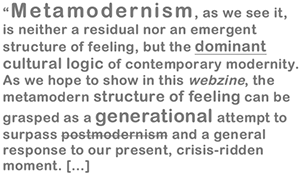
Metamodernism is a term employed to situate and explain recent developments across current affairs, critical theory, philosophy, architecture, art, cinema, music and literature which are emerging from and reacting to postmodernism.
The term metamodernism was introduced as an intervention in the post-postmodernism debate by the cultural theorists Timotheus Vermeulen and Robin van den Akker in 2010. In their article ‘Notes on metamodernism’ they assert that the 2000s are characterized by the return of typically modern positions without altogether forfeiting the postmodern mindsets of the 1990s and 1980s.
read more »
Posted in Art, Language, Philosophy |
Leave a Comment »
May 22, 2012

Post-Postmodernism is a general term used to describe new developments emerging from Postmodernism. It is a positive idea that faith, sincerity, and trust can be better for society than Postmodern irony.
The term ‘Post-Postmodernism’ was initially coined by seminal cultural theorist Alice Sanders in her magnum opus ‘The Shadow of the Rainbow.’
read more »
Posted in Language, Philosophy, Politics |
1 Comment »
May 22, 2012
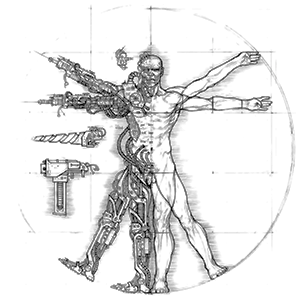
Hypermodernity is a type, mode, or stage of society that reflects a deepening or intensification of modernity. Characteristics include a deep faith in humanity’s ability to understand, control, and manipulate every aspect of human experience. This typically is manifested in a forward-looking commitment to science and knowledge, particularly with regard to the convergence of technology and biology.
The emphasis on the value of new technology to overcome natural limitations lends itself to a diminution or outright repudiation of the past, since yesterday’s knowledge can be considered ‘less’ than today’s. There can be a profound lack of integration between the past and the present since: what happened necessarily took place under ‘lesser’ circumstances than now, which generates a fundamentally separate context; and artifacts from the past superabundantly clutter the cultural landscape and are seamlessly reused to generate an even greater superabundance from which individuals are unable to discern original intent or meaning.
read more »
Posted in Philosophy, Politics, Technology |
Leave a Comment »


 The Daily Omnivore