May 17, 2012

The silent majority is an unspecified large majority of people in a country or group who do not express their opinions publicly. The term was popularized (though not first used) by U.S. President Richard Nixon in a 1969, speech in which he said, ‘And so tonight—to you, the great silent majority of my fellow Americans—I ask for your support.’
In this usage it referred to those Americans who did not join in the large demonstrations against the Vietnam War at the time, who did not join in the counterculture, and who did not participate in public discourse. Nixon along with many others saw this group of Middle Americans as being overshadowed in the media by the more vocal minority. The phrase was used in the 19th century as a euphemism referring to all the people who have died, and others have used it before and after Nixon to refer to groups of voters in various nations of the world.
read more »
Posted in Language, Politics, World |
Leave a Comment »
May 17, 2012
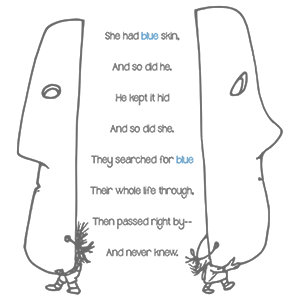
Social desirability bias is the tendency of respondents to answer questions in a manner that will be viewed favorably by others. It can take the form of over-reporting good behavior or under-reporting bad behavior. The tendency poses a serious problem with conducting research with self-reports, especially questionnaires. Topics of special concern are self-reports of abilities, personality, sexual behavior, and drug use.
When confronted with the question ‘How often do you masturbate?,’ for example, respondents may be pressured by the societal taboo against masturbation, and either under-report the frequency or avoid answering the question. Therefore the mean rates of masturbation derived from self-report surveys are likely to be severe underestimates.
read more »
Posted in Politics, Science, Sex |
Leave a Comment »
May 17, 2012

Emotional intelligence is a thought model that claims that to be successful, people must be able to know their own feelings. They must also be able to guess and influence the emotions of other people, and of groups of other people. There are several different models that disagree about the exact definition of the term. Criticisms have centered on whether the construct is a real intelligence and whether it has incremental validity over IQ and the Big Five personality dimensions.
The earliest roots of emotional intelligence can be traced to Charles Darwin’s work on the importance of emotional expression for survival and, second, adaptation. In the 1900s, even though traditional definitions of intelligence emphasized cognitive aspects such as memory and problem-solving, several influential researchers in the intelligence field of study had begun to recognize the importance of the non-cognitive aspects. For instance, as early as 1920, American psychologist E.L. Thorndike used the term ‘social intelligence’ to describe the skill of understanding and managing other people.
read more »
Posted in Health, Science |
Leave a Comment »
May 17, 2012
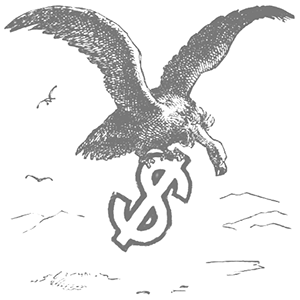
A vulture fund is a private equity or hedge fund that invests in debt issued by an entity that is considered to be very weak or dying, or whose debt is in imminent default. The name is a metaphor comparing these investors to vultures patiently circling, waiting to pick over the remains of a rapidly weakening company or, in the case of sovereign debt, debtor country. Market practitioners refer to them as distressed debt or special situations funds.
Vulture funds have sometimes had success in bringing actions against sovereign debtor governments, usually settling with them before forced sales. Settlements typically are made at a discount in hard or local currency or in the form of new debt issuance. A related term is ‘vulture investing,’ where certain stocks in near bankrupt companies are purchased upon anticipation of asset divestiture or successful reorganization. A prime example in the US is K-Mart, where the real estate held by the company was the anticipated payout for investors who bought stock during their bankruptcy proceedings.
Posted in Money, Politics, World |
Leave a Comment »
May 17, 2012
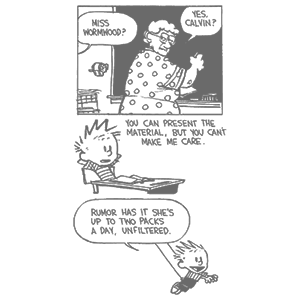
L’enfant terrible [ahn-fahn te-ree-bluh] (‘terrible child’) is a French term for a child who is terrifyingly candid by saying embarrassing things to adults, especially parents.
The OED describes it as, ‘a child who embarrasses his elders by untimely remarks; transf. a person who compromises his associates or his party by unorthodox or ill-considered speech or behavior; loosely, one who acts unconventionally.’ Webster’s defines an enfant terrible as an unusual person who is strikingly unorthodox, innovative, and/or avant-garde.
Posted in Humor, Language |
1 Comment »
May 17, 2012

The Glock is a series of semi-automatic pistols designed and produced in Austria. The company’s founder, engineer Gaston Glock, had no experience with firearm design or manufacture at the time their first pistol, the Glock 17, was being prototyped in 1982.
Glock did, however, have extensive experience in advanced synthetic polymers, knowledge of which was instrumental in the company’s design of the first successful line of pistols with a polymer frame. Glock introduced ferritic nitrocarburizing, a form of case hardening, into the firearms industry as an anti-corrosion surface treatment for metal gun parts.
read more »
Posted in Money, Technology, War |
Leave a Comment »
May 16, 2012

Verner Panton (1926 – 1998) is considered one of Denmark’s most influential 20th-century furniture and interior designers. During his career, he created innovative, funky and futuristic designs in a variety of materials, especially plastics, and in vibrant and exotic colors.
His style was very ‘1960s’ but regained popularity at the end of the 20th century; as of 2004, Panton’s most well-known furniture models are still in production (at Vitra, among others).
read more »
Posted in Art, Money, Technology |
Leave a Comment »
May 16, 2012

Martin Sharp (b. 1942) is an Australian artist, underground cartoonist, songwriter and film-maker. His famous psychedelic posters of Bob Dylan, Donovan, and others, rank as classics of the genre, alongside the work of Rick Griffin, Hapshash and the Coloured Coat, and Milton Glaser.
His covers, cartoons and illustrations were a central feature of ‘Oz’ magazine, both in Australia and in London. Martin co-wrote one of Cream’s most famous songs, ‘Tales of Brave Ulysses,’ created the cover art for Cream’s ‘Disraeli Gears’ and ‘Wheels of Fire’ albums, and in the 1970s, he became a champion of singer Tiny Tim, and of Sydney’s embattled Luna Park.
read more »
Posted in Art, Language |
Leave a Comment »
May 16, 2012

Mars to Stay missions propose astronauts sent to Mars for the first time should intend to stay, with their unused emergency return vehicles recycled into settlement construction as soon as the habitability of Mars becomes evident to the initial pioneers. Mars to Stay missions are advocated both to reduce cost and to ensure permanent settlement of Mars.
Among many notable Mars to Stay advocates, former Apollo astronaut Buzz Aldrin has been particularly outspoken, suggesting in numerous forums ‘Forget the Moon, Let’s Head to Mars!’ The Mars Underground, Mars Homestead Foundation, and Mars Artists Community have also adopted Mars to Stay policy initiatives. The earliest formal outline of a Mars to Stay mission architecture was given at the ‘Case for Mars VI Workshop’ in 1990, during a presentation by George Herbert titled ‘One Way to Mars.’
read more »
Posted in Money, Technology, World |
1 Comment »
May 16, 2012

Max Headroom is a fictional British artificial intelligence, known for his wit and stuttering, distorted, electronically sampled voice. It was introduced in early 1984. The character was created by George Stone, Annabel Jankel, and Rocky Morton, and portrayed by Matt Frewer as ‘The World’s first computer generated TV host’ although the computer generated appearance was achieved with prosthetic make up. The classic look for the character was a shiny dark suit – which was actually a fibreglass mould – often paired with Ray-Ban Wayfarer sunglasses.
Only his head and shoulders were depicted, usually against a ‘computer generated’ backdrop of a slowly rotating wire-frame cube interior, which was also initially generated by analogue means – in this case traditional cel animation, though later actual computer graphics were employed for the backdrop. Another distinguishing trademark of Max was his chaotic speech patterns – his voice would seemingly randomly pitch up or down, or occasionally get stuck in a loop. These modulations also appeared when the character was performed live.
read more »
Posted in Humor, Money, Technology |
Leave a Comment »
May 16, 2012
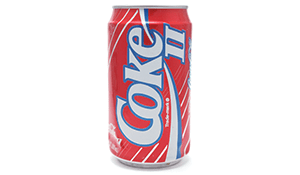

New Coke was the reformulation of Coca-Cola introduced in 1985; it originally had no separate name of its own, and was simply known as ‘the new taste of Coca-Cola’ until 1992 when it was renamed Coca-Cola II. The American public’s reaction to the change was negative and the new cola was a major marketing failure.
The subsequent reintroduction of Coke’s original formula, re-branded as ‘Coca-Cola Classic,’ resulted in a significant gain in sales, leading to speculation that the introduction of the New Coke formula was just a marketing ploy.
read more »
Posted in Food, Humor, Money |
Leave a Comment »
May 16, 2012
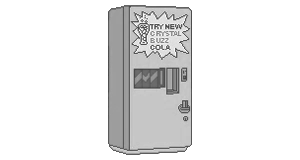

Crystal Pepsi was a caffeine-free soft drink made by PepsiCo from 1992 to 1993 in the United States, Canada, and for a short time in Australia. Crystal Pepsi was sold for a longer time in Europe.
In the early 1990s, a marketing fad equating clarity with purity began with the remake of Ivory soap from its classic milky solution; the idea spread to many companies, including PepsiCo. Its marketing slogan was ‘You’ve never seen a taste like this.’ A large marketing campaign was launched, for which the company invented the world’s first photo-realistic, computer-generated bus wrap printing. A series of television advertisements featuring Van Halen’s hit song ‘Right Now’ during Super Bowl XXVII.
read more »
Posted in Food, Humor, Money |
1 Comment »


 The Daily Omnivore