
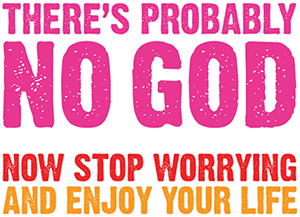
The Atheist Bus Campaign aims to place ‘peaceful and upbeat’ messages about atheism on transport media in Britain, in response to evangelical Christian advertising. It was created by comedy writer Ariane Sherine and launched in 2008, with official support from the British Humanist Association and Richard Dawkins. The campaign’s original goal was to raise £5,500 to run 30 buses across London for four weeks early in 2009 with the slogan: ‘There’s probably no God. Now stop worrying and enjoy your life.’
Richard Dawkins, author of ‘The God Delusion,’ agreed to match all donations up to a maximum of £5,500, providing a total of £11,000 if the full amount were to be raised. The campaign closed in April 2009, having raised a total of £153,516.51. The first buses started running on in January 2009 – 800 are running around the whole of the UK and it is also planned to place 1,000 adverts on the London Underground featuring quotations from famous atheists. Subsequently, two large LCD screens were placed on Oxford Street, central London.
Sherine first proposed the campaign in June 2008 in a ‘guardian.co.uk’ ‘Comment is Free’ blog post, ‘Atheists – gimme five.’ She expressed her frustration that the Christian organization ‘JesusSaid.org’ was allowed to use bus advertising to promote the web address of a website which said that all non-Christians would burn in hell for all eternity. Sherine called on atheists to counter this kind of evangelical advertising by donating five pounds towards a positive philosophical advert. Her idea was taken up by political blogger Jon Worth, who went on to set up a PledgeBank page. Sherine then wrote a follow-up ‘Comment is free’ article, ‘Dawkin ’bout a Revolution,’ detailing events since the original piece. In response, the British Humanist Association offered to lend the campaign its official support and undertook to administer all donations. The Atheist Bus Campaign’s donation phase launched in October 2008 with another article by Sherine, ‘All aboard the atheist bus campaign,’ on ‘Comment is free.’
After four days the campaign had raised more than £100,000. There have been donations to the Justgiving page every day since the campaign’s launch, and by 9 January 2009 the total had surpassed £140,000. The BHA has reported a flood of interest in its activities and the Atheist Bus Campaign Facebook group has been growing rapidly since the launch. Many atheists[who?] feel the campaign has given them a voice and represented them in a way they have long hoped for.[citation needed]
There has been some opposition to the adverts. Within the first month, the ASA received 326 complaints about the bus adverts, including a complaint from Stephen Green of ‘Christian Voice’ (UK) who said, ‘It is given as a statement of fact and that means it must be capable of substantiation if it is not to break the rules.’ Hanne Stinson of the BHA has suggested that if the ASA rule on this complaint, then the ASA will be ruling on whether God exists. They ruled that the adverts were not in breach of its rules as the advert ‘was an expression of the advertiser’s opinion’ and was incapable of substantiation. They also claimed that although the advert was contrary to many people’s beliefs, it would not generate ‘serious or widespread offence.’ The campaign has also received criticism from leading clergy including George Carey, the former Archbishop of Canterbury, and Peter Price, the current Bishop of Bath and Wells, who said ‘the campaign lacked both judgement and a sense of reality.’ In Southampton, a bus driver refused to drive a bus displaying the advert. His employers, First Bus, undertook to find him another bus to drive. Canadian author, Margaret Atwood, has said of the campaign: ‘That’s religion! Once you’re paying money to put slogans on things, well it’s either a product you’re selling, a political party or religion.’
Partly in response to the campaign three different Christian groups have launched advertising campaigns. Slogans include, ‘There definitely is a God; so join the Christian Party and enjoy your life.’ ‘The fool hath said in his heart, There is no God.’ a quote from Psalm 14; and ‘There IS a God, BELIEVE. Don’t worry and enjoy your life.’
The wording of the proposed advert caused considerable debate among atheists and Christians alike and Sherine discussed it in a post-launch article, ‘Probably the best atheist bus campaign ever,’ on the Guardian’s ‘Comment Is Free’ section. Dawkins stated that he preferred the wording ‘There is almost certainly no God.’ Ariane Sherine claims it is necessary to be factually accurate, and that as it is impossible to disprove the existence of God it is only possible to say one ‘probably’ does not exist. Critic D. J. Taylor felt that this qualification let the campaign down, but admired it for introducing some tentativeness into an often polarized debate, while atheists including A. C. Grayling think that they can be certain there is no God and therefore the word ‘probably’ should not be used. It was also suggested that inserting the word would avoid a breach of the Advertising Standards Authority’s rules.
Influenced by the Atheist Bus Campaign, the American Humanist Association launched a bus campaign in Washington DC in November 2008 with the slogan ‘Why believe in a God? Just be good for goodness’ sake.’ In February, a campaign formed in Bloomington, Indiana to run ads saying ‘You Can Be Good Without God’ in various cities in the state of Indiana. Significant attention and media coverage has been devoted to atheist roadside billboard campaigns, funded by various groups at the local level between 2008 and 2010. In February 2009, a nation-wide campaign was launched by the Freethought Association of Canada with Katie Kish and Justin Trottier serving as spokespersons. The Toronto Transit Commission in Canada approved the advertisements on the commission’s buses, trams, and metro and rapid transit trains, with the same message as the British adverts, and debuted in mid-February. In 2010, CFI Canada announced plans to put ads on Canadian buses with the phrase ‘Extraordinary Claims require Extraordinary Evidence.’ Below that phrase it lists Allah, bigfoot, UFOs, Homeopathy, Zeus, Psychics, and Christ. To date, the bus campaign has not gone into action.
In 2010 the Brazilian Association of Atheists and Agnostics (ATEA) also attempted to run a bus campaign with the slogan ‘Atheism – celebrate reason,’ but were prevented from doing so. ATEA was prevented from relaying on a bus in Salvador (Bahia) and Porto Alegre messages like ‘Religion does not define character’ and ‘If God exists, everything is permitted.’ The agency responsible for the ads in Salvador informed that they could not fulfill the contract for fear of a lawsuit by the state and the entrepreneur’s bus. The Atheist Foundation of Australia also attempted to run a bus campaign with the slogan ‘Atheism – celebrate reason,’ but were prevented from doing so by advertising company APN Outdoor, Australia’s largest outdoor advertiser, which refused to run the adverts.
An atheist bus campaign promoted by the Italian Union of Rationalist Atheists and Agnostics (UAAR) was due to start in February 2009 in Genoa. The city was chosen on the occasion of the nomination of its archbishop, Cardinal Angelo Bagnasco, as president of the Italian Episcopal Conference (CEI). The slogan of the Italian campaign reads ‘The bad news is that God does not exist. The good news is that you do not need him.’ IGPDecaux, the company holding licenses for ads on public transport in Genoa, refused to give authorization to the atheist bus campaign on the grounds that it may ‘offend the moral, civic, and religious convictions of the public.’ Antonio Catricalà, the then head of the Italian National Authority for Fair Trading and Competition, announced that the Authority filed a case against the Atheist Bus initiative because of the potentially ‘dangerous and mendacious nature’ of the ads. As a reaction, the UAAR launched a new campaign in Genoa with a different slogan to comply with the advertising authority’s rules: ‘The good news is there are millions of atheists in Italy. The excellent news is they believe in freedom of expression.’
The German Atheist Bus Campaign had problems finding a bus company which would run their ads and the official website states that they were rejected by 17 companies from all over Germany. Instead they decided to drive the bus themselves on a tour which covered 20 major German cities. On each stop the bus took people from the city on a sightseeing roundtrip with an emphasis on scientific and religious historical developments in respect to secularization and atheism. This decision was met with mixed reactions from the supporters of the campaign who had originally hoped for a conventional advertising campaign which had succeeded in other countries.
The final phase of the campaign challenged the idea that children should be labelled with their parents’ religion. In November 2009, an ad appeared on billboards, not buses, in London, Edinburgh, Cardiff, and Belfast, displaying a young girl’s picture with the caption ‘Please don’t label me’ followed by ‘Let me grow up and choose for myself.’ The background displays phrases ascribing various labels to the child—’Libertarian child,’ ‘Catholic child,’ ‘Sikh child,’ ‘Capitalist child,’ ‘Atheist child,’ ‘Protestant child,’ and so forth.


 The Daily Omnivore
Leave a comment