September 14, 2012

Trademark dilution is a legal concept giving the owner of a famous trademark standing to forbid others from using that mark in a way that would lessen its uniqueness.
In most cases, trademark dilution involves an unauthorized use of another’s trademark on products that do not compete with, and have little connection with, those of the trademark owner. For example, a famous trademark used by one company to refer to hair care products might be diluted if another company began using a similar mark to refer to breakfast cereals.
read more »
Posted in Money, Politics |
Leave a Comment »
September 13, 2012


‘A moron in a hurry‘ is a hypothetical person against whom a claimant’s concern might be judged in an English law civil action for passing off or trademark infringement.
The expression is used to reject a claim that two items could reasonably be confused by a passer-by (i.e. that even a moron in a hurry would notice the difference), on the grounds that the items are so different that the goodwill and brand of the claimant’s item cannot genuinely be affected by the existence of the other.
read more »
Posted in Language, Money, Politics |
Leave a Comment »
September 13, 2012

Social intuitionism is a movement in moral psychology that arose in contrast to more heavily rationalist theories of morality, like that of Lawrence Kohlberg. Kohlberg developed a stage theory of moral reasoning that he claimed accounts for people’s moral behavior. More sophisticated reasoning, he asserted, should lead one to more consistent moral action, because one realizes that moral principles are prescriptive in nature and so demand action from the self. NYU psychologist Jonathan Haidt greatly de-emphasizes the role of reasoning in reaching moral conclusions.
Haidt asserts that moral judgment is primarily given rise to by intuition with reasoning playing a very marginalized role in most of our moral decision-making. Conscious thought-processes serves as a kind of post hoc justification of our decisions. His main evidence comes from studies of ‘moral dumbfounding’ where people have strong moral reactions but fail to establish any kind of rational principle to explain their reaction. He suggests that we have affective heuristics (mental shortcuts) which are unconscious that generate our reactions to morally charged situations and our moral behavior. He suggests that if people reason about morality, it is independent of or at least processes causing moral decisions to be made.
Posted in Health, Philosophy, Science |
2 Comments »
September 13, 2012
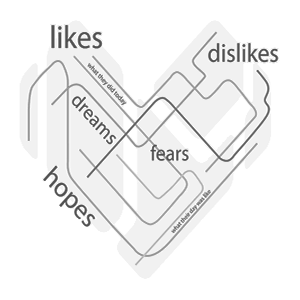
The concept of a lovemap was originated by psychologist and sexologist John Money to assist in a discussion of why people like what they enjoy sexually and erotically. According to Money, it is ‘a developmental representation or template in the mind and in the brain depicting the idealized lover and the idealized program of sexual and erotic activity projected in imagery or actually engaged in with that lover.’
According to Money, the word lovemap was first used in 1980 in an article entitled: ‘Pairbonding and Limerence.’ Money describes the formation of an individual’s lovemap as similar to the acquisition of a native language, in that it bears the mark of his or her own unique individuality, similar to an accent in a spoken language. A lovemap is usually quite specific as to details of the temperament, build, race, color, etc. of the ideal lover. Since its inception, the concept of ‘love maps,’ applied to interpersonal relationships, has found apt acceptance and is frequently referenced in love / relationship / sexual-evolution theory books; as for example in Wilson and McLaughlin’s 2001 ‘The Science of Love.’
read more »
Posted in Health, Love, Sex |
1 Comment »
September 13, 2012

In computing a 10-foot user interface is a software GUI (graphical user interface) designed for display on a large television (or similar sized screen) with interaction using a regular television-style remote control. ’10-foot’ refers to the fact that the GUI’s elements—i.e. menus, buttons, text fonts, and so on—are theoretically ergonomically large enough to read easily at a distance of 10 feet (3 m) from the display. To avoid distractions and to be more clear, 10 foot UIs also tend to be very simple and usually only have the minimum core buttons.
Typical examples of popular 10-foot user interfaces are HTPC (Home theater PC) media center software applications such as Google TV, MediaPortal, XBMC, Windows Media Center, and Front Row / Apple TV interfaces, but most other Smart TV and set-top boxes devices and software with interactive television interfaces also belong in this category. In 2010, Hillcrest Labs released the Kylo browser, which is a web browser optimized for television use, which features a 10-foot user interface. Hillcrest also invented the first motion-controlled remote for television.
read more »
Posted in Money, Technology |
Leave a Comment »
September 13, 2012

@earth is a 2011 book made by London born (and based) photomontage artist Peter Kennard with Lebanese artist Tarek Salhany. It is a photo-essay told through photomontage with seven chapters exposing the current state of the earth, the conditions of life on it and the need to resist injustice. Apart from the title (which is also in different languages on its back cover) the pocket book contains no words and its story is told in sequences of constructed images. ‘@earth’ combines images created digitally over the past two years by Kennard with Salhany especially for the project, with Kennard’s earlier darkroom based photomontages (spanning over 40 years of work) some of which are part of the Tate Permanent Collection. They have been recontextualised for the book. The authors met whilst Kennard taught Salhany at the Byam Shaw School of Art in London.
‘@earth’ has received recognition from, amongst others, Naomi Klein (author of ‘No Logo’ and ‘The Shock Doctrine’) who has said: ‘This book perfectly captures the brutal asymmetries of our age: heavy weaponry trained on broken people, all-seeing technologies and disappearing identities, perpetually exhaling industry and an asphyxiating planet. If there’s a word that’s worth a thousand pictures, it’s ‘@earth.”
Posted in Art, Politics, World |
Leave a Comment »
September 13, 2012


Ron Fricke is an American film director and cinematographer, considered to be a master of time-lapse photography and large format cinematography. He was the director of photography for ‘Koyaanisqatsi’ (a film consisting primarily of slow motion and time-lapse footage) in 1982 and directed the purely cinematic non-verbal non-narrative feature ‘Baraka’ (1992). He designed and used his own 65 mm camera equipment for ‘Baraka’ and his later projects.
He also directed the IMAX films ‘Chronos’ (1985) and ‘Sacred Site’ (1986). His most recent work was as cinematographer for parts of the film ‘Star Wars Episode III: Revenge of the Sith’ (he was hired to shoot the eruption of Mt. Etna in Sicily for use in scenes of the volcanic planet Mustafar). The sequel to ‘Baraka,’ ‘Samsara,’ premiered at the Toronto International Film Festival in 2011. Fricke writes about his work: ‘I feel that my work has evolved through ‘Koyaanisqatsi,’ ‘Chronos’ and ‘Baraka.’ Both technically and philosophically I am ready to delve even deeper into my favorite theme: humanity’s relationship to the eternal.’
Posted in Art, Philosophy, Technology |
Leave a Comment »
September 13, 2012

70mm film is a wide high-resolution film gauge, with higher resolution than standard 35mm motion picture film format. As used in camera, the film is 65 mm wide. The additional 5mm are for magnetic strips holding four of the six tracks of sound.
Although more recent 70 mm prints use digital sound encoding, the vast majority of 70 mm prints predate this technology. Each frame is five perforations tall, with an aspect ratio of 2.20:1. The vast majority of film theaters are unable to handle 70mm film, and so original 70mm films are shown with 35mm prints at these venues.
read more »
Posted in Art, Money, Technology |
1 Comment »
September 13, 2012

In cinematography, full frame refers to the use of the full film gate (the rectangular opening in the front of a motion picture camera where the film is exposed to light) at maximum width and height for 35mm film cameras. It is sometimes also referred to as ‘silent aperture’ or ‘full gate.’
It is the original gate size pioneered by William Dickson and Thomas Edison in 1892 and first used in the short film ‘Blacksmithing Scene.’ Full frame is generally used by all 4-perf (four perforations per frame) films, whether silent, standard 35 (Academy ratio width), or Super 35.
read more »
Posted in Language, Technology |
Leave a Comment »
September 13, 2012
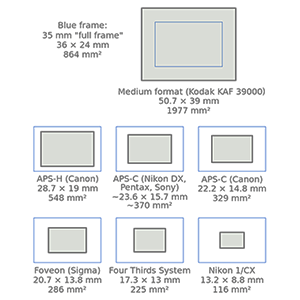
A full-frame digital SLR is a digital single-lens reflex camera fitted with an image sensor that is the same size as a 35 mm (36×24 mm) film frame. This is in contrast to cameras with smaller sensors, typically of a size equivalent to APS-C-size film (20.7×13.8 mm to 28.7×19.1 mm), much smaller than a full 35 mm frame.
Currently, the majority of digital cameras, both compact and SLR models, use a smaller-than-35 mm frame, as it is easier and cheaper to manufacture imaging sensors at a smaller size. Historically, the earliest digital SLR models, such as the Nikon NASA F4 or Kodak DCS 100, also used a smaller sensor.
read more »
Posted in Money, Technology |
1 Comment »
September 12, 2012
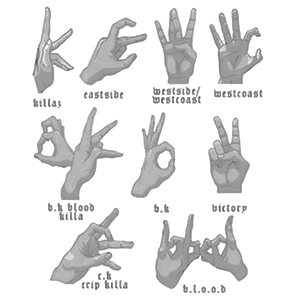
A gang signal is a visual or verbal way gang members identify their affiliation. This can take many forms including slogans, tattoos or hand signs. Many of these, especially slogans and hand signs, have become part of popular culture. ‘Throwing up’ a gang sign (e.g., ‘Stacking,’ ‘walk’) with the hands is one of the most known and obvious forms of ‘claiming.’
It is used in many situations where other identifiers may not be possible or appropriate, and it can also show that a gang member is in the area to ‘do business’ as opposed to just passing through. Usually these signs are made by formation of the fingers on one or both hands to make some sort of symbol or letter. It can also serve to relay more specific information, such as what set they represent within a larger gang or in which activities they are currently taking part.
read more »
Posted in Politics |
1 Comment »
September 12, 2012


Hanna Rosin is an American Journalist. Rosin was born in Israel and grew up in Queens, New York where her father was a taxi driver. She graduated from Stuyvesant High School in 1987. She graduated from Stanford University, and is married to ‘Slate’ editor David Plotz; they live in Washington, D.C. with their three children. She is a co-founder of ‘DoubleX,’ a women’s site connected to ‘Slate.’ She is also a writer for ‘The Atlantic.’ A character portrayed by actress Chloë Sevigny in the movie ‘Shattered Glass’ about Rosin’s colleague at ‘The New Republic,’ Stephen Glass, was loosely based on Rosin. Rosin has written a book based on her 2010 Atlantic story, ‘The End of Men.’
In the past she has specialized in writing about religious-political issues, in particular the influence of evangelical Christians on the 2004 U.S. presidential campaign. She is the author of ‘God’s Harvard: A Christian College on a Mission to Save America,’ published in 2007. Based on a ‘New Yorker’ story, the book follows several young Christians at Patrick Henry College, a new evangelical institution that teaches its students to ‘shape the culture and take back the nation.’ Rosin’s portrayals of the students are part of a larger attempt to chronicle the cultural and political history of the modern Christian right.
Posted in Language, Money, Politics |
Leave a Comment »


 The Daily Omnivore