November 26, 2012

Deep learning refers to a sub-field of machine learning (systems that examine data, from sensors or databases, and identify complex relationships) that is based on learning several levels of representations, corresponding to a hierarchy of features or factors or concepts, where higher-level concepts are defined from lower-level ones, and the same lower-level concepts can help to define many higher-level concepts.
Deep learning is part of a broader family of machine learning methods based on learning representations. An observation (e.g., an image) can be represented in many ways (e.g., a vector of pixels), but some representations make it easier to learn tasks of interest (e.g., is this the image of a human face?) from examples, and research in this area attempts to define what makes better representations and how to learn them.
read more »
Posted in Education, Technology |
Leave a Comment »
November 25, 2012

Machine learning, a branch of artificial intelligence, is a scientific discipline concerned with the development of algorithms that take as input empirical data (from sensors or databases), identify complex relationships, and employ these identified patterns to make predictions. The algorithm studies a portion of the observed data (called ‘training data’) to capture characteristics of interest. Optical character recognition, in which printed characters are recognized automatically based on previous examples, is a classic engineering example of machine learning.
In 1959, AI pioneer Arthur Samuel defined machine learning as a ‘Field of study that gives computers the ability to learn without being explicitly programmed.’ Computer scientist Tom M. Mitchell provided a widely quoted, more formal definition: ‘A computer program is said to learn from experience E with respect to some class of tasks T and performance measure P, if its performance at tasks in T, as measured by P, improves with experience E.’
read more »
Posted in Education, Technology |
Leave a Comment »
November 21, 2012
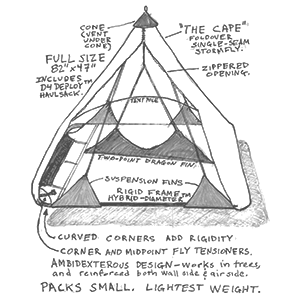
A portaledge is a deployable hanging tent system designed for rock climbers who spend multiple days and nights on a big wall climb. An assembled portaledge is a fabric-covered platform surrounded by a metal frame that hangs from a single point and has adjustable suspension straps. A separate cover, called a ‘stormfly,’ covers the entire system in the event of bad weather.
The first portaledges used in Yosemite were non-collapsible cots purloined from Housekeeping Camp, a Yosemite Valley campground that featured primitive metal framed bunks for the campers. These heavy cots were used on multi-day climbs on granite monoliths like El Capitan, and then sometimes tossed off the summit for later retrieval.
read more »
Posted in Games, Money, Technology |
Leave a Comment »
November 20, 2012

A memory hole is any mechanism for the alteration or disappearance of inconvenient or embarrassing documents, photographs, transcripts, or other records, such as from a web site or other archive, particularly as part of an attempt to give the impression that something never happened.
The concept was first popularized by George Orwell’s dystopian novel ‘Nineteen Eighty-Four,’ in which the memory hole is a small chute leading to a large incinerator used for censorship.
read more »
Posted in Language, Politics |
2 Comments »
November 20, 2012

In Karl Marx’s critique of capitalism, commodity fetishism is theory that objects are imagined to dictate the social activities that produce them. When the social relationships among people are expressed with objectified economic relationships, the subjective, abstract aspects of economic value are transformed into objective, real things that people believe have intrinsic value (reification).
In a capitalist society, social relations between people—who makes what, who works for whom, the production-time for a commodity, et cetera—are perceived as economic relations among objects, that is, how valuable a given commodity is when compared to another commodity. Therefore, the market exchange of commodities masks the true economic character of the human relations of production, between the worker and the capitalist.
read more »
Posted in Money, Philosophy |
3 Comments »
November 20, 2012
A fetish (from Latin ‘facticius,’ ‘artificial’ and ‘facere,’ ‘to make’) is an object believed to have supernatural powers, or in particular, a man-made object that has power over others. Essentially, fetishism is the emic (intracultural) attribution of inherent value or powers to an object. Initially, the Portuguese developed the concept of fetishism to refer to the objects used in religious cults by West African natives.
The concept was popularized in Europe circa 1757, when French scholar Charles de Brosses used it in comparing West African religion to the magical aspects of ancient Egyptian religion. Later, French philosopher Auguste Comte employed the concept in his theory of the evolution of religion, wherein he posited fetishism as the earliest (most primitive) stage, followed by polytheism and monotheism.
read more »
Posted in Philosophy, Sex |
Leave a Comment »
November 20, 2012

A cargo cult is a religious practice that has appeared in many traditional pre-industrial tribal societies in the wake of interaction with technologically advanced cultures. The cults focus on obtaining the material wealth (the ‘cargo’) of the advanced culture through magic and religious rituals and practices.
Cult members believe that the wealth was intended for them by their deities and ancestors. Cargo cults developed primarily in remote parts of New Guinea and other Melanesian and Micronesian societies in the southwest Pacific Ocean, beginning with the first significant arrivals of Westerners in the 19th century.
read more »
Posted in Philosophy, Technology, World |
Leave a Comment »
November 19, 2012
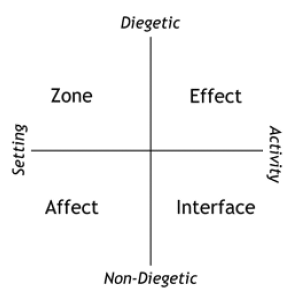
Diegesis [dahy-uh-jee-sis] is a style of storytelling in fiction which presents an interior view of a world and is: that world itself experienced by the characters in situations and events of the narrative; telling, recounting, as opposed to showing, enacting. In diegesis the narrator tells the story. The narrator presents to the audience or the implied readers the actions, and perhaps thoughts, of the characters.
Diegesis (‘narration’) and ‘mimesis’ (‘imitation’) have been contrasted since Plato’s and Aristotle’s times. Mimesis shows rather than tells, by means of action that is enacted. Diegesis, however, is the telling of the story by a narrator. The narrator may speak as a particular character or may be the invisible narrator or even the all-knowing narrator who speaks from above in the form of commenting on the action or the characters.
read more »
Posted in Art, Language, Philosophy |
1 Comment »
November 19, 2012

Alterity [all-ter-eh-tee] is a philosophical term meaning ‘otherness,’ strictly being in the sense of the other of two. In the phenomenological tradition it is usually understood as the entity in contrast to which an identity is constructed, and it implies the ability to distinguish between self and not-self, and consequently to assume the existence of an alternative viewpoint. The concept was established by French philosopher Emmanuel Lévinas in a series of essays, collected under the title ‘Alterity and Transcendence.’
The term is also deployed outside of philosophy, notably in anthropology by scholars such as Nicholas Dirks, Johannes Fabian, Michael Taussig, and Pauline Turner Strong to refer to the construction of ‘cultural others.’ The term has gained further use in seemingly somewhat remote disciplines, e.g. historical musicology where it is effectively employed by John Michael Cooper in a study of Goethe and Mendelssohn.
Posted in Language, Philosophy, World |
1 Comment »
November 19, 2012
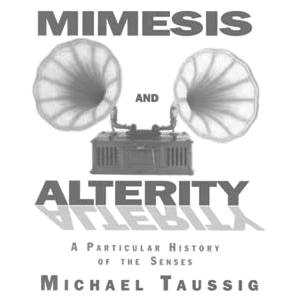
Mimesis [my-mee-sis] (‘to immitate’) is a critical and philosophical term that carries a wide range of meanings, which include imitation, representation, mimicry, Dionysian imitatio (an influential literary method of imitation, receptivity, nonsensuous similarity, the act of resembling, the act of expression, and the presentation of the self.
In ancient Greece, mimesis was an idea that governed the creation of works of art, in particular, with correspondence to the physical world understood as a model for beauty, truth, and the good. Plato contrasted ‘mimesis,’ or ‘imitation,’ with ‘diegesis,’ or ‘narrative.’ After Plato, the meaning of mimesis eventually shifted toward a specifically literary function in ancient Greek society, and its use has changed and been reinterpreted many times since then.
read more »
Posted in Art, Philosophy |
Leave a Comment »
November 19, 2012

Anti-mimesis [my-mee-sis] is a philosophical position that holds the direct opposite of mimesis (the belief that art imitates life). Its most notable proponent is Oscar Wilde, who held in his 1889 essay ‘The Decay of Lying’ that ‘Life imitates Art far more than Art imitates Life.’
In the essay, written as a Platonic dialogue, Wilde holds that such anti-mimesis ‘results not merely from Life’s imitative instinct, but from the fact that the self-conscious aim of Life is to find expression, and that Art offers it certain beautiful forms through which it may realize that energy.’
read more »
Posted in Art, Philosophy |
Leave a Comment »
November 19, 2012

Long drive is a competitive sport where success is derived by hitting a golf ball the farthest by driving. A small but dedicated talent base of golfers populate the world of Long-Drive, with the top talent competing professionally in various events and exhibitions. Professional long drivers can average over 350 yards in competition, compared with 300 yard averages from the top PGA Tour drivers and 200 yards for an average amateur.
Some shots in competitions surpass 400 yards. The world record recognized by Guinness Records as the longest drive in a competition is 515 yards by 64 year old Mike Austin in 2002 at the US National Open Qualifier with a 43.5″ steel shafted persimmon wood driver. The current all-time record holder is Mike Dobbyn with 551 yards.
read more »
Posted in Games, Money |
Leave a Comment »


 The Daily Omnivore
