November 5, 2012
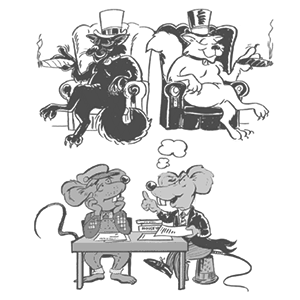
The Story of Mouseland was first told first by Canadian politician Clarence Gillis, and later and most famously by Tommy Douglas, leader of the Saskatchewan Co-operative Commonwealth Federation and, later, the New Democratic Party of Canada, both social democratic parties.
It was a political fable expressing the CCF’s view that the Canadian political system was flawed in offering voters a false dilemma: the choice of two parties, neither of which represented their interests. The mice voted in black cats, which represented the Progressive Conservative Party, and then they found out how hard life was. So they voted in the white cats, which symbolized the Liberal Party.
read more »
Posted in Humor, Politics, World |
Leave a Comment »
November 5, 2012

In political science, Duverger’s law is a principle which asserts that a plurality rule election system (voters vote for one candidate, and the candidate with the most votes wins) tends to favor a two-party system. This is one of two hypotheses proposed by French sociologist and politician Maurice Duverger, the second stating that ‘the double ballot majority system and proportional representation tend to multipartism.’
Duverger observed the effect and recorded it in several papers published in the 1950s and 1960s. In the course of further research, other political scientists began calling the effect a ‘law’ or principle.
read more »
Posted in Politics, World |
Leave a Comment »
November 5, 2012

The moralistic fallacy is in essence the reverse of the naturalistic fallacy (defining the term ‘good’ in terms of one or more natural properties). The moralistic fallacy is the formal fallacy of assuming that what is desirable is found or inherent in nature. It presumes that what ought to be—something deemed preferable—corresponds with what is or what naturally occurs. What should be moral is assumed a priori to also be naturally occurring.
Cognitive scientist Steven Pinker writes that ‘The naturalistic fallacy is the idea that what is found in nature is good. It was the basis for Social Darwinism, the belief that helping the poor and sick would get in the way of evolution, which depends on the survival of the fittest. Today, biologists denounce the Naturalistic Fallacy because they want to describe the natural world honestly, without people deriving morals about how we ought to behave — as in: If birds and beasts engage in adultery, infanticide, cannibalism, it must be OK.’
read more »
Posted in Philosophy, Politics, Science |
1 Comment »
November 5, 2012

The phrase ‘naturalistic fallacy‘ refers to the claim that what is natural is inherently good or right, and that what is unnatural is bad or wrong (‘appeal to nature’). It is the converse of the ‘moralistic fallacy,’ the notion that what is good or right is natural and inherent. The naturalistic fallacy is related to (and even confused with) Hume’s ‘is–ought problem,’ which examines the difference between descriptive statements (about what is) and prescriptive or normative statements (about what ought to be).
Another usage of ‘naturalistic fallacy’ was described by British philosopher G. E. Moore in his 1903 book ‘Principia Ethica.’ Moore stated that a naturalistic fallacy is committed whenever a philosopher attempts to prove a claim about ethics by appealing to a definition of the term ‘good’ in terms of one or more natural properties (such as ‘pleasant,’ ‘more evolved,’ ‘desired,’ etc.).
read more »
Posted in Language, Philosophy, Science |
Leave a Comment »
November 5, 2012

An appeal to nature is a logical fallacy used in arguments or rhetorical tactics in which a phenomenon is described as desirable merely because it is natural, or undesirable merely because it is unnatural, it is related but not identical to the naturalistic fallacy, as the latter considers defining ‘good’ in ethics in terms of any natural properties (even if not merely for being natural) as a fallacy.
The Fallacy of appeal to nature depends on a positive view about the nature, e.g. good, desirable..etc. as a foundation of the reasoning of the argument. To appeal to nature in an argument is to argue from a premise or premises claimed to be implied by the concept of nature.
read more »
Posted in Money, Philosophy |
Leave a Comment »
November 5, 2012

Chemophobia literally means ‘fear of chemicals.’ It is most often used to describe the assumption that ‘chemicals’ (i.e., man-made products or artificially concentrated but naturally occurring chemicals) are bad and harmful, while ‘natural’ things (i.e., chemical compounds that occur naturally or that are obtained using traditional techniques) are good and healthy.
General chemophobia derives from incomplete knowledge of science, or a misunderstanding of science, and is a form of technophobia and fear of the unknown. In terms of chemical safety, ‘industrial,’ ‘synthetic’ ‘artificial,’ and ‘man-made’ do not necessarily mean damaging, and ‘natural’ does not necessarily mean better.
read more »
Posted in Health, Science |
Leave a Comment »
November 5, 2012

The fine-tuned Universe is the proposition that the conditions that allow life in the Universe can only occur when certain universal fundamental physical constants lie within a very narrow range, so that if any of several fundamental constants were only slightly different, the Universe would be unlikely to be conducive to the establishment and development of matter, astronomical structures, elemental diversity, or life as it is presently understood.
The existence and extent of fine-tuning in the Universe is a matter of dispute in the scientific community.
read more »
Posted in Philosophy, Science |
2 Comments »
November 4, 2012
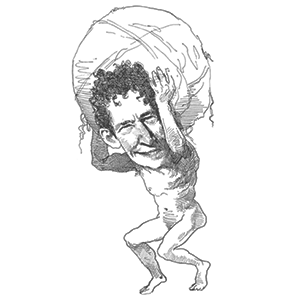
In astrophysics and cosmology, the anthropic [an-throp-ik] principle is the philosophical consideration that observations of the physical Universe must be compatible with the conscious life that observes it. Some proponents of the anthropic principle reason that it explains why the Universe has the age and the fundamental physical constants necessary to accommodate conscious life. As a result, they believe it is unremarkable the universe’s fundamental constants happen to fall within the narrow range thought to be compatible with life.
The strong anthropic principle (SAP) as explained by Barrow and Tipler states that this is all the case because the Universe is compelled, in some sense, for conscious life to eventually emerge. English writer Douglas Adams, who wrote ‘The Hitchhiker’s Guide to the Galaxy,’ used the metaphor of a living puddle examining its own shape, since, to those living creatures, the universe may appear to fit them perfectly (while in fact, they simply fit the universe perfectly).
read more »
Posted in Philosophy, Science |
2 Comments »
November 4, 2012

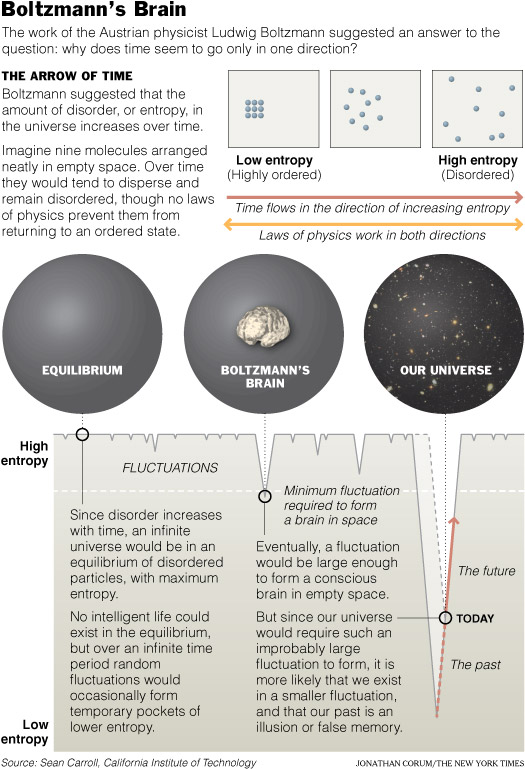
A Boltzmann brain is a hypothesized self-aware entity which arises due to random fluctuations out of a state of chaos. The idea is named for the physicist Ludwig Boltzmann (1844–1906), who advanced an idea that the known universe arose as a random fluctuation, similar to a process through which Boltzmann brains might arise. Boltzmann brains are often referred to in the context of the ‘Boltzmann brain paradox.’
They have also been referred to as ‘Boltzmann babies.’ The concept arises from the need to explain why we observe such a large degree of organization in the universe. The second law of thermodynamics states that the total entropy in a closed universe will never decrease. We may think of the most likely state of the universe as one of high entropy, closer to uniform and without order. So why is the observed entropy so low?
read more »
Posted in Philosophy, Science |
Leave a Comment »
November 4, 2012

Night Thoughts of a Classical Physicist is a 1918 novel by historian of science Russell McCormmach, which explores the world of physics in the early 20th century—including the advent of modern physics and the role of physicists in World War I—through the recollections of the fictional Viktor Jakob.
Jakob is an old German physicist who spent most of his career during the period of classical physics, a paradigm being confronted by the rapid and radical developments of relativistic physics of Albert Einstein in 1900s and 1910s. This conflict allows for extensive examination of the various tensions placed on Jakob by the academic environment, the German academic system and the changing academic culture of the early 20th century.
read more »
Posted in Language, Science |
Leave a Comment »
November 3, 2012


A paradigm [par-uh-dahym] shift (or revolutionary science) is, according to American physicist Thomas Kuhn, in his influential book ‘The Structure of Scientific Revolutions’ (1962), a change in the basic assumptions, or paradigms, within the ruling theory of science.
It is in contrast to his idea of ‘normal science’ (everyday problem solving within an existing paradigm). According to Kuhn, ‘A paradigm is what members of a scientific community, and they alone, share.’ Unlike a normal scientist, Kuhn held, ‘a student in the humanities has constantly before him a number of competing and incommensurable solutions to these problems, solutions that he must ultimately examine for himself.’
read more »
Posted in Language, Science |
Leave a Comment »
November 2, 2012

The Structure of Scientific Revolutions by Thomas S. Kuhn, is an analysis of the history of science, published in 1962. Its publication was a landmark event in the history, philosophy, and sociology of scientific knowledge and it triggered an ongoing worldwide assessment and reaction in—and beyond—those scholarly communities. In this work, Kuhn challenged the then prevailing view of progress in ‘normal science’ (the routine work of scientists experimenting within a paradigm).
Scientific progress had been seen primarily as ‘development-by-accumulation’ of accepted facts and theories. Kuhn argued for an episodic model in which periods of such conceptual continuity in normal science were interrupted by periods of revolutionary science. During revolutions in science the discovery of anomalies leads to a whole new paradigm that changes the rules of the game and the ‘map’ directing new research, asks new questions of old data, and moves beyond the puzzle-solving of normal science.
read more »
Posted in Language, Philosophy, Science |
1 Comment »


 The Daily Omnivore