June 6, 2013
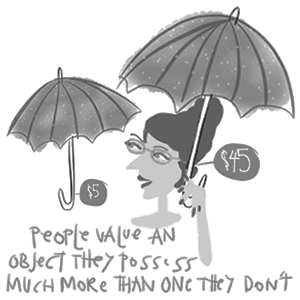
In behavioral economics, the endowment effect (also known as divestiture aversion) is the hypothesis that a person’s willingness to accept (WTA) compensation for a good is greater than their willingness to pay (WTP) for it once their property right to it has been established. People will pay more to retain something they own than to obtain something owned by someone else—even when there is no cause for attachment, or even if the item was only obtained minutes ago. This is due to the fact that once you own the item, foregoing it feels like a loss, and humans are loss-averse.
The endowment effect contradicts the Coase theorem (a theory of economic efficiency), and was described as inconsistent with standard economic theory which asserts that a person’s willingness to pay (WTP) for a good should be equal to their willingness to accept (WTA) compensation to be deprived of the good, a hypothesis which underlies consumer theory and indifference curves.
read more »
Posted in Money, Politics, Science |
1 Comment »
June 6, 2013

Inscape, in visual art, is a term especially associated with certain works of Chilean artist Roberto Matta, but it is also used in other senses within the visual arts. Though the term has been applied to stylistically diverse artworks, it usually conveys some notion of representing the artist’s psyche as a kind of interior landscape. The word inscape can therefore be read as a kind of portmanteau, combining interior (or inward) with landscape.
According to Professor Claude Cernuschi, Matta’s use of the term inscape for a series of landscape-like abstract or surrealist paintings reflects ‘the psychoanalytic view of the mind as a three-dimensional space: the ‘inscape.” The ‘inscape’ concept is particularly apt for Matta’s works of the late 1930s. As art historian Dawn Ades writes, ‘A series of brilliant oil paintings done during the years of his [Matta’s] first association with the Surrealists explore visual metaphors for the mental landscape.’
read more »
Posted in Art, Language, Philosophy |
Leave a Comment »
June 6, 2013
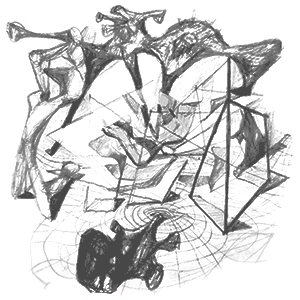
Roberto Matta (1911 – 2002) was one of Chile’s best-known painters and a seminal figure in 20th century abstract expressionist and surrealist art. Born in Santiago, he initially studied architecture at the Pontificia Universidad Católica de Chile in Santiago, but became disillusioned with this occupation and left for Paris in 1933. His travels in Europe and the USA led him to meet artists such as Arshile Gorky, René Magritte, Salvador Dalí, André Breton, and Le Corbusier. Matta was of Spanish, Basque, and French descent.
It was Breton who provided the major spur to the Chilean’s direction in art, encouraging his work and introducing him to the leading members of the Paris Surrealist movement. Matta produced illustrations and articles for Surrealist journals such as ‘Minotaure.’ During this period he was introduced to the work of many prominent contemporary European artists, such as Pablo Picasso and Marcel Duchamp.
read more »
Posted in Art, World |
Leave a Comment »
June 6, 2013

Biomorphism is an art movement that began in the 20th century. It models artistic design elements on naturally occurring patterns or shapes reminiscent of nature.
Taken to its extreme it attempts to force naturally occurring shapes onto functional devices, often with mixed results.
read more »
Posted in Art, Language |
Leave a Comment »
June 6, 2013

HeadOn is the brand name of a homeopathic product claimed to relieve headaches. It achieved widespread notoriety in 2006 as a result of a repetitive commercial, consisting only of the tagline ‘HeadOn. Apply directly to the forehead,’ stated three times in succession, accompanied by a video of a model using the product without ever directly stating the product’s purpose.
Focus groups recalled the ads much more than with any other method, although many people considered the ads annoying. Manufacturer Miralus Healthcare decided not to include any factual claims about the product in the spots after the National Advertising Division of the Better Business Bureau objected to the claim that HeadOn provided ‘fast, safe, effective’ headache relief made in an earlier spot.
Posted in Health, Money |
1 Comment »
June 5, 2013

‘Juicy‘ is a single by American hip hop artist The Notorious B.I.G. and his solo debut single from his 1994 debut album ‘Ready to Die.’ It was produced by Poke of Trackmasters & Sean ‘Puffy’ Combs. It is a sample of Mtume’s ‘Juicy Fruit,’ but samples from the song’s ‘Fruity Instrumental’ mix, and has an alternative chorus sung by girl group Total.
The song is considered one of the greatest hip hop songs of all time. After the death of The Notorious B.I.G. in 1997, a tribute version of this song was made in his honor by the R&B musical group Next with new lyrics.
read more »
Posted in Art, Language, Money |
Leave a Comment »
June 5, 2013

‘Born Rich‘ is a 2003 documentary film about growing up in the world’s richest families. It was created by Jamie Johnson, an heir to the Johnson & Johnson fortune. It consists primarily of Johnson interviewing his friends and peers about living life free of financial constraints. These interviews are offset by Johnson’s exploration of his own experience and family.
Interviewees include: Georgina Bloomberg, Stephanie Ercklentz (born to New York lawyer Enno W. Ercklentz Jr.), Christina Floyd (born to golfer Raymond Floyd), Juliet Hartford (born to A&P heir Huntington Hartford), Josiah Cheston Hornblower (born into Vanderbilt-Whitney lineage), S.I. Newhouse IV, Ivanka Trump, Cody Franchetti (heir to Milliken & Co), and Carlo von Zeitschel (German baron and Italian viscount, great grandson of Kaiser Wilhelm). Luke Weil (born to Scientific Games CEO A. Lorne Weil) sued unsuccessfully to remove his segments from the film.
Posted in Money, Politics |
Leave a Comment »
June 5, 2013

Lookism is a term used to refer to the positive stereotypes, prejudice, and preferential treatment given to physically attractive people, or more generally to people whose appearance matches cultural preferences.
The pejorative term ‘body fascism’ is also used as a synonym and educator and activist Warren Farrell has proposed the term ‘genetic celebrity’ to describe adoration of the attractive.
read more »
Posted in Language, Politics, Sex |
Leave a Comment »
June 4, 2013

‘You Only Move Twice‘ is the second episode of The Simpsons’ eighth season. It first aired in 1996. The original concept for the episode came from a story idea by Greg Daniels involving Homer getting a new job for an employee-friendly, Silicon Valley type, modern boss (Hank Scorpio voiced by Albert Brooks) who would stand in contrast with Mr. Burns, an authoritarian, 19th century style boss.
Homer’s new boss, despite being friendly and personable, would be a supervillain in the mold of Ernst Stavro Blofeld of the James Bond novels and films. This element was meant to be in the background and Homer would be oblivious to it.
read more »
Posted in Art, Humor |
Leave a Comment »
June 4, 2013

Patent monetization refers to the generation of revenue or the attempt to generate revenue by a person or company by selling or licensing the patents it owns.
The so-called patent trolls—which is a pejorative term—attempt to generate revenue by buying and enforcing patents against one or more alleged infringers in a manner considered by the target or observers as unduly aggressive or opportunistic, often with no intention to further develop, manufacture or market the patented invention. Other persons or companies, which are not regarded as patent trolls, also try to make money from patents on inventions they develop, manufacture or market.
Posted in Money, Politics, Technology |
Leave a Comment »
June 4, 2013

Nathan Myhrvold (b. 1959), formerly Chief Technology Officer at Microsoft, is co-founder and 40% owner of Intellectual Ventures, a patent portfolio holding company.
Myhrvold, usually with coinventors, holds 17 U.S. patents assigned to Microsoft and has applied for more than 500 patents. In addition, Myhrvold and coinventors hold 115 U.S. patents assigned mostly to The Invention Science Fund I, LLC.
read more »
Posted in Food, Money, Technology |
Leave a Comment »
June 4, 2013

Intellectual Ventures is a private company notable for being one of the top-five owners of U.S. patents, as of 2011. Its business model has a focus on buying patents and aggregating them into a large patent portfolio and licensing this ‘IV’ portfolio to companies.
Publicly, it states that a major goal is to assist small inventors against corporations. In practice, the vast majority of IV’s revenue comes from buying patents, aggregating them into a large portfolio and licensing this portfolio to other companies or filing lawsuits for infringement of patents, a controversial practice known as patent trolling.
read more »
Posted in Money, Politics, Technology |
Leave a Comment »


 The Daily Omnivore