September 13, 2013

Pon farr is a Vulcan mating ritual and biological condition. Every seven years, Vulcan males and females become aroused. They undergo a blood fever (‘plak tow’), become violent, and finally die unless they mate with someone with whom they are empathically bonded or engage in the ritual battle known as ‘kal-if-fee.’ The idea is based on the mating ritual of animals on earth, notably the female ferret that also dies if it has not mated by the end of the season.
In the rebooted ‘Star Trek’ (2009), Vulcans also mate outside of pon farr, and with species other than Vulcan even if not mentally bonded with them. A common misconception associated with the series (and Spock in particular) is that Vulcans only have sex once every seven years. However, pon farr is not coincident with the sex lives of Vulcans, and they are able to have intercourse without the affliction.
read more »
Posted in Humor, Sex |
Leave a Comment »
September 13, 2013

Kirk/Spock (K/S) refers to the pairing of James T. Kirk and Spock from ‘Star Trek’ in slash fiction (erotic fan fiction), possibly the first slash pairing according to media scholar Henry Jenkins. Early on, a few fan writers started speculating about the possibility of a sexual relationship between Kirk and Spock, adding a romantic or a ‘sexual element’ to the friendship between the men.
As of 1998, ‘most’ academic studies on slash focused on Kirk/Spock, as ‘Star Trek’ was one of the most accessible titles for academics and their audience, and as the first slash pairing, K/S was developed independently from the influence of other slash fiction.
read more »
Posted in Humor, Sex |
1 Comment »
September 12, 2013

Ailanthus altissima, commonly known as tree of heaven is a deciduous tree originating from China known for its ability to thrive in inhospitable urban environments; it has acquired the derisive nicknames of ‘ghetto palm,’ ‘stink tree,’ and ‘tree of Hell.’ The tree grows rapidly and is capable of reaching heights of 49 ft in 25 years. However, the species is also short lived and rarely lives more than 50 years.
In has become an invasive species due to its ability both to colonize disturbed areas quickly, including areas of rubble in war-torn Afghanistan, and to suppress competition with allelopathic chemicals. It is considered a noxious weed in Australia, the United States, New Zealand and several countries in southern and eastern Europe. The tree also resprouts vigorously when cut, making its eradication difficult and time consuming.
read more »
Posted in Language, Science, World |
Leave a Comment »
September 11, 2013
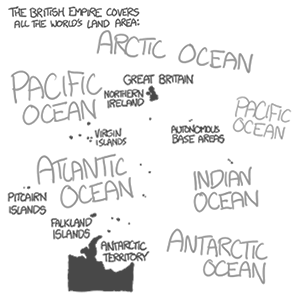
The phrase “the empire on which the sun never sets” has been used with variations to describe certain global empires that were so extensive that there was always at least one part of their territory in daylight.
It was originally used for the Spanish Empire in the 16th and 17th centuries, and for the British Empire in the 19th and early 20th centuries. German historian of language Georg Büchmann traces the idea to a speech in Herodotus’ Histories, made by Xerxes I of Persia before invading Greece.
read more »
Posted in Language, Politics, World |
3 Comments »
September 10, 2013

The Rally Fighter is the first automobile manufactured by Local Motors. The car is designed under a freely distributable Creative Commons license. It was featured in an episode of the American version of the television show ‘Top Gear.’
The Rally Fighter was also featured on the Discovery Channel television show ‘Game Changers’ showing the build process that customers who purchase a Rally Fighter would go through. The Rally Fighter is an automobile built by the customer at a Micro Factory owned and operated by Local Motors.
Posted in Technology |
Leave a Comment »
September 10, 2013

Unitarian [yoo-ni-tair-ee-uhn] Universalism [yoo-nuh-vur-suh-liz-uhm] (UUism or Unitarianism) is a syncretistic, theologically liberal religion characterized by a, ‘free and responsible search for truth and meaning.’ Unitarian Universalists do not share a creed, but are unified by their shared search for spiritual growth and by the understanding that an individual’s theology is a result of that search and not a result of obedience to an authoritarian requirement.
Unitarian Universalists draw from all major world religions, and have a wide range of beliefs and practices. Members might describe themselves as humanist, agnostic, deist, atheist, pagan, Christian, Muslim, monotheist, pantheist, polytheist, or use no label at all.
read more »
Posted in Philosophy |
3 Comments »
September 9, 2013

Balrog is a character from Capcom’s Street Fighter fighting game series depicted as an African American boxer wearing blue trunks with white trim and a torn white shirt under a blue tank top. He wears red boxing gloves and boxing shoes.
His hairstyle consists of short hair cut in an odd pointing style in the front, similar to Mike Tyson’s haircuts from the time ‘Street Fighter II’ was made. A character named Mike, who was also an African-American boxer, appears in the original ‘Street Fighter.’ Although recognized as a separate character, Mike is considered to be a prototype of Balrog.
read more »
Posted in Games |
Leave a Comment »
September 8, 2013

‘Holy cow!‘ is an exclamation of surprise used mostly in the United States, Canada, Australia and England. It is a minced oath or euphemism for ‘Holy Christ!’ Similar expressions such as ‘Holy buckets’ and ‘Holy underwear’ employ a play-on-words, ‘holy’ implying ‘riddled with holes.’
According to the ‘Dictionary of American Slang’ (1960): ‘It is also the common oath and popular exclamation put into the mouths of teenagers by many screenwriters, and, is universally heard on radio, television, and in the movies. It was first popularized by the ‘Corliss Archer’ series of short stories, television programs, and movies, which attempted to show the humorous, homey side of teenage life.’
read more »
Posted in Games, Humor, Language |
1 Comment »
September 7, 2013

Sacred cow is an idiom, a figurative reference to sacred cows in some religions. It is based on the popular understanding of the elevated place of cows in Hinduism and appears to have emerged in America in the late 19th century. A literal sacred cow or sacred bull is an actual cow or bull that is treated with sincere reverence. A figurative sacred cow is something else that is considered immune from question or criticism, especially unreasonably so.
There is an element of paradox in the concept of reverence for a sacred cow, as illustrated in a comment about the novelist V. S. Naipaul: ‘[He] has the ability to distinguish the death of an ordinary ox, which, being of concern to no one, may be put quickly out of its agony, from that of a sacred cow, which must be solicitously guarded so that it can die its agonizing death without any interference. ‘Irreverence is our only sacred cow’ is the motto of ‘The Realist,’ a pioneering magazine of social-political-religious criticism and satire.
Posted in Language, Philosophy, World |
Leave a Comment »
September 7, 2013

Fictionalism [fik-shuhn-ahl-izuhm] is the view in philosophy according to which statements that appear to be descriptions of the world should not be construed as such, but should instead be understood as cases of ‘make believer,’ of pretending to treat something as literally true (a ‘useful fiction’).
Two important strands of fictionalism are modal fictionalism developed by Princeton philosopher Gideon Rosen, which states that possible worlds, regardless of whether they exist or not, may be a part of a useful discourse, and mathematical fictionalism advocated by NYU philosopher Hartry Field, which states that talk of numbers and other mathematical objects is nothing more than a convenience for doing science.
Posted in Philosophy |
Leave a Comment »
September 6, 2013

Julian L. Simon and Paul Ehrlich entered in a famous scientific wager in 1980, betting on a mutually agreed-upon measure of resource scarcity over the decade leading up to 1990. Simon had Ehrlich choose five commodity metals. Copper, chromium, nickel, tin, and tungsten were chosen and Simon bet that their prices would decrease, while Ehrlich bet they would increase. Ehrlich lost the bet, as all five commodities that were bet on declined in price from 1980 through 1990, the wager period.
In 1968, Ehrlich published ‘The Population Bomb,’ which argued that mankind was facing a demographic catastrophe with the rate of population growth quickly outstripping growth in the supply of food and resources. Simon was highly skeptical of such claims, so proposed a wager, telling Ehrlich to select any raw material he wanted and select ‘any date more than a year away,’ and Simon would bet that the commodity’s price on that date would be lower than what it was at the time of the wager.
read more »
Posted in Money, Science, World |
Leave a Comment »
September 6, 2013

‘The Ultimate Resource‘ is a 1981 book written by Julian Lincoln Simon challenging the notion that humanity was running out of natural resources. It was revised in 1996 as ‘The Ultimate Resource 2.’
The overarching thesis is that there is no resource crisis because as a particular resource becomes more scarce, its price rises, creating an incentive for people to discover more of the resource, ration and recycle it and, eventually, develop substitutes. The ‘ultimate resource’ is not any particular physical object but the capacity for humans to invent and adapt.
read more »
Posted in Language, Money, World |
1 Comment »


 The Daily Omnivore