March 31, 2025
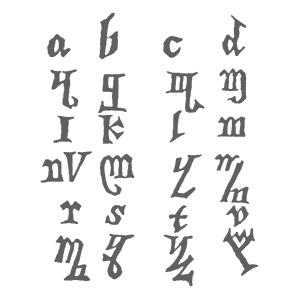
Steganography [steg-uh-nog-ruh-fee] is the practice of representing information within another message or physical object, in such a manner that the presence of the concealed information would not be evident to an unsuspecting person’s examination.
The word steganography comes from Greek words steganós (‘covered or concealed’) and graphia (‘writing’). The first recorded use of the term was in 1499 by German Benedictine abbot Johannes Trithemius in his Steganographia, a treatise on cryptography and steganography, disguised as a book on magic.
read more »
Posted in Politics, Science, Technology |
Leave a Comment »
March 21, 2025
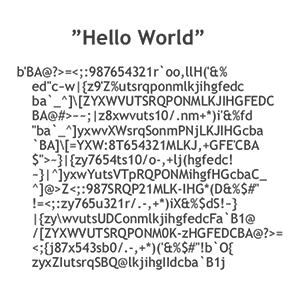
Malbolge [mahl-bol-jeh] is a public domain esoteric programming language invented by Ben Olmstead in 1998, named after the eighth circle of hell in Dante’s Inferno, the Malebolge. It was specifically designed to be almost impossible to use, via a counter-intuitive ‘crazy operation,’ base-three arithmetic, and self-altering code. It builds on the difficulty of earlier challenging esoteric languages (such as Brainfuck and Befunge) but exaggerates this aspect to an extreme degree, playing on the entangled histories of computer science and encryption. Despite this design, it is possible to write useful Malbolge programs, though the author himself has never written one.
The first program was not written by a human being; it was generated by a beam search algorithm designed by Andrew Cooke and implemented in Lisp. Later, Lou Scheffer posted a cryptanalysis of Malbolge and provided a program to copy its input to its output. He also saved the original interpreter and specification after the original site stopped functioning and offered a general strategy of writing programs in Malbolge as well as some thoughts on its Turing completeness.
Posted in Humor, Technology |
Leave a Comment »
March 19, 2025
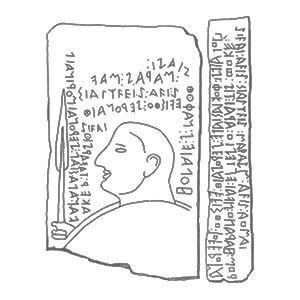
A stele [stee-lee] or stela [stee-lah] is a stone or wooden slab, generally taller than it is wide, erected in the ancient world as a monument. The surface of the stele often has text, ornamentation, or both. These may be inscribed, carved in relief, or painted.
Steles have also been used to publish laws and decrees, to record a ruler’s exploits and honors, to mark sacred territories or mortgaged properties, as territorial markers, as the boundary steles of Akhenaton at Amarna, or to commemorate military victories. They were widely used in the ancient Near East, Mesopotamia, Greece, Egypt, Somalia, Eritrea, Ethiopia, and, most likely independently, in China and elsewhere in the Far East, and, independently, by Mesoamerican civilizations, notably the Olmec and Maya.
read more »
Posted in Philosophy, Politics, World |
Leave a Comment »
March 8, 2025
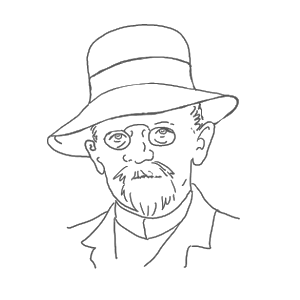
In mathematics, Hilbert’s program, formulated by German mathematician David Hilbert in the early 1920s, was a proposed solution to the foundational crisis of mathematics, when early attempts to clarify the foundations of mathematics were found to suffer from paradoxes and inconsistencies. Hilbert wanted to ground all existing theories to a finite, complete set of axioms, and provide a proof that these axioms were consistent. He proposed that the consistency of more complicated systems, such as real analysis, could be proven in terms of simpler systems.
Gödel’s incompleteness theorems, published in 1931, showed that Hilbert’s program was unattainable for key areas of mathematics. In his first theorem, Gödel showed that any consistent system with a computable set of axioms which is capable of expressing arithmetic can never be complete. In his second theorem, he showed that such a system could not prove its own consistency, so it certainly cannot be used to prove the consistency of anything stronger with certainty. This refuted Hilbert’s assumption that a finitistic system could be used to prove the consistency of itself, and therefore could not prove everything else. Many current lines of research in mathematical logic, such as proof theory and reverse mathematics, can be viewed as natural continuations of Hilbert’s original program.
Posted in Science, World |
Leave a Comment »
March 3, 2025

The Acme siren is a musical instrument used in concert bands for comic effect. Often used in cartoons, it produces the stylized sound of a police siren. It is one of the few aerophones in the percussion section of an orchestra. The instrument is typically made of metal and is cylindrical. Inside the cylinder is a type of fan-blade which, when the performer blows through one end, spins and creates the sound. The faster the performer blows, the faster the fan-blade moves and the higher the pitch the instrument creates. Conversely, the slower the performer blows, the lower the pitch.
Iannis Xenakis used it in the 1960s in his works Oresteia, Terretektorh, and Persephassa. A siren was used in Bob Dylan’s classic album, ‘Highway 61 Revisited.’ One is also heard in Stevie Wonder’s song ‘Sir Duke’ just before the second chorus. Dan Zanes also uses a siren in his version of ‘Washington at Valley Forge.’ Acme is the trade name of J Hudson & Co of Birmingham, England, who developed and patented the Acme siren in 1895. It was sometimes known as ‘the cyclist’s road clearer.’
Posted in Art, Humor |
Leave a Comment »


 The Daily Omnivore