A Witness Tree is a tree that was present during a grand historical or cultural event of America. Witness trees are centuries old and are known to be of great importance to the U.S. nation’s history. It is unclear how many witness trees there are, but the ones documented are archived in the Library of Congress through the Witness Tree Protection Program, which was founded in 2006.
The program was initially created to document and identify two dozen historically significant trees in the Washington DC area. The creation of the program came from the discovery of Yoshino cherry trees from the year 1910.
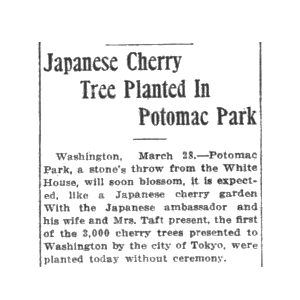
In 1910, the people of Japan had gifted the U.S. Yoshino Cherry Trees as a sign of friendship. The trees gifted in 1910 were all issued to be destroyed after the U.S. Department of Agriculture had determined they had disease and were filled with insects. In 1912, Japan replaced their gift with a new set of Yoshinos. USDA records show that two dozen of the trees from 1910 were saved and quarantined for observation by an entomologist. The cherry trees are believed to have been planted near Hains Point where you can find a cluster of them that both show signs of being from the early 1900s and that don’t match the DNA of the trees from 1912. The discovery of the 1910 Yoshino Cherry Trees showed the importance of documenting trees that had “witnessed” historically significant events.
The Olmsted Elm located on the Frederick Law Olmsted National Historic Site in Brookline, Massachusetts, was planted around 1810. The elm was present when Frederick Law Olmsted bought the property in 1883, which he called ‘Fairsted.’ Olmsted and his son, John Charles Olmsted, removed all the other trees left by an orchard in the vicinity but decided to keep the elm. The elm was kept on by the National Park Service as an important feature of the South Lawn until it succumbed to Dutch elm disease, and was removed in 2011. The elm was replaced with a new, disease resistant variety, a Jefferson Elm, in 2013.
The original Jefferson Elm came from 333 American elms that were planted North of the Smithsonian Freer Gallery on the National Mall in 1935. Most of the elms have perished and been replaced except for the Jefferson Elm. The Jefferson Elm’s leaves remain green through late October, indicating genetically unique specimens. Many experiments were done on the Jefferson Elm from 1980 to the early 1990s. The experiment’s results showed resistance to Dutch elm disease, which is believed to have come from a unique genetic arrangement. The elm also has a unique U-shaped branch junction that provides it more stability.
In 1829 President Andrew Jackson planted his late wife’s favorite Magnolia trees in memory of her passing. The trees can be found on both sides of the south portico of the White House. These Magnolia trees are the oldest presidentially planted on the White House grounds and they’re also depicted on the U.S. twenty dollar bill. One tree was felled in 2025 due to its dire condition due to its age; it had previously suffered damage in 1994, and underwent a trimming operation in 2017. Subsequently, President Donald Trump planted a new tree in its place.
Located in Maryland, the War of 1812 Willow Oak sits on the former site of the Mount Welby House. The house that was home to British sympathizers Samuel DeButts and his family. Today the tree is near the parking lot for the Oxon Cove Park and Oxon Hill Farm in Oxon Hill. The oak witnessed the Battle of Bladensburg in 1814. The oak is believed to be at least 200 years old, which is past the average life expectancy of a Willow Oak.
One of the most well known Civil war era trees is the Burnside Sycamore located on the Antietam National Battlefield in Maryland. After the battle of Antietam, Alexander Gardner photographed Burnside’s Bridge, along with the young sycamore sapling. The tree has faced many casualties and still remains as an important landmark and feature to the site.
The Sickle Oak is Located in Gettysburg, Pennsylvania, near the Trostle Farm. The oak is known for its use by Daniel Sickles during the Civil War. While in search of a command post, Sickles gathered his men and rested under the shade. The moment was commemorated by Bugler Charles Reed in a sketch.
The Oklahoma City survivor tree is an American elm located in downtown Oklahoma City. In 1995 Timothy McVeigh bombed the Alfred P. Murrah Federal Building. The survivor elm had absorbed some of the blast and had glass and metal embedded into its bark. The elm was initially wanted for evidence but survivors and family members of those killed in the blast had pleaded to save the elm. The elm is now the focal point of the Oklahoma City National Memorial.
Located on Mount Vernon in Virginia, the George Washington’s Mount Vernon Historic tree is believed to have been planted during the 1780s. The tree was known to have witnessed George Washington’s life, including his return home from presidency. The tree was also carved with corps insignia by Union troops while they were stationed during the Civil War.



