December 5, 2014

Body worn video (BWV), including what is referred to as a body worn camera (BWC), is a video recording system that is typically utilized by law enforcement to record their interactions with the public, gather video evidence at crime scenes, and has been known to increase both officer and citizen accountability. BWCs are notable because their placement, often on the front of a shirt, provides for first person perspective and ultimately a more complete chain of evidence.
Body worn video was first adopted by British police in 2005, appearing in the form of small-scale tests conducted by the Devon and Cornwall Police. In 2006, the first significant deployments of BWV were undertaken as part of the Domestic Violence Enforcement Campaign. The basic command units equipped with the head cameras recorded everything that happened during an incident from the time of arrival which led to the ‘preservation of good-quality first disclosure evidence from the victim.’
read more »
Posted in Politics, Technology, World |
1 Comment »
December 4, 2014


Metamagical [met-uh-maj-i-kuhl] Themas [thee-muhs] is an eclectic collection of articles that cognitive scientist Douglas Hofstadter wrote for ‘Scientific American’ during the early 1980s. The title is an anagram of Martin Gardner’s ‘Mathematical Games,’ the column that preceded Hofstadter’s. The anthology was published in 1985. Major themes include: self-reference in memes (ideas that spread within cultures), language, art and logic; discussions of philosophical issues important in cognitive science/AI; analogies and what makes something similar to something else (specifically what makes, for example, an uppercase letter ‘A’ recognizable as such); and lengthy discussions of the work of political scientist Robert Axelrod on the prisoner’s dilemma (a game theory problem).
There are three articles centered on the Lisp programming language, where Hofstadter first details the language itself, and then shows how it relates to Gödel’s incompleteness theorem. Two articles are devoted to Rubik’s Cube and other such puzzles. Many other topics are also mentioned, all in Hofstadter’s usual easy, approachable style. Many chapters open with an illustration of an extremely abstract alphabet, yet one which is still recognizable as such. The game of ‘Nomic’ (in which the rules of the game include mechanisms for the players to change those rules) was first introduced to the public in this column, in June 1982.
Posted in Language, Philosophy, Science |
1 Comment »
December 3, 2014

Takako Konishi (1973 – 2001) was an office worker from Tokyo who was found dead in a field outside Detroit Lakes, Minnesota on November 15, 2001. Konishi had originally arrived in Minneapolis earlier that month, traveled to Bismarck, then to Fargo, and finally to Detroit Lakes, where she died. Her death was ruled a suicide, but it was insinuated by the media that she had died trying to locate the missing money hidden by Steve Buscemi’s character, Carl Showalter, in the 1996 film ‘Fargo,’ under the impression that the film was based on a true story. Investigations by American film writer/director Paul Berczeller discovered the entire ‘Fargo’ story had come about as the result of a misunderstanding between Konishi and one of the Bismarck police officers with whom she had been talking.
The story was then inflated by the media, leading to an urban legend. Instead, it was discovered, Konishi had been very depressed after losing her job at a Tokyo travel agency, and had come to Minneapolis because it was a place she had previously visited with her lover, a married American businessman. Depressed and lonely, Konishi had been wandering Detroit Lakes when she decided to commit suicide with an overdose of alcohol and sedatives. Her story was detailed in the 2003 documentary film ‘This Is a True Story,’ directed by Berczeller. In addition, the urban legend surrounding her death is the basis for the 2014 film ‘Kumiko, the Treasure Hunter.’
Posted in Death, World |
Leave a Comment »
December 2, 2014
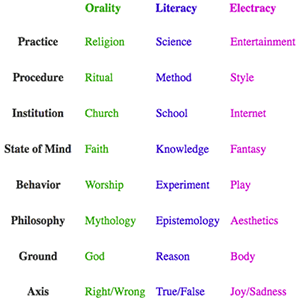

Electracy [ee-lek-truh-see] is a theory by Gregory Ulmer, a professor of English and electronic languages, that describes the skills necessary to access and utilize electronic media such as multimedia (audio, visual, and text), hypermedia (linked material), social networks, and virtual worlds. According to Ulmer, electracy ‘is to digital media what literacy is to print.’ However, ‘If literacy focused on universally valid methodologies of knowledge (sciences), electracy focuses on the individual state of mind within which knowing takes place (arts).’ It is his attempt to describe the transition from a culture of print literacy to a culture saturated with electronic media.
Ulmer sees this shift as a positive step, writing, ‘The near absence of art in contemporary schools is the electrate equivalent of the near absence of science in medieval schools for literacy. The suppression of empirical inquiry by religious dogmatism during the era sometimes called the ‘dark ages’ (reflecting the hostility of the oral apparatus to literacy), is paralleled today by the suppression of aesthetic play by empirical utilitarianism (reflecting the hostility of the literate apparatus to electracy). The ambivalent relation of the institutions of school and entertainment today echoes the ambivalence informing church-science relations throughout the era of literacy.’ He concludes that the sociological changes will be profound: ‘What literacy is to the analytical mind, electracy is to the affective body: a prosthesis that enhances and augments a natural or organic human potential. Alphabetic writing is an artificial memory that supports long complex chains of reasoning impossible to sustain within the organic mind. Digital imaging similarly supports extensive complexes of mood atmospheres beyond organic capacity.’
Posted in Language, Philosophy, Technology |
Leave a Comment »
December 2, 2014

The drunken monkey hypothesis proposes that human attraction to ethanol may have a genetic basis due to the high dependence of the primate ancestor of Homo sapiens on fruit as a food source. Ethanol naturally occurs in ripe and overripe fruit and consequently early primates developed a genetically based attraction to the substance. This hypothesis was originally proposed by Dr. Robert Dudley of UC, Berkeley and was the subject of a symposium for the ‘Society for Integrative and Comparative Biology.’
Dudley believes that while most addictive substances are relatively new to humans, ethanol attraction may have a long evolutionarily based history. He believes that fruit ethanol may have been a significant source of energy and that the smell of the ripening fruit would help primates locate it. Ethanol is a light molecule and diffuses rapidly in a natural environment. Primates are known to have a higher olfactory sensitivity to alcohol than other mammals. The once-beneficial attraction to ethanol may underlie human tendencies for alcohol use and alcohol abuse.
Posted in Drugs, Health, Science |
1 Comment »
November 30, 2014

Caffeine is a naturally occurring chemical found in various seeds, leaves, nuts, and berries. It serves a dual function in plants: as a toxin against unwanted pests, and as an enticement to pollinators, who are stimulated by it. Common sources of caffeine include coffee seeds (beans), tea leaves, kola nuts, yerba mate leaves, and guarana berries. It is extracted from the plant by steeping in water, a process called infusion. Chemically caffeine is an alkaloid, a non-acidic, nitrogen containing compound. A number of alkaloids are produced by flowering plants (e.g. cocaine from coca, nicotine from tobacco, morphine from poppies) to reduce or avoid being eaten by herbivores.
Specifically, caffeine is a xanthine alkaloid, an organic (carbon-based) compound from which many stimulants are derived. It is the world’s most widely consumed psychoactive drug, but unlike many other psychoactive substances, it is legal and unregulated in nearly all parts of the world. Part of the reason caffeine is classified by the FDA as ‘generally recognized as safe’ is that toxic doses, over 10 grams per day for an adult, are much higher than the typically used doses of under 500 milligrams.
read more »
Posted in Drugs, Food, Health |
Leave a Comment »
November 29, 2014


Coffee culture describes a social atmosphere or series of associated social behaviors that depends heavily upon coffee, particularly as a social lubricant. The term also refers to the diffusion and adoption of coffee as a widely consumed stimulant by a culture. In the late 20th century, particularly in the Western world and urbanized centers on the globe, espresso has been an increasingly dominant form. Individuals that participate in cafe culture are sometimes referred to as ‘cafe au laiters’ and ‘espressonites.’
In many urban centers on the world, it is not unusual to see several espresso shops and stands within walking distance of each other or on opposite corners of the same intersection, typically with customers overflowing into parking lots. Thus, the term coffee culture is also used frequently in popular and business media to describe the deep impact of the market penetration of coffee-serving establishments.
read more »
Posted in Food, Politics, World |
1 Comment »
November 27, 2014

The tolerance paradox arises from a problem that a tolerant person might be antagonistic toward intolerance, hence intolerant of it. The tolerant individual would then be by definition intolerant of intolerance. American political philosopher Michael Walzer asks ‘Should we tolerate the intolerant?’ He notes that most minority religious groups who are the beneficiaries of tolerance are themselves intolerant, at least in some respects. In a tolerant regime, such people may learn to tolerate, or at least to behave ‘as if they possessed this virtue.’ Philosopher Karl Popper asserted, in ‘The Open Society and Its Enemies Vol. 1,’ that we are warranted in refusing to tolerate intolerance.
However, philosopher John Rawls concludes in ‘A Theory of Justice’ that a just society must tolerate the intolerant, for otherwise, the society would then itself be intolerant, and thus unjust. But, Rawls also insists, like Popper, that society has a reasonable right of self-preservation that supersedes the principle of tolerance: ‘While an intolerant sect does not itself have title to complain of intolerance, its freedom should be restricted only when the tolerant sincerely and with reason believe that their own security and that of the institutions of liberty are in danger.’
Posted in Philosophy, Politics |
Leave a Comment »
November 26, 2014
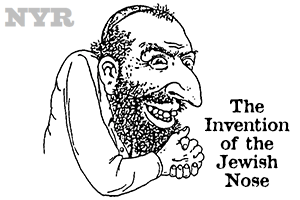

An aquiline [ak-wuh-lahyn] nose (also called a Roman nose or hook nose) is a human nose with a prominent bridge, giving it the appearance of being curved or slightly bent. The term is derived from the Latin word ‘aquilinus’ (‘eagle-like’) an allusion to the curved beak of an eagle. While some have ascribed the aquiline nose to specific ethnic, racial, or geographic groups, and in some cases associated it with other supposed non-physical characteristics (i.e. intelligence, status, personality, etc.), no scientific studies or evidence support any such linkage. As with many phenotypical expressions (i.e. ‘widow’s peak’, eye color, earwax type) it is found in many geographically diverse populations.
The aquiline nose was deemed a distinctive feature of some Native American tribes, members of which often took their names after their own characteristic physical attributes (i.e. The Hook Nose, or Chief Henry Roman Nose). In the depiction of Native Americans, for instance, an aquiline nose is one of the standard traits of the ‘noble warrior’ type. It is so important as a cultural marker, political scientist Renee Ann Cramer argued in ‘Cash, Color, and Colonialism’ (2005), that tribes without such characteristics have found it difficult to receive ‘federal recognition’ from the US government, resulting in failure to win benefits including tax-exempt status, reclamation rights, and (perhaps most significantly) the right to administer and profit from casinos.
read more »
Posted in Politics, Science, World |
1 Comment »
November 25, 2014

An origin myth is a myth that purports to describe the origin of some feature of the natural or social world. One type of origin myth is the cosmogonic myth, which describes the creation of the world. However, many cultures have stories set after the cosmogonic myth, which describe the origin of natural phenomena and human institutions within a preexisting universe. In Western classical scholarship, the terms ‘etiological myth’ and ‘aition’ (Ancient Greek: ’cause’) are sometimes used for a myth that explains an origin, particularly how an object or custom came into existence.
Every origin myth is a tale of creation describing how some new reality came into existence. In many cases, origin myths also justify the established order by explaining that it was established by sacred forces. The distinction between cosmogonic myths and origin myths is not clear-cut. A myth about the origin of some part of the world necessarily presupposes the existence of the world—which, for many cultures, presupposes a cosmogonic myth. In this sense, one can think of origin myths as building upon and extending their cultures’ cosmogonic myths. In fact, in traditional cultures, the recitation of an origin myth is often prefaced with the recitation of the cosmogonic myth.
read more »
Posted in Philosophy, Politics, World |
Leave a Comment »
November 24, 2014


Most new laws in the US are made by Congress, however the Constitution also grants the President some legislative authority in the form of executive orders for the purpose of empowering officers and agencies of the Executive branch and managing operations within the federal government itself. Congress can also explicitly delegate to the President discretionary powers (delegated legislation) for a particular law. Like both legislative statutes and regulations promulgated by government agencies, executive orders are subject to judicial review, and may be struck down if deemed by the courts to be unsupported by statute or the Constitution.
Major policy initiatives usually require approval by the legislative branch, but executive orders have significant influence over the internal affairs of government, deciding how and to what degree laws will be enforced, dealing with emergencies, waging war, and in general fine-tuning policy choices in the implementation of broad statutes.
read more »
Posted in Politics, War |
Leave a Comment »
November 23, 2014
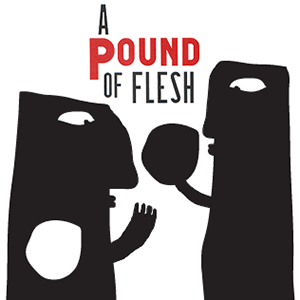
To have ‘skin in the game’ is to have incurred monetary risk by being invested in achieving a goal. In the phrase, ‘skin’ is a synecdoche (a part that represents the whole) for the person involved, and ‘game’ is the metaphor for the actions on whatever field of play is at reference. The aphorism is common in finance, gambling, and politics. The origin of the phrase is unknown. It has been attributed to Warren Buffett since in Buffett’s first fund he raised $105,000 from 11 doctors, himself placing a token sum of $100.00 as his ‘skin in the game’ (though New York Times columnist William Safire dispelled the Buffett origin). Another possible explanation is that the phrase is derived from William Shakespeare’s ‘The Merchant of Venice’; in which a money lender demands a pound of actual flesh from a borrower should they default.
The term is used to ask or convey a principals undefined but significant equity stake in an investment vehicle where outside investors are solicited to invest. The theory is that principal’s equity contribution is directly related to the stability of the investment and confidence that management has in the venture and is also (falsely) strongly correlated to the expected yield of the investment. Research has shown that there tends to be a negative correlation between excess ‘skin’ and negative returns. The main issues is the principal–agent problem whereby transparency and fiduciary obligations are disregarded by principals who have capital or excess capital (skin) tied into an entity. Many banks and other financial institutions bar employees from having any ‘skin’ where client capital is managed, principally to address the issue of commingled funds. Hedge funds, private equity, Trusts, and Mutual funds are legally limited to a minority investment positions.
Posted in Language, Money |
Leave a Comment »



