December 13, 2014

A fortune cookie is a folded wafer cookie with a piece of paper inside with words of wisdom, an aphorism, or a vague prophecy. The message may also include a Chinese phrase with translation or a list of lucky numbers used by some in lotteries (some of which have become actual winning numbers). Fortune cookies are often served as a dessert in Chinese restaurants in the United States and some other countries, but are absent in China.
The exact origin of fortune cookies is unclear, though various immigrant groups in California claim to have popularized them in the early 20th century, basing their recipe on a traditional Japanese cracker. Fortune cookies have been summarized as being ‘introduced by the Japanese, popularized by the Chinese, but ultimately … consumed by Americans.’ In 1992, Wonton Food of Brooklyn, NY attempted to expand its fortune cookie business into China, but gave up because the product was considered ‘too American.’
read more »
Posted in Food, World |
1 Comment »
December 13, 2014
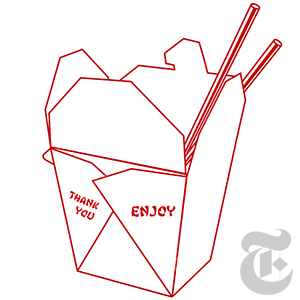
An oyster pail is a folded, waxed, paper food container commonly used by American Chinese restaurants, traditionally with a handle made of solid wire (microwave-safe plastic handles are also available). In the US oyster pails are now available in standard sizes and can also serve as self-measuring containers, so that many take-out foods are sold in pints and quarts and packed into pails of the appropriate size. They can also be found in some European countries such as Germany and England, but are rarely seen in China. The container has the advantage of being inexpensive, durable, and fairly leakproof, as long as it is kept upright. The top usually includes a locking paperboard tab. The simple origami-like folded construction also allows for some escape of steam from hot food. If the sides are unfolded, the pail can also double as a makeshift plate, but it is more common to eat directly out of the container, a feat that the long reach of chopsticks makes possible.
The paperboard oyster pail was invented in the US around 1894, at a time when fresh oysters were more popular, more plentiful, and less expensive than they are at present. Since shucking oysters (removing the raw meat from the shell) can be difficult and dangerous, it was common to ask the oyster seller open them. The oyster pail provided an inexpensive and sanitary way to bring home shucked oysters. In the early 20th century oyster pails were also used to hold honey. In the mid-20th century, overfishing (and the subsequent rise in price) of oysters left manufacturers with a significant number of unsold oyster pails. However, in the US after World War II, there was a huge increase in sales of prepared foods that could be purchased from restaurants, and heated or finished at home. Chinese food proved to be a popular choice, since it was relatively inexpensive and traveled well. The oyster pail was quickly adopted for ‘Chinese takeout.’
Posted in Food, World |
Leave a Comment »
December 12, 2014

Knocking on wood, or to touch wood, refers to the apotropaic tradition (a ritual intended to ward off evil) of literally touching, tapping, or knocking on wood, or merely stating that you are doing or intend same, in order to avoid ‘tempting fate’ after making a favorable observation, a boast, or declaration concerning one’s own death or other situation beyond one’s control. The origin of this may be in Germanic folklore, wherein dryads (forest spirits) are thought to live in trees, and can be invoked for protection.
In Italy, ‘tocca ferro’ (‘touch iron’) is used, especially after seeing an undertaker or something related to death. In Iran, ‘bezan be takhteh’ (‘knock on the wood’) is said. The ‘evil eye,’ and being jinxed are common phobias and superstitions in Iranian culture. In old English folklore, ‘knocking on wood’ also referred to when people spoke of secrets – they went into the isolated woods to talk privately and ‘knocked’ on the trees when they were talking to hide their communication from evil spirits who would be unable to hear when they knocked. Another version holds that the act of knocking was to perk up the spirits to make them work in the requester’s favor. Yet another version holds that a sect of Monks who wore large wooden crosses around their necks would tap or ‘knock’ on them to ward away evil.
Posted in Language, Philosophy, World |
Leave a Comment »
December 11, 2014
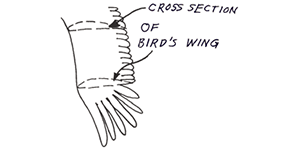
Biomimicry [bahy-oh-mim-ik-ree] is the imitation of biological systems in human technology. Living organisms have evolved well-adapted structures and materials over geological time through natural selection. Nature has solved engineering problems such as self-healing, environmental exposure tolerance, hydrophobicity (waterproofing), self-assembly, and harnessing solar energy.
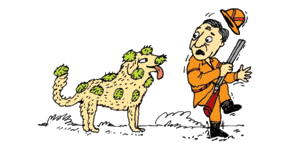
One of the early examples of biomimicry was the study of birds to enable human flight. Although never successful in creating a ‘flying machine,’ Leonardo da Vinci (1452–1519) was a keen observer of the anatomy and flight of birds, and made numerous notes and sketches on his observations as well as designs of rudimentary ornithopters based on bats. The Wright Brothers, who succeeded in flying the first heavier-than-air aircraft in 1903, derived inspiration from observations of pigeons in flight. Their airfoil was based on a design by German ‘Glider King’ Otto Lilienthal who published ‘Birdflight as the Basis of Aviation.’ Velcro, another famous example, was inspired by the tiny hooks found on the surface of burs.
read more »
Posted in Science, Technology |
Leave a Comment »
December 10, 2014
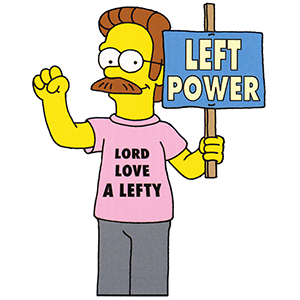
Handedness [han-did-nis] is a better (faster or more precise) performance or individual preference for use of a hand. It is not a discrete variable (right or left), but a continuous one that can be expressed at levels between strong left and strong right. While in an ordinary disclosure the terms left and right are used to define handedness, there are actually four types: left-handedness, right-handedness, mixed-handedness (favoring one hand for some tasks and the other hand for others), and ambidexterity (equally adept with both hands). Left-handedness is somewhat more common among men.
Global studies indicate that 10% of people are left-handed, 30% are mixed-handed, and the remainder are right-handed. Ambidexterity is exceptionally rare, although it can be learned. However, a truly ambidextrous person is able to do any task equally well with either hand, whereas those who learn it still tend to favor their originally dominant hand. Ambilevous or ambisinister people demonstrate awkwardness with both hands. Parkinson’s disease in particular is associated with a loss of dexterity.
read more »
Posted in Health, Language, Science |
Leave a Comment »
December 9, 2014

Lumpers and splitters are opposing factions in any discipline which has to place individual examples into rigorously defined categories. The lumper-splitter problem occurs when there is the need to create classifications and assign examples to them, for example schools of literature, biological taxa and so on. ‘Lumpers’ take a gestalt view (looking at the whole rather than the parts) and assign examples broadly, assuming that differences are not as important as signature similarities. ‘Splitters’ prefer precise definitions, and create new categories to classify things that don’t fit perfectly within an existing group.
The earliest use of these terms was by Charles Darwin, in a letter to botanist J. D. Hooker in 1857: ‘Those who make many species are the ‘splitters,’ and those who make few are the ‘lumpers.’ They were introduced more widely by paleontologist George G. Simpson in his 1945 work ‘The Principles of Classification and a Classification of Mammals.’ As he put it, ‘splitters make very small units – their critics say that if they can tell two animals apart, they place them in different genera … and if they cannot tell them apart, they place them in different species. … Lumpers make large units – their critics say that if a carnivore is neither a dog nor a bear, they call it a cat.’
read more »
Posted in Language, Philosophy, Science |
Leave a Comment »
December 9, 2014
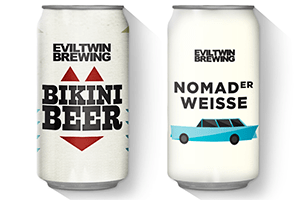
A gypsy brewery is a beer company that does not have its own equipment or premises; it operates on a temporary or itinerant basis out of the facilities of another brewery, generally making ‘one-off’ special occasion beers. The term may refer to the brewmaster, or to the brand of beer. The trend of gypsy brewing spread early in Scandinavia. Their beers, and collaborations later spread to America and Australia.
Gypsy brewers typically use facilities of larger makers with excess capacity. Often, their beers are made with herbs, spices, and fruits, use experimental styles, are high in alcohol, or are aged in old wine or liquor barrels. Prominent examples include Pretty Things, Stillwater Artisanal Ales, Mikkeller and Evil Twin.
Posted in Drugs, Food, Money |
Leave a Comment »
December 8, 2014
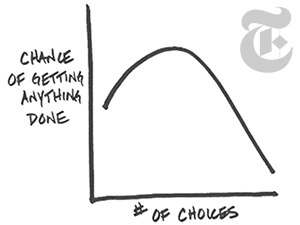
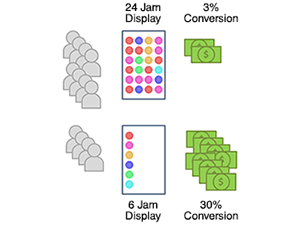
Overchoice, also referred to as ‘choice overload,’ is a term describing a problem facing consumers in the postindustrial society: too many choices. The term was first introduced by futurist Alvin Toffler in his 1970 book, ‘Future Shock.’ Overchoice is the result of technological progress. Since the beginning of the Industrial Revolution, each year, more and more products are being offered. Consumers have more disposable income to spend, and producers can more easily and cheaply introduce product variations.
Having more choices, on the surface, appears to be a positive development; however it hides an underlying problem: faced with too many choices, consumers have trouble making optimal choices, and thus as a result can be indecisive. When confronted with a plethora of choices without perfect information, many people prefer to make no choice at all, even if making a choice would lead to a better outcome. Toffler noted that as the choice turns to overchoice, ‘freedom of more choices’ ironically becomes the opposite—the ‘unfreedom.’
read more »
Posted in Education, Money |
Leave a Comment »
December 7, 2014

Behavioral economics is a smaller part of economics that combines what we know about psychology with what we know about economics. Normally, economics does not consider the way humans actually think, but instead, abstracts complex decision-making into comparatively simple mathematical models.
Normally, economists assume people are rational, meaning they make good decisions at the right times using all information. In reality, people are subject to problems with self-control, limitations of time and physical resources, and make different choices depending on how decisions are presented to them.
read more »
Posted in Money, Science |
Leave a Comment »
December 7, 2014


Naïve diversification is a ‘choice heuristic,’ a mental shortcut used to simplify decisions, first demonstrated by professor of marketing Itamar Simonson in the context of consumption decisions by individuals. It was subsequently shown in the context of economic and financial decisions.
Simonson showed that when people have to make a simultaneous choice (e.g. choose now which of six snacks to consume in the next three weeks), they tend to seek more variety (e.g., pick more kinds of snacks) than when they make sequential choices (e.g., choose once a week which of six snacks to consume that week for three weeks).
read more »
Posted in Money, Science |
Leave a Comment »
December 6, 2014

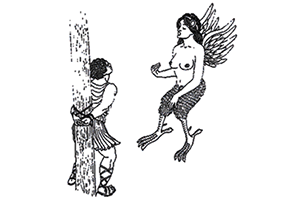
In economics, dynamic inconsistency, or time inconsistency, describes the situation: A decision-maker’s preferences change over time, in such a way that a preference, at one point in time, is inconsistent with a preference at another point in time. It is often easiest to think about preferences over time in this context by thinking of decision-makers as being made up of many different ‘selves,’ with each self representing the decision-maker at a different point in time. So, for example, there is my today self, my tomorrow self, my next Tuesday self, my year from now self, etc. The inconsistency will occur when somehow the preferences of some of the selves are not aligned with each other.
In the context of behavioral economics, time inconsistency is related to how each different self of a decision-maker may have different preferences over current and future choices. One common way in which selves may differ in their preferences is they may be modeled as all holding the view that now has especially high value compared to any future time. This is sometimes called the ‘immediacy effect’ or ‘temporal discounting.’ As a result the present self will care too much about herself and not enough about her future selves. Self control literature relies heavily on this type of time inconsistency, and it relates to a variety of topics including procrastination, addiction, efforts at weight loss, and saving for retirement.
read more »
Posted in Games, Money, Politics |
Leave a Comment »
December 5, 2014
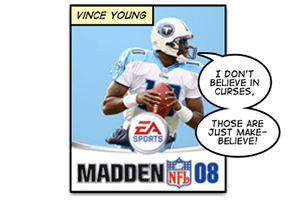

Regression toward the mean simply says that, following an extreme random event, the next random event is likely to be less extreme. In no sense does the future event ‘compensate for’ or ‘even out’ the previous event, though this is assumed in the gambler’s fallacy. Regression toward the mean was first described by Victorian polymath Francis Galton. He found that offspring of tall parents tended to be shorter. Also, offspring of shorter parents tended to be taller. Galton stated that processes that did not follow regression towards the mean would quickly go out of control. In finance, the term ‘mean reversion’ has a different meaning. Jeremy Siegel at Wharton uses it to describe a financial time series in which ‘returns can be very unstable in the short run but very stable in the long run,’ in seasonal businesses for example.
The effect can be exploited for general inference and estimation: the hottest place in the country today is more likely to be cooler tomorrow than hotter, as compared to today; the best performing mutual fund over the last three years is more likely to see relative performance decline than improve over the next three years; the most successful Hollywood actor of this year is likely to have less gross than more gross for his or her next movie; the baseball player with the greatest batting average by the All-Star break is more likely to have a lower average than a higher average over the second half of the season, etc.
read more »
Posted in Games, Money, Science |
Leave a Comment »



