May 3, 2011

The Yellow Kid emerged as the lead character in ‘Hogan’s Alley,’ a comic first drawn by Richard F. Outcault in 1894, which became one of the first Sunday supplement comic strips in an American newspaper. The Yellow Kid was a bald, snaggle-toothed boy who wore a yellow nightshirt and hung around in a ghetto alley filled with equally odd characters, mostly other children.
With a goofy grin, the Kid habitually spoke in a ragged, peculiar ghetto argot printed on his shirt, a device meant to lampoon advertising billboards. His head was drawn wholly shaved as if having been recently ridden of lice, a common sight among children in New York’s tenement ghettos at the time. His nightshirt, a hand-me-down from an older sister, was white or pale blue in the first color strips.
read more »
Posted in Art, Humor, Money |
Leave a Comment »
May 3, 2011
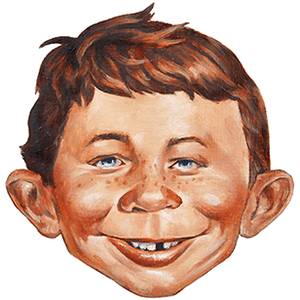
Alfred E. Neuman is the fictional mascot and iconic cover boy of Mad magazine. The face had drifted through American pictography for decades before being claimed and named by Mad editor Harvey Kurtzman. Since his debut in Mad, Neuman’s likeness, distinguished by jug ears, a missing front tooth, and one eye lower than the other has graced the cover of all but a handful of the magazine’s 500 issues. His face is rarely seen in profile; he has virtually always been shown in full frontal view, directly from behind, or in silhouette.
Harvey Kurtzman first spotted the image on a postcard pinned to the office bulletin board of Ballantine Books editor Bernard Shir-Cliff. ‘It was a face that didn’t have a care in the world, except mischief,’ recalled Kurtzman.
read more »
Posted in Art, Humor |
Leave a Comment »
May 3, 2011

The Stay Puft Marshmallow Man is a fictional mascot from the Ghostbusters franchise of media, which sometimes appears as a giant, lumbering paranormal monster.
It first appears in the 1984 film Ghostbusters as a picture logo on a prop package of marshmallows in Dana Barrett’s apartment when she places the groceries on her kitchen counter, on a graffiti advertisement on the building next to the Ghostbuster’s HQ when the ghosts are released from the containment grid after the power is shut down, then later in the climax of the film.
read more »
Posted in Art, Humor |
Leave a Comment »
May 2, 2011


The final girl is a thriller and horror film (particularly slasher film) trope that specifically refers to the last woman or girl alive to confront the killer, ostensibly the one left to tell the story. The final girl has been observed in dozens of films, including Halloween, Friday the 13th, A Nightmare on Elm Street, The Texas Chain Saw Massacre, Alien and Scream. The term was coined by American professor of film studies, Carol J. Clover, who argues that in these films, the viewer begins by sharing the perspective of the killer, but experiences a shift in identification to the final girl partway through the film.
According to Clover, the final girl is typically sexually unavailable or virginal, avoiding the vices of the victims (sex, narcotic usage, etc.). She sometimes has a unisex name (e.g., Teddy, Billie, Georgie, Sidney). Occasionally the Final Girl will have a shared history with the killer. The final girl is the ‘investigating consciousness’ of the film, moving the narrative forward and as such, she exhibits intelligence, curiosity, and vigilance. One of the basic premises of Clover’s theory is that audience identification is unstable and fluid across gender lines, particularly in the case of the slasher film. During the final girl’s confrontation with the killer, Clover argues, she becomes masculinized through ‘phallic appropriation’ by taking up a weapon, such as a knife or chainsaw, against the killer.
Posted in Art, Death, Sex |
1 Comment »
April 29, 2011

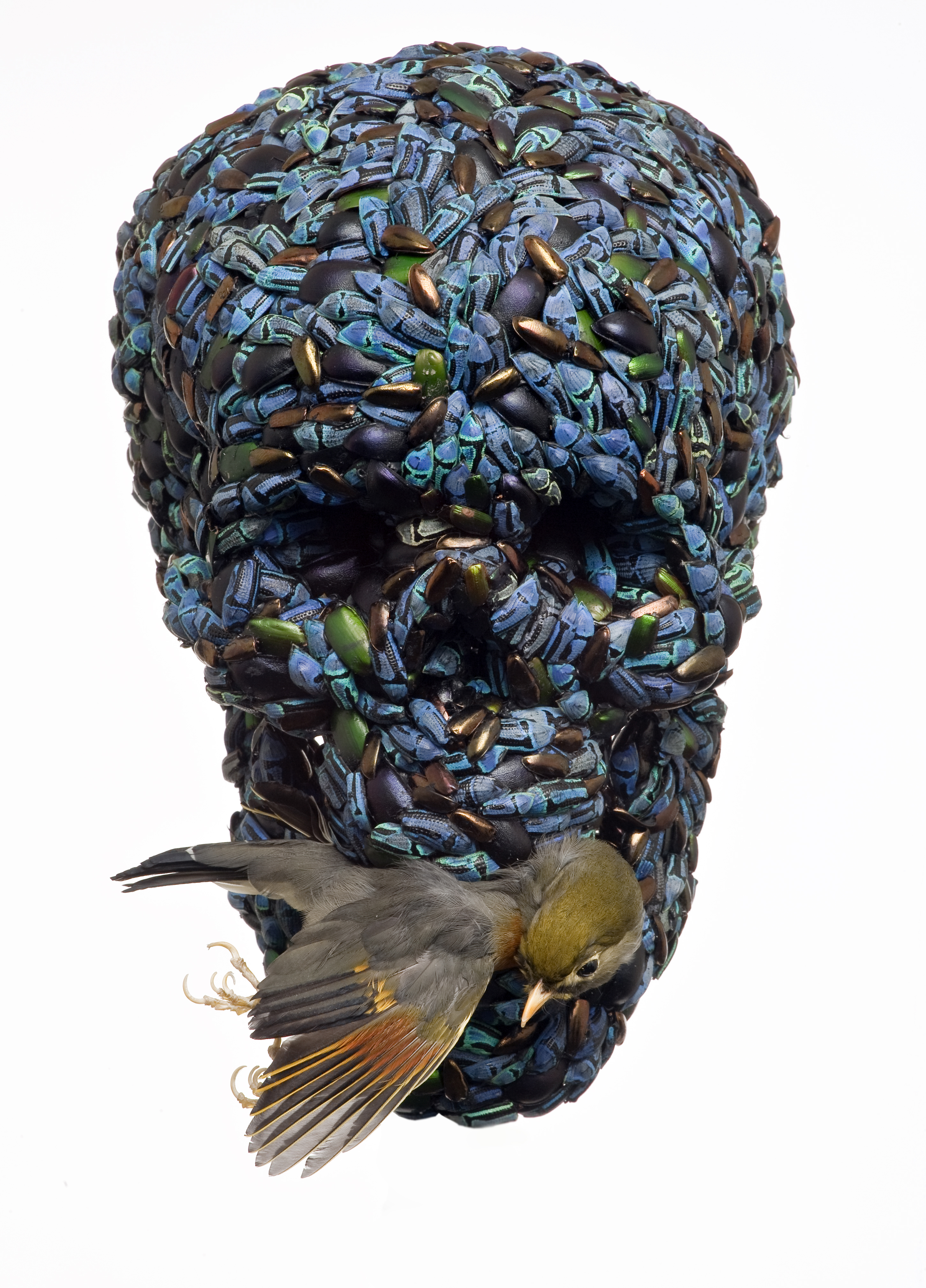
Jan Fabre [fah-ber] (b. 1958) is a Belgian multidisciplinary artist, playwright, stage director, choreographer and designer. Fabre is famous for his Bic-art (ballpoint drawings). In 1990, he covered an entire building with ballpoint drawings.
His decoration of the ceiling of the Royal Palace in Brussels ‘Heaven of Delight’ (made out of one million six hundred thousand jewel-scarab wing cases) is widely praised. In 2004 he erected Totem, a giant bug stuck on a 70 foot steel needle in Leuven, Belgium.
Posted in Art |
2 Comments »
April 28, 2011

A leisure suit is a casual suit consisting of a shirt-like jacket and matching trousers, often associated with American-influenced fashion and fads of the 1970s.
Suits as casual wear became popular among members of Britain’s mod subculture in the 1960s, but only achieved widespread popularity in the United States when—with the creation and popularization of synthetic materials—unprecedented cheapness met with a culture that had come to hate formality.
read more »
Posted in Art, Humor, Money |
2 Comments »
April 27, 2011

Proun is a freeware racing game in a world of geometric objects and large colored surfaces. You avoid obstacles by rotating around a cable in order to gain as much speed as possible. There is no up or down; there is only the cable to which you are attached. The game was developed by Amsterdam-based, Joost van Dongen.
Posted in Art, Games, Technology |
Leave a Comment »
April 27, 2011

The Art of the Motorcycle was an exhibition that presented 114 motorcycles chosen for their historic importance or design excellence in a display designed by Frank Gehry in the curved rotunda of the Frank Lloyd Wright-designed Solomon R. Guggenheim Museum in New York City, running for three months in late 1998.
read more »
Posted in Art, Money, Technology |
Leave a Comment »
April 26, 2011

Music Under New York (MUNY) is part of the New York Metropolitan Transportation Authority’s ‘Arts for Transit Office’ that increases the attractiveness of transit facilities for customers.
At present more than 350 individual performers and music ensembles participate in over 7,000 annual performances in approximately 25 locations throughout the transit system.
read more »
Posted in Art, Money |
1 Comment »
April 26, 2011
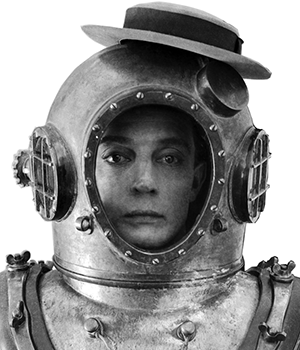
Deadpan is a form of comic delivery in which humor is presented without a change in emotion or body language, usually speaking in a casual, monotone, solemn, blunt, disgusted or matter-of-fact voice and expressing an unflappably calm, archly insincere or artificially grave demeanor.
This delivery is also called dry wit when the intent, but not the presentation, is humorous, oblique, sarcastic, or apparently unintentional. The term ‘deadpan’ first emerged as an adjective or adverb in the 1920s, as a compound word (‘pan’ was a slang term for ‘face’).
read more »
Posted in Art, Humor, Language |
Leave a Comment »
April 25, 2011

The magic lantern or Laterna Magica is an early type of image projector developed in the 17th century. It has a concave mirror in front of a light source that gathers light and projects it through a slide with an image printed on it.
The lens throws an enlarged picture of the original image from the slide onto a screen. The main light sources used during the time it was invented were candles or oil lamps. These light sources were quite inefficient and produced weak projections.
read more »
Posted in Art, Technology |
Leave a Comment »
April 25, 2011
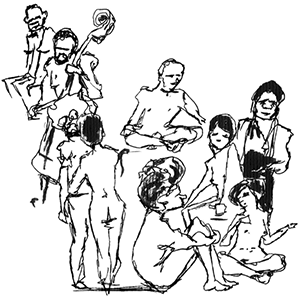
Tableau [ta-bloh] vivant [vee-vahn] (French for ‘living picture’) is a group of suitably costumed actors or artist’s models, carefully posed and often theatrically lit. Throughout the duration of the display, the people shown do not speak or move. The approach thus marries the art forms of the stage with those of painting/photography, and as such it has been of interest to modern photographers.
In the 19th century, virtually nude tableaux vivants or ‘poses plastiques’ provided a form of erotic entertainment.
read more »
Posted in Art, Sex |
Leave a Comment »






 The Daily Omnivore