April 11, 2011


A macaroni [mak-uh-roh-nee] in mid-18th century England, was a fashionable fellow who dressed and spoke in an outlandishly affected and effeminate manner.
The term pejoratively referred to a man who ‘exceeded the ordinary bounds of fashion’ in terms of clothes, fastidious eating and gambling.
read more »
Posted in Art, Humor, Language |
Leave a Comment »
April 11, 2011

Amigurumi [ah-mee-goo-roo-mee] is the Japanese art of knitting or crocheting small stuffed animals and anthropomorphic creatures. The word is derived from a combination of the Japanese words ‘ami,’ meaning crocheted or knitted, and ‘nuigurumi,’ meaning stuffed doll. The pervading aesthetic of amigurumi is cuteness. To this end, typical amigurumi animals have an over-sized spherical head on a cylindrical body with undersized extremities.
Amigurumi are usually crocheted out of yarn using the single crochet stitch. They can also be knit. Typically, crochet hooks or knitting needles that are slightly smaller than normal are used, in order to achieve a tight gauge that retains stuffing. Stuffing is usually standard polyester or cotton craft stuffing, but may be improvised from other materials. Plastic pellets may be inserted beneath stuffing in order to distribute weight at the bottom of the figure. They are usually worked in sections and then joined, except for some amigurumi which have no limbs, only a head and torso which are worked as one piece.
Posted in Art, Games, World |
2 Comments »
April 11, 2011
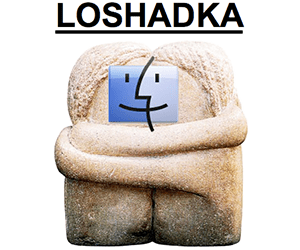

An internet Surf Club is a group site (usually a blog) where artists and others link to ‘surfed’ or ‘surfable’ items on the Web and also post some of their own creative work. ‘Nasty Nets Internet Surfing Club’ was the first to use the words ‘surfing club’ (ironically) and others followed the form or adopted the word ‘club’ to sound relevant. The original clubs were never true clubs but there has been much rancor over the issue of invited membership in the supposedly open and democratic web that still exists outside Facebook-like commercial enclaves.
Dump.fm is a real-time image sharing website that has many aspects of a surf club; however, anyone can sign up for Dump. The core surf clubs (Nasty, Double Happiness, Loshadka) are barely active now—their heyday was 2006-2009, which could be called the ‘surf club era.’ Arguably the widely-used, configurable tumblr, and other a microblogging platforms have made surf clubs obsolete.
Posted in Art, Humor, Technology |
Leave a Comment »
April 8, 2011
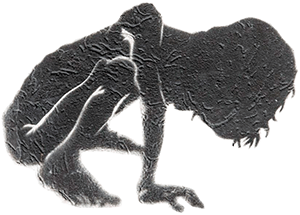

Kevin Carter (1960 – 1994) was an award-winning South African photojournalist and member of the ‘Bang-Bang Club,’ a collective of war photojournalists that also included Greg Marinovich, Ken Oosterbroek, and Joao Silva.
read more »
Posted in Art, Politics, War |
Leave a Comment »
April 8, 2011

Nardwuar the Human Serviette (b. 1968), is a Canadian celebrity interviewer and musician from Vancouver. He is the lead singer and keyboardist for ‘The Evaporators’ and plays in ‘Thee Goblins.’ He legally changed his name from John Ruski in 1986.
Nardwuar got his start in media at the University of British Columbia radio station CITR 101.9 FM in Vancouver. His show has been running every Friday afternoon (3:30-5:00 p.m. Pacific) since October 1987. The program features a mix of eclectic music, along with interviews and commentary.
read more »
Posted in Art, Humor |
1 Comment »
April 8, 2011


Tyler, the Creator (b. 1991) is an American rapper and record producer from Los Angeles, California. He is the leader of the hip hop collective OFWGKTA. He has rapped on, and produced for, nearly every OFWGKTA release.
Posted in Art, Money |
Leave a Comment »
April 7, 2011

The Criterion Collection is a video-distribution company selling ‘important classic and contemporary films’ to cinema aficionados founded in 1984. Criterion Collection releases were the first to provide several features that have become standard.
The 1984 Criterion Laserdisc release of King Kong included the world’s first optional commentary audio track. The Criterion series is noted for helping to standardize the letterbox ratio, bonus features, and special editions. They are also known for taking great lengths to restore and clean all movies released on their label.
read more »
Posted in Art, Money |
Leave a Comment »
April 7, 2011

Odd Future Wolf Gang Kill Them All, often abbreviated OFWGKTA or Odd Future, are a hip hop collective from Los Angeles, California. They have released three mixtapes and nine studio albums, all available for free on their website. Rapper/producer Tyler the Creator is the de facto leader of Odd Future. Other members include rappers Hodgy Beats, Earl Sweatshirt, Domo Genesis, Mike G, singer Frank Ocean, producers Left Brain, Syd Bennett, Matt Martians, Hal Williams and Jasper Dolphin.
As of February 2011, their ages range from 16 to 23 years old. There are three groups inside the collective: MellowHype, The Jet Age of Tomorrow and EarlWolf. MellowHype consists of rapper Hodgy Beats and producer Left Brain, The Jet Age of Tomorrow consists of producers Matt Martians and Hal Williams and EarlWolf consists of Tyler, the Creator and Earl Sweatshirt.
Posted in Art |
Leave a Comment »
April 7, 2011
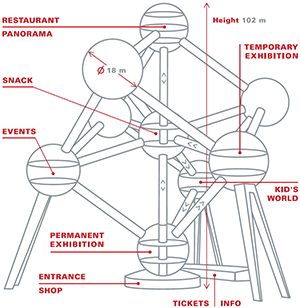
The Atomium is a monument in Brussels, originally built for Expo ’58, the 1958 Brussels World’s Fair. Designed by Belgian engineer, André Waterkeyn, it stands 102-metres (335 ft) tall. It has nine steel spheres connected so that the whole forms the shape of a unit cell of an iron crystal magnified 165 billion times. Tubes connect the spheres along the 12 edges of the cube and all eight vertices to the center. They enclose escalators connecting the spheres containing exhibit halls and other public spaces. The top sphere provides a panoramic view of Brussels. Each sphere is 18 meters in diameter.
Three of the four uppermost spheres lack vertical support and hence are not open to the public for safety reasons, although the sphere at the pinnacle is open to the public. The original design called for no supports; the structure was simply to rest on the spheres. Wind tunnel tests proved that the structure would have toppled in an 80 km/h wind. Support columns were added to achieve enough resistance against overturning.
Posted in Art, Technology, World |
1 Comment »
April 7, 2011

The blue hour comes from the French expression l’heure bleue, which refers to the period of twilight each morning and evening where there is neither full daylight nor complete darkness. The time is considered special because of the quality of the light at this time of day. The phrase is also used to refer to Paris immediately prior to World War I, which was considered to be a time of relative innocence.
In English culture the term was used to describe the period of inactivity and uselessness a drinker encounters when Pubs and other licensed premises have closed after the lunch-time session (typically 15:30 hrs) and will not open for the evening session until (typically 18:30 hrs).
Posted in Art, Drugs, Language |
Leave a Comment »
April 7, 2011
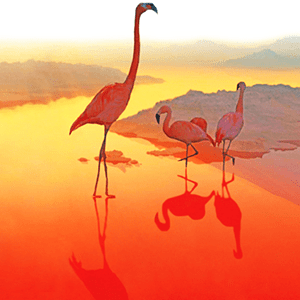
In photography and cinematography, the golden or magic hour, is the first and last hour of sunlight during the day, when a specific photographic effect is achieved due to the quality of the light. Typically, lighting is softer (more diffuse) and warmer in hue. When the Sun is near the horizon, sunlight travels through more of the atmosphere, reducing the intensity of the direct light, so that more of the illumination comes from indirect light from the sky.
More blue light is scattered, so that light from the Sun appears more reddish. In addition, the Sun’s small angle with the horizon produces longer shadows. In the middle of the day, the bright overhead Sun can create too-bright highlights and dark shadows. Because the contrast is less during the golden hour, shadows are less dark, and highlights are less likely to be overexposed.
Posted in Art, Language, Science |
Leave a Comment »
April 7, 2011

Martini Shot is a Hollywood term that describes the final shot set-up of the day, so named because ‘the next shot is out of a glass,’ referring to a post-wrap drink.
Posted in Art, Drugs, Humor |
Leave a Comment »