April 7, 2011

The Aurora Clock has been in production for over 40 years. There are continuously changing colors and surprising color ‘shifts’ when the secondhand disk overlaps the minute & hour hands, and the colors change depending on your viewing angle. The color changes have to do with polarized light and a phenomenon called bi-refractance. Vectors of light are being rotated as they pass through each material which is very different from color filtering.
The first Aurora clocks were made by Rathcon and called the Spectrum. Then they were manufactured by Kirsch-Hamilton. Next, in the late 80’s, Hampton Haddon had a version made in Japan, but abandoned the clock around 1991. In 1993 we at ChronoArt started manufacturing Luminas (a different polarized light clock) and then a year later started also manufacturing new Auroras.
Posted in Art, Technology |
Leave a Comment »
April 7, 2011
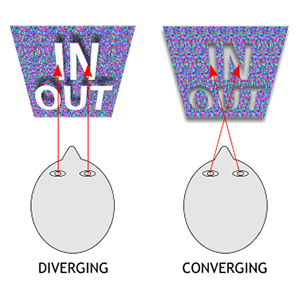
An autostereogram [aw-toh-ster-ee-uh-gram] is a stereogram (an optical illusion of depth created from flat images), designed to create the visual illusion of a three-dimensional scene from a two-dimensional image in the human brain.
In order to perceive 3D shapes in these autostereograms, the brain must overcome the normally automatic coordination between focusing and vergence (the simultaneous movement of both eyes in opposite directions to obtain or maintain single binocular vision).
read more »
Posted in Art, Games, Technology |
Leave a Comment »
April 7, 2011
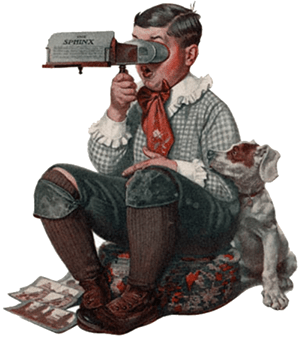
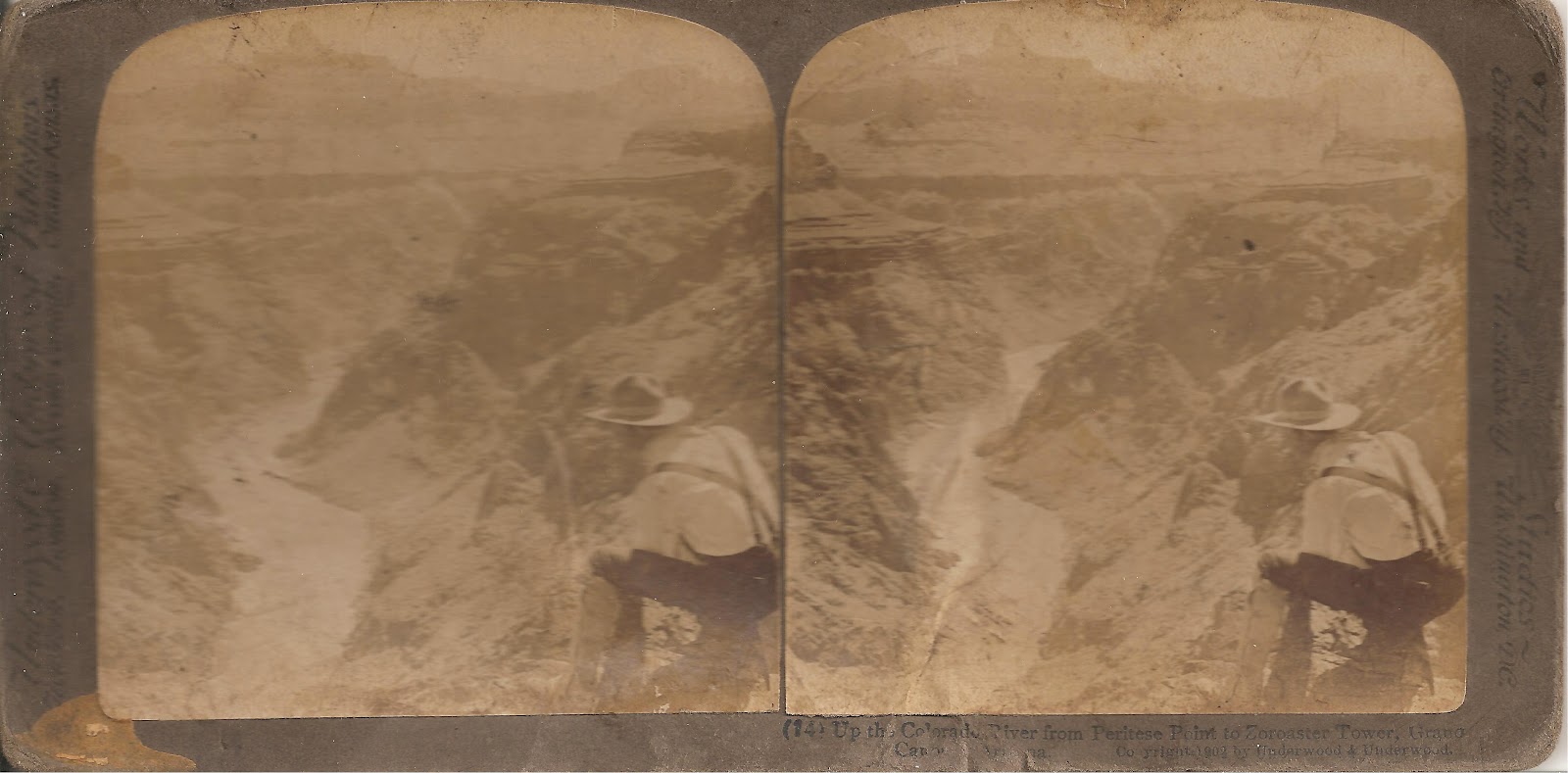
A stereogram [ster-ee-uh-gram] is an optical illusion of depth created from flat, two-dimensional image or images. Originally, the term referred to a pair of stereo images which could be viewed using a stereoscope. Other types of stereograms include anaglyphs and autostereograms. The stereogram was discovered by Victorian scientist, Charles Wheatstone in 1838. He found an explanation of binocular vision which led him to construct a stereoscope based on a combination of prisms and mirrors to allow a person to see 3D images from two 2D pictures. A stereoscope presents 2D images of the same object from slightly different angles to the left eye and the right eye, allowing the brain to reconstruct the original object via binocular disparity.
Oliver Wendell Holmes, Sr. invented an improved form of stereoscope in 1861, which had no mirrors and was inexpensive to produce. These stereoscopes were immensely popular for decades. Salvador Dalí created some impressive stereograms in his exploration in a variety of optical illusions. Stereograms were re-popularized by the creation of autostereograms on computers, wherein a 3D image is hidden in a single 2D image, until the viewer focuses their eyes correctly. The Magic Eye series is a popular example of this. Magic Eye books refer to autostereograms as stereograms, leading most people to believe that the word stereogram is synonymous with autostereogram.
Posted in Art, Technology |
Leave a Comment »
April 6, 2011


A baseball cap is a type of hat with a long, stiff brim, that is a part of the traditional baseball uniform worn by players, with the brim pointing forward to shield the eyes from the sun.
In 1860, the Brooklyn Excelsiors wore the ancestor of the modern rounded-top baseball cap, and by 1900, the ‘Brooklyn style’ cap became popular. During the 1940s, latex rubber became the stiffening material inside the hat and the modern baseball cap was born. The ‘bill’ or ‘brim’ was designed to protect a player’s eyes from the sun. Typically, the brim was much shorter in the earlier days of the baseball hat. Also, the hat has become more structured, versus the overall ‘floppy’ cap of the 19th and early 20th centuries.
read more »
Posted in Art, Games, War |
Leave a Comment »
April 6, 2011

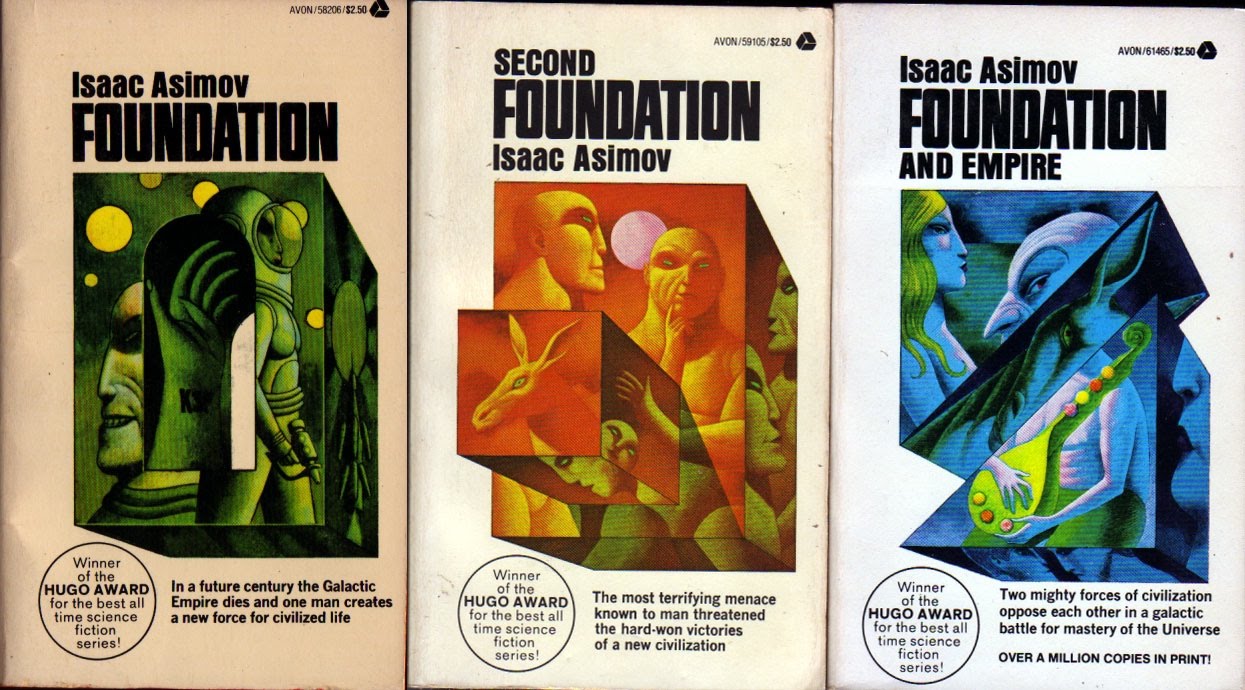
Foundation is the first book in Isaac Asimov’s Foundation Trilogy (and later Foundation Series). Foundation is a collection of five short stories, which were first published together as a book in 1951. It also appeared in 1955 under the title ‘The 1,000-Year Plan.’ The novel tells the story of a group of scientists who seek to preserve knowledge as the civilizations around them begin to regress. The first story is set on Trantor, the capital planet of the 12,000-year-old Galactic Empire. Whilst the empire gives the appearance of stability, beneath this façade it is suffering a slow decay. Hari Seldon, a mathematician, has developed ‘psychohistory,’ which equates all possibilities in large societies to mathematics, allowing predictable long term outcomes.
Seldon discovers a horrifying truth to the Empire’s decay, but his results are considered treasonable. On trial, Seldon shares the discoveries made through psychohistory, such as the collapse of the Empire within 500 years, followed by a 30,000-year period of barbarism. Seldon proposes an alternative to this future; one that would not avert the collapse but shorten the interregnum period to a mere 1000 years. But this plan would require a large group of people to develop a compendium of all human knowledge, titled the Encyclopedia Galactica. A still skeptical commission, not wanting to make a martyr of Seldon, exile him and his group of ‘Encyclopedists’ to a remote planet Terminus. There, they will carry out the Plan under an imperial decree, while Seldon would remain barred from returning to Trantor.
Posted in Art, Language, Technology |
Leave a Comment »
April 6, 2011

Isaac Asimov (b. 1920 – 1992) was an American author and professor of biochemistry at Boston University, best known for his works of science fiction and for his popular science books. Asimov was one of the most prolific writers of all time, having written or edited more than 500 books. His works have been published in nine of the ten major categories of the Dewey Decimal System (The sole exception being the 100s: philosophy and psychology). Isaac Asimov is widely considered a master of hard science fiction and, along with Robert A. Heinlein and Arthur C. Clarke, he was considered one of the ‘Big Three’ science fiction writers during his lifetime. Asimov’s most famous works are the ‘Foundation’ and ‘Robot’ series.
The prolific Asimov also wrote mysteries and fantasy, as well as much non-fiction. Most of his popular science books explain scientific concepts in a historical way, going as far back as possible to a time when the science in question was at its simplest stage. He often provides nationalities, birth dates, and death dates for the scientists he mentions, as well as etymologies and pronunciation guides for technical terms. Examples include his ‘Guide to Science,’ the three volume set ‘Understanding Physics,’ ‘Asimov’s Chronology of Science and Discovery,’ as well as numerous works on astronomy, chemistry, mathematics, the Bible, and William Shakespeare’s works.
Posted in Art, Language, Science |
Leave a Comment »
April 6, 2011

Laurence Tureau, known as Mr. T (b. 1951), is an American actor known for his roles as B. A. Baracus in the 1980s television series The A-Team, as boxer Clubber Lang in the 1982 film Rocky III.
Mr. T is known for his trademark African Mandinka warrior hairstyle, his gold jewelry, and his tough-guy image. In 2006 he starred in the reality show ‘I Pity the Fool,’ shown on TV Land, the title of which comes from his catchphrase from the film Rocky III.
read more »
Posted in Art, Money |
Leave a Comment »
April 5, 2011
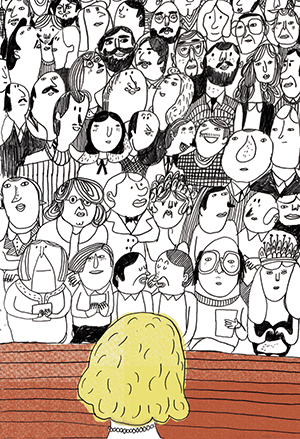
Stage fright or performance anxiety is the anxiety aroused by the requirement to perform in front of an audience, whether actually or potentially (for example, when performing before a camera). In the context of public speaking, this fear is termed glossophobia, one of the most common of phobias. Such anxiety may precede or accompany participation in any activity involving public self-presentation.
In some cases stage fright may be a part of a larger pattern of social phobia or social anxiety disorder, but many people experience stage fright without any wider problems. Quite often, stage fright arises in a mere anticipation of a performance, often a long time ahead. It has numerous manifestations: fluttering or pounding heart, tremor in the hands and legs, sweaty hands, diarrhea, facial nerve tics, dry mouth, and erectile dysfunction.
read more »
Posted in Art, Drugs, Health |
Leave a Comment »
April 5, 2011

Byron ‘Buster’ Bluth is a fictional character on the US sitcom, ‘Arrested Development.’ He is the youngest son of George Sr. and Lucille, though it is later revealed that his biological father is actually George Sr.’s identical twin brother Oscar (the two share obvious personality traits and a mutual habit for awkwardly giving people shoulder massages). Buster is portrayed by Tony Hale.
Buster is a professional student, having completed coursework in cartography, Native American tribal ceremonies, 18th century agrarian business principles, and archaeology. Archival footage indicates his participation in various university medical studies, such as sleep deprivation studies. As the baby of the family, he idolizes his brothers Gob and Michael.
read more »
Posted in Art, Humor |
Leave a Comment »
April 4, 2011


Gorillaz is a musical project created in 1998 by Damon Albarn of Blur and Jamie Hewlett, co-creator of ‘Tank Girl.’ The Gorillaz have an extensive fictional universe depicting a ‘virtual band’ of cartoon characters composed of four animated members: 2D (lead vocalist, keyboard), Murdoc Niccals (bass guitar), Noodle (guitar, keyboard, and occasional vocals) and Russel Hobbs (drums and percussion). The music is a collaboration between various musicians, Albarn being the only permanent contributor.
Their style is a composition of multiple musical genres, with a large number of influences including: dub, hip hop, alternative rock, electronic and pop music. The trio of musicians behind Gorillaz’ first incarnation included Damon Albarn, Del the Funkee Homosapien, and Dan the Automator, who had previously worked together on the track ‘Time Keeps on Slipping’ for Deltron 3030’s eponymous debut album. The song can be seen as the genesis of the musical style that continued into Gorillaz’ first album.
Posted in Art, Humor, Money |
Leave a Comment »
April 4, 2011

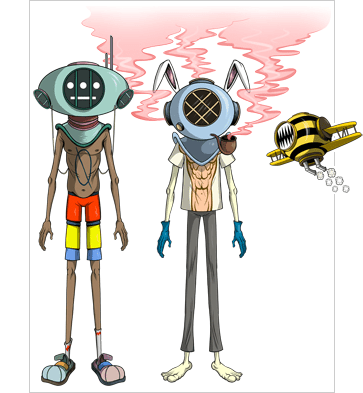
Deltron 3030 is an alternative hip hop supergroup composed of producer Dan the Automator, rapper Del tha Funkee Homosapien and DJ Kid Koala. Their work features many other artists as well, all taking on various futuristic pseudonyms. The group’s debut album Deltron 3030, released in 2000, is a concept album set in the year 3030 that tells of the fight by Deltron Zero (Del’s alter ego) against huge corporations that rule the universe.
The lyrics were written in less than two weeks and are characterized by extravagant allusions to futuristic outer-space themes in the tradition of Afrofuturist works by Sun Ra and George Clinton. Many samples originated with the contemporary French classical composer William Sheller. Del tha Funkee Homosapien’s lyrics veer from serious social commentary to humor to epic sci-fi battles, while producer Dan the Automator creates an eerie and dense atmosphere. Following the release of the album, all three members worked on the Gorillaz’ self-titled debut album. Deltron 3030’s second album will be titled Deltron Event II. Production began in 2006 and is still in progress.
Posted in Art, Money, Technology |
Leave a Comment »
April 4, 2011

Deltron 3030 is the debut album by hip hop supergroup Deltron 3030. Released in 2000, it is a rap opera concept album set in a dystopian year 3030.
The album follows Deltron Zero’s fight against an oppressive government and powerful corporations, while also battling to be the Galactic Rhyme Federation Champion. Del tha Funkee Homosapien’s lyrics veer from serious social commentary to humor to epic sci-fi battles, while producer Dan the Automator creates an eerie and dense atmosphere.
Posted in Art, Money, Technology |
Leave a Comment »