March 25, 2011
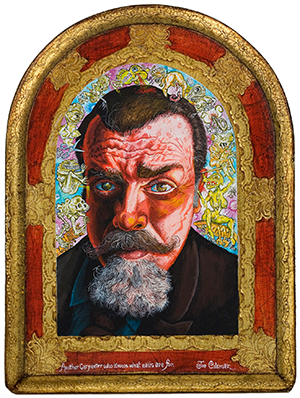
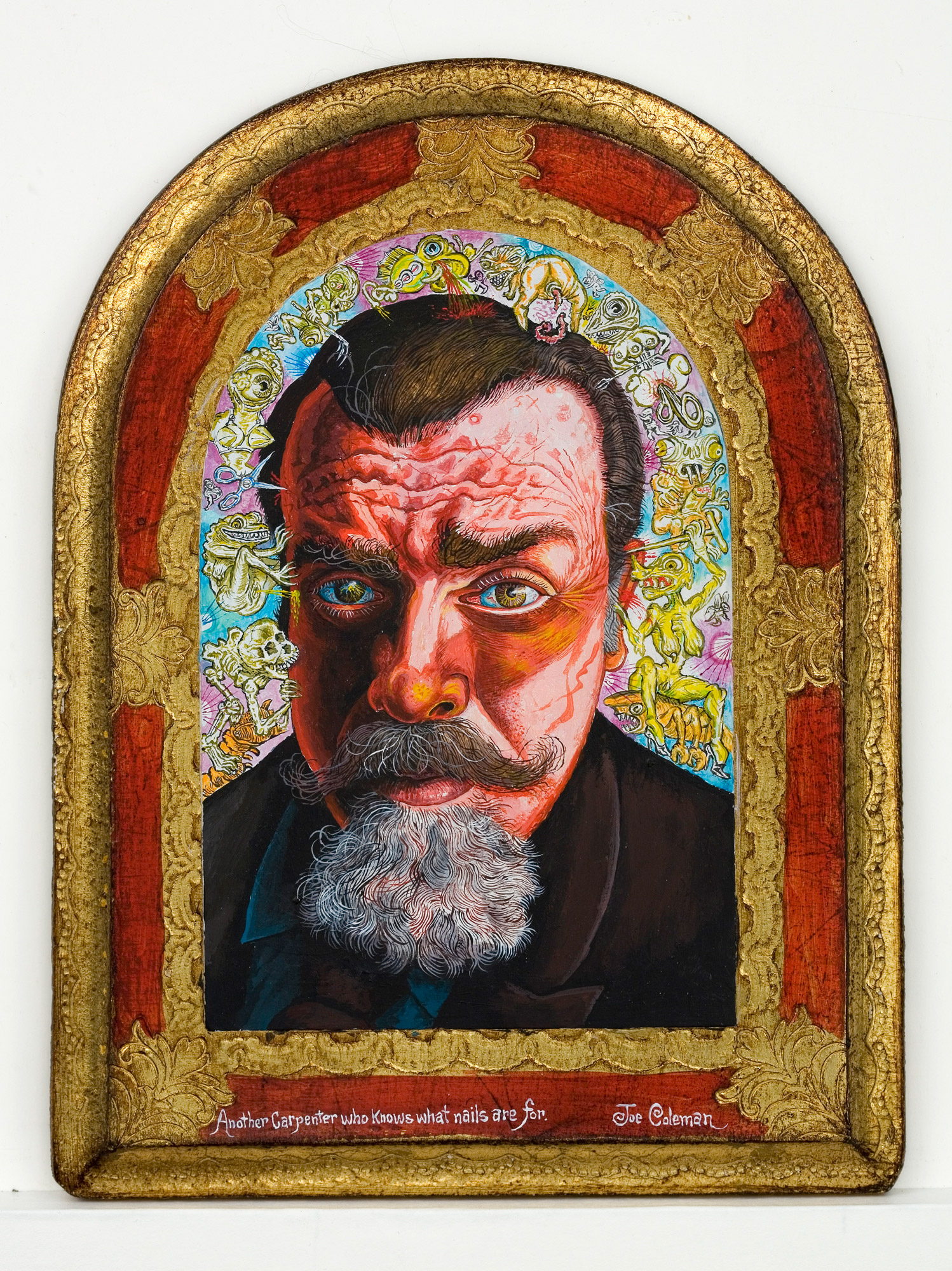
Joe Coleman (born November 22, 1955) is an American painter, illustrator and performance artist. He is best known for intricately detailed portraits of subjects both famous and infamous: artists, outlaws, serial killers, movies stars, friends, and family. He paints with a single-hair brush and uses a jewelers loupe; much of the detail is not visible to the naked eye.
The majority of his portraits portray the central subject in the center of the canvas, while biographical scenes and details from the subject’s life ring the central image. His work draws as much from Coleman’s beginnings as a comic book artist as from historical precedents. His paintings are most often compared to those of Hieronymus Bosch, and his work has been exhibited alongside canvases by the Dutch master.
Posted in Art |
Leave a Comment »
March 24, 2011
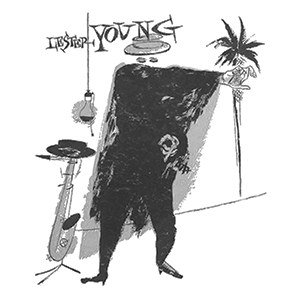
Lester Young (1909 – 1959), nicknamed ‘Prez,’ was an American jazz tenor saxophonist. He also played clarinet, trumpet, violin, and drums. Coming to prominence while a member of Count Basie’s orchestra, Young was one of the most influential players on his instrument, playing with a cool tone and using sophisticated harmonies. He invented or popularized much of the hipster ethos which came to be associated with the music. He is said to have popularized the term ‘cool’ as slang for something fashionable.
Another slang term he reputedly coined was the term ‘bread’ for money. He would ask ‘How does the bread smell?’ when asking how much a gig was going to pay. Young’s playing style influenced many other tenor saxophonists. Perhaps the most famous and successful of these were Stan Getz and Dexter Gordon, but he also influenced many in the cool movement such as Zoot Sims. Lester Young also had a direct influence on young Charlie Parker (‘Bird’), and thus the entire be-bop movement.
Posted in Art, Language, Money |
Leave a Comment »
March 24, 2011
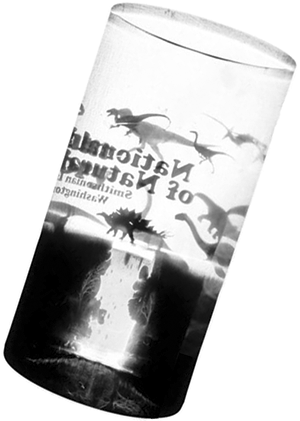
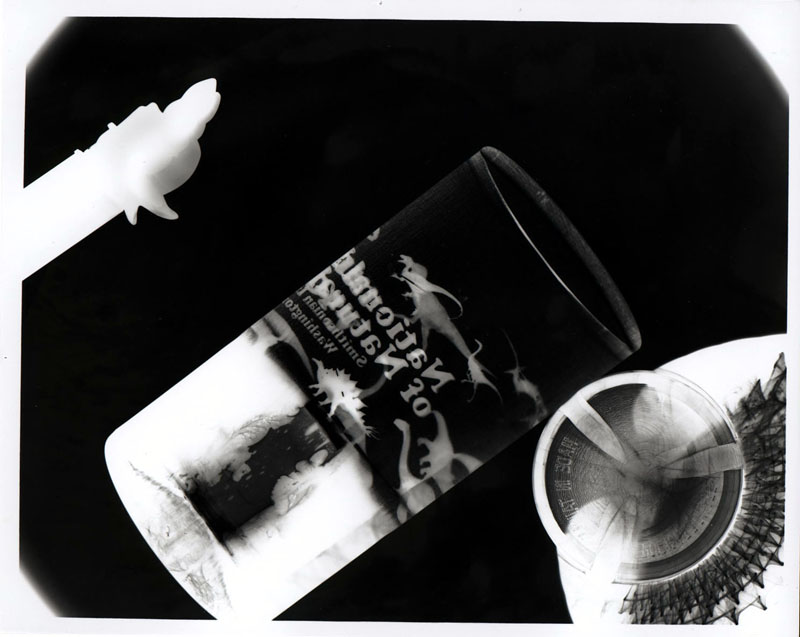
A photogram is a photographic image made without a camera by placing objects directly onto the surface of a photo-sensitive material such as photographic paper and then exposing it to light. The result is a negative shadow image varying in tone, depending on the transparency of the objects used. Areas of the paper that have received no light appear white; those exposed through transparent or semi-transparent objects appear grey.
Artistic cameraless photography, as the technique producing photograms is usually known, is perhaps most prominently associated with Man Ray and his exploration of ‘rayographs.’ Others who have experimented with the technique include László Moholy-Nagy, Christian Schad (who called them ‘Schadographs’), Imogen Cunningham and even Pablo Picasso.
Posted in Art, Technology |
Leave a Comment »
March 24, 2011
Kinetic art is art that contains moving parts or depends on motion for its effect. The moving parts are generally powered by wind, a motor or the observer. ‘Bicycle Wheel’ (1913) by Marcel Duchamp, is said to be the first kinetic sculpture. Besides being an example of kinetic art it is also an example of a readymade, a type of art of which Duchamp made a number of varieties throughout his life.
read more »
Posted in Art, Language, Money |
Leave a Comment »
March 24, 2011
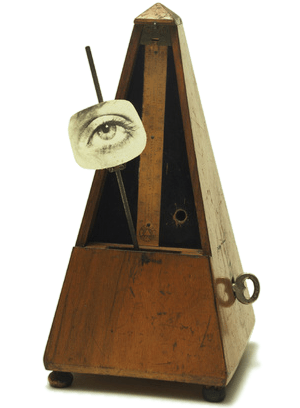
Man Ray (1890 – 1976), born Emmanuel Radnitzky, was an American artist who spent most of his career in Paris, France. Perhaps best described simply as a modernist, he was a significant contributor to both the Dada and Surrealist movements, although his ties to each were informal.
Best known in the art world for his avant-garde photography, Man Ray produced major works in a variety of media and considered himself a painter above all. He was also a renowned fashion and portrait photographer. He is noted for his photograms (images made without a camera by placing objects directly onto photographic paper, which he renamed ‘rayographs’ after himself.
read more »
Posted in Art, Money |
Leave a Comment »
March 24, 2011
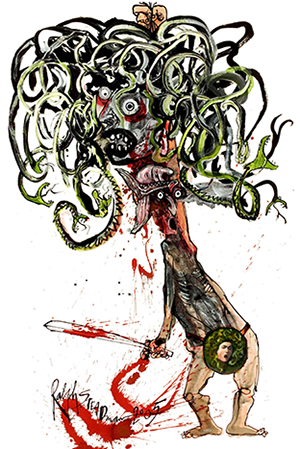
Ralph Steadman (b. 1936) is a British cartoonist and caricaturist who is perhaps best known for his work with American author Hunter S., drawing pictures for several of his articles and books. He accompanied Thompson to the Kentucky Derby for an article for ‘Scanlan’s,’ to the Honolulu Marathon for the ‘Running,’ and illustrated both ‘Fear and Loathing in Las Vegas’ and ‘Fear and Loathing on the Campaign Trail ’72.’
read more »
Posted in Art, Money |
1 Comment »
March 23, 2011

Antonin Carême [kah-rehm] (1784 – 1833), known as the ‘King of Chefs, and the Chef of Kings’ was an early practitioner and exponent of the elaborate style of cooking known as haute cuisine, the ‘high art’ of French cooking: a grandiose style of cookery favored by both international royalty and by the newly rich of Paris. Carême is often considered as one of the first, internationally renowned celebrity chefs.
He is remembered as the founder of the haute cuisine, and credited with creating the standard chef’s hat, the toque. He designed new sauces and dishes, and published a classification of all sauces into groups, based on four mother sauces. He is also frequently credited with replacing the practice of service à la française (serving all dishes at once) with service à la russe (serving each dish in the order printed on the menu).
read more »
Posted in Art, Food, Language |
Leave a Comment »
March 23, 2011
Nouvelle cuisine (‘new cuisine’) is an approach to cooking and food presentation used in French cuisine. By contrast with ‘cuisine classique,’ an older form of French ‘haute cuisine,’ nouvelle cuisine is characterized by lighter, more delicate dishes and an increased emphasis on presentation.
The modern usage can be attributed to author Henri Gault, who used it to describe the cooking of Paul Bocuse and Fernand Point. Bocuse claims that Gault first used the term to describe food prepared for the maiden flight of the Concorde airliner in 1969.
read more »
Posted in Art, Food, World |
Leave a Comment »
March 22, 2011


Kenneth Robert Howard (1929 – 1992), also known as Von Dutch, was a motorcycle mechanic, artist, pinstriper, metal fabricator, knifemaker and gunsmith. His father, Wally Howard, was a Los Angeles sign painter, and by the age of ten Kenny was able to paint and letter at a professional level. Some of his famous works include the flying eyeball and a custom Kenford truck.
Among many custom car and motorcycle enthusiasts, he is thought of as one of the fathers of Kustom Kulture (an aesthetic born out of the hot rod culture of Southern California of the 1960s). Dutch’s lifelong alcoholism led to major medical issues later in life, and he died from alcohol related complications. His daughters sold the ‘Von Dutch’ name to Michael Cassel and Robert Vaughn, who used it to form a clothing brand.
Posted in Art, Money, Technology |
Leave a Comment »
March 22, 2011

Kustom Kulture is an an aesthetic and lifestyle born out of the hot rod culture of Southern California of the 1960s, associated with artists such as Kenny Howard (also known as Von Dutch), custom car builders such as ‘Big Daddy’ Ed Roth and Dean Jeffries, hot rod and lowrider customizers such as the Barris Brothers, along with numerous tattoo artists, automobile painters, and movies and television shows such as ‘American Graffiti,’ ‘Happy Days,’ ‘The Munsters’ and ‘The Monkees.’
Kustom Kulture is usually identified with the greasers of the 1950s, the drag racers of the 1960s, and the lowriders of the 1970s. Other subcultures that have had an influence on Kustom Kulture are the Skinheads, mods and rockers of the 1960s, the punks of the 1970s, metal and rockabilly music, the scooterboys of the 1980s, and psychobilly of the 1990s. Each has its own style, but common themes include wild pinstriped paintjobs, choptop Mercurys, custom Harley-Davidson and Triumph Motorcycles, metalflake and black primer paint jobs, and monster movies.
Posted in Art, Politics, Technology |
1 Comment »
March 22, 2011
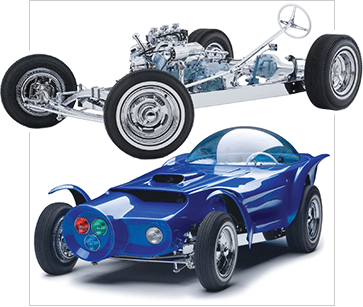
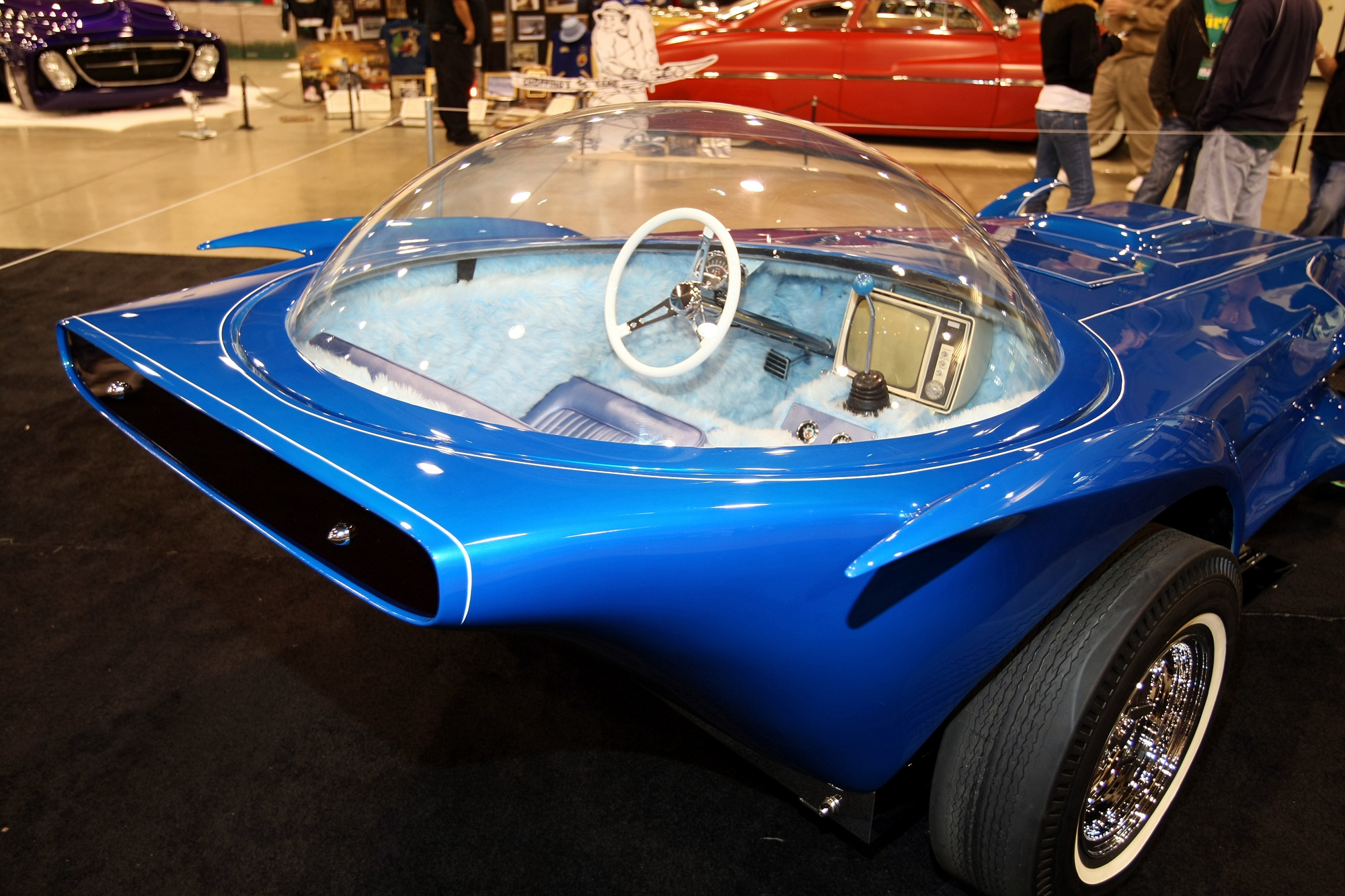
The Orbitron is a custom car built by Ed Roth and feared lost until its rediscovery in Mexico in 2007. Built in 1964, the vehicle was powered by a 1955 or 1956 Chevrolet V8 and was backed by a Powerglide automatic transmission. The body was hand-laid fiberglass which actually hid Roth’s extensive chrome work to the chassis.
The cockpit, set at the extreme rear of the vehicle in the manner of a dragster, was lined with fake fur and featured a General Electric portable television inserted in the console. Topping the cockpit was a custom-made, hydraulically operated plexiglass bubble top. One of a series of ordinary doorbell switches atop the hood activated the top from the outside.
read more »
Posted in Art, Money, Technology |
Leave a Comment »
March 22, 2011

‘Big Daddy‘ Ed Roth (1932 – 2001) was an artist and cartoonist who created the hot-rod icon ‘Rat Fink.’ As a custom car builder, Roth was a key figure in Southern California’s Kustom Kulture and hot-rod movement of the 1960s. He grew up in Bell, California, attending Bell High School, where his classes included auto shop and art. Roth is best known for his grotesque caricatures — typified by Rat Fink — depicting imaginative, out-sized monstrosities driving representations of the hot rods that he and his contemporaries built.
Although Detroit native Stanley Mouse is credited with creating the so-called ‘Monster Hot Rod’ art form, Roth is the individual who popularized it. Roth is also well known for his innovative work in turning hot rodding from crude backyard engineering, where performance was the bottom line, into a refined art form where aesthetics were equally important, breaking new ground with fiberglass bodywork.
Posted in Art, Humor, Money |
Leave a Comment »




 The Daily Omnivore