March 22, 2011

The Biker Cross is a derivative of the Iron Cross (a Prussian, and later German, military decoration). Bikers started to display the Iron Cross in the mid 1960’s with the advent of outlaw biker gangs. Originally bikers displayed the Iron Cross as a symbol of rebellion to society in general.
Today it is also worn to signify honor, valor, strength and ‘standing up for what you believe.’ Hot rodders (American car customizers) and others also use it as a provocative gesture to offend the public, or as a symbol of rebellion or non-conformity.
read more »
Posted in Art, Language, War |
Leave a Comment »
March 21, 2011

Multivac is the name of a fictional supercomputer in many stories by Isaac Asimov. Like most of the technologies Asimov describes in his fiction, Multivac’s exact specifications vary among appearances. In all cases, it is a government-run computer that answers questions, usually buried deep underground for security purposes. However, Asimov never settles on a particular size for the computer except for mentioning it is very large.
Unlike the artificial intelligences portrayed in his ‘Robot’ Series, Multivac’s interface is mechanized and impersonal, consisting of complex command consoles few humans can operate. Though the technology depended on bulky vacuum tubes, the concept – that all information could be contained on computer(s) and accessed from a domestic terminal – constitutes an early reference to the possibility of the Internet.
Posted in Art, Language, Technology |
1 Comment »
March 21, 2011

‘The Last Question‘ is a science fiction short story by Isaac Asimov. It first appeared in the November 1956 issue of Science Fiction Quarterly. It was Asimov’s favorite short story of his own authorship, and is one of a loosely connected series of stories concerning a fictional computer called Multivac. In conceiving Multivac, Asimov was extrapolating the trend towards centralization that characterised computation technology planning in the 1950s to an ultimate centrally managed global computer.
The story deals with the development of computers called Multivacs and their relationships with humanity through the courses of seven historic settings, beginning in 2061. In each of the first six scenes a different character presents the computer with the same question; namely, how the threat to human existence posed by the heat death of the universe can be averted.
Posted in Art, Technology |
Leave a Comment »
March 21, 2011

Vernor Vinge (b. 1944) is a computer scientist and science fiction author. He is best known for his Hugo Award-winning novels and novellas A Fire Upon the Deep (1992), as well as his 1993 essay ‘The Coming Technological Singularity,’ in which he argues that the creation of superhuman artificial intelligence will mark the point at which ‘the human era will be ended,’ such that no current models of reality are sufficient to predict beyond it.
Vinge came to prominence in 1981 with his novella ‘True Names,’ perhaps the first story to present a fully fleshed-out concept of cyberspace, which would later be central to cyberpunk stories by William Gibson, Neal Stephenson and others.
read more »
Posted in Art, Technology |
Leave a Comment »
March 21, 2011
Colin Stetson, born in Ann Arbor, Michigan, is a bass saxophone player and touring member of Arcade Fire and Bell Orchestre. In addition to saxophone, he plays clarinet, bass clarinet, french horn, flute, and cornet.
Stetson has worked with dozens of artists, including David Byrne, Tom Waits, TV on the Radio, Sinéad O’Connor, and LCD Soundsystem. His solo album New History Warfare, Vol 1. was released in 2008. The follow up, New History Warfare, Vol. 2: Judges was released in 2011.
Posted in Art, Money |
Leave a Comment »
March 21, 2011

Hefty Records is an independent record label based in Chicago, founded in 1995 by John Hughes III (aka Slicker). The label has established itself as a home for innovative electronica, releasing post-rock, IDM, downtempo, nu jazz, experimental music, and hip-hop. The label was formed by Hughes (as well as Bill Ding and Dan Snazelle) as a way of releasing his own music from his Ohio University dorm room in 1995. Soon afterwards a demo was given to Hughes from Scott Herren who was added to the roster under the name Savath and Savalas.
Hefty released the ‘Immediate Action’ series in 2000, a limited collection of six vinyl records from various electronic artists. All the records were hand pressed by Hughes, with sleeves created by the Brooklyn graphics company Graphic Havoc (now known as GHAVA), which used a stencil and spray painting technique to create each album; with different stickers to tell them apart.
Posted in Art, Money |
Leave a Comment »
March 21, 2011

Telefon Tel Aviv is an American electronic music act formed in 1999. Formerly comprising Charles Cooper and Joshua Eustis, Telefon Tel Aviv continues with Eustis as the sole official member since Cooper’s death in 2009 from an accidental overdose of sleeping pills and alcohol. The two were high school friends whose four-song demo was picked up by John Hughes III’s music label, Hefty.
Posted in Art |
Leave a Comment »
March 21, 2011
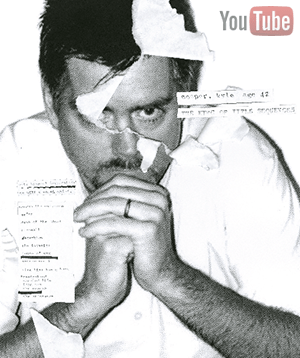
Kyle Cooper is an acclaimed modern designer of motion picture title sequences. He studied graphic design under Paul Rand at Yale University. In 1995 he designed the title sequence for the film Se7en, a seminal work which received critical acclaim and inspired a number of younger designers.
In 1996, he co-founded Imaginary Forces, a design firm, and in 2003 another firm, Prologue, based in Los Angeles. Cooper has also directed a feature film, New Port South (2001), a teen drama produced by John Hughes, based on a script written by Hughes’ son James. The project was filmed in Chicago and scored by Telefon Tel Aviv.
Posted in Art, Money |
Leave a Comment »
March 19, 2011

The stereographic projection, in geometry, is a particular mapping that projects a sphere onto a plane. The projection is defined on the entire sphere, except at one point — the projection point. Intuitively, then, the stereographic projection is a way of picturing the sphere as the plane, with some inevitable compromises. Because the sphere and the plane appear in many areas of mathematics and its applications, so does the stereographic projection; it finds use in diverse fields including complex analysis, cartography, geology, and photography.
The projection has been used to map spherical panoramas. This results in interesting effects: the area close to the point opposite to the center of projection becomes significantly enlarged, resulting in an effect known as little planet (when the center of projection is the nadir) and tube (when the center of projection is the zenith).
Posted in Art, Technology |
Leave a Comment »
March 17, 2011

Kickstarter is an online threshold pledge system for funding creative projects, from indie film and music to journalism to consumer products, and food-related projects. One of a new set of fundraising platforms dubbed ‘crowdfunding,’ Kickstarter facilitates gathering monetary resources from the general public, a model which circumvents many traditional avenues of investment. It was founded in 2009 by Perry Chen, Yancey Strickler, and Charles Adler in Manhattan. Project owners choose a deadline and a target minimum of funds to raise. If the chosen target is not gathered by the deadline, no funds are collected (a provision point mechanism).
Money pledged by donors is collected using Amazon Payments, and initiating projects requires a US bank account. Kickstarter turns a profit by claiming 5% of the funds raised; Amazon takes an additional percentage (around two). Unlike many forums for fundraising or investment, Kickstarter claims no ownership over the projects and the work they produce. However, projects launched on the site are permanently archived and accessible to the public. After funding is completed, projects and uploaded media cannot be edited or removed from the site.
Posted in Art, Money, Technology |
Leave a Comment »
March 17, 2011


The threshold pledge or fund and release system is a way of making a fundraising pledge as a group of individuals, often involving charitable goals or financing the provision of a public good. An amount of money is set as the goal or threshold to reach for the specified purpose and interested individuals will pitch in, keeping the donation in an escrow fund. When the threshold is reached, the contributions are retired from the escrow fund and a contract is formed so that the collective good is supplied.
This system is often applied to creative works, both for financing new productions and for buying out existing works; in the latter cases, it’s sometimes known as ransom publishing model or Street Performer Protocol (SPP). Sometimes contributions are refunded to the donors if the threshold amount is not reached as of some expiration date, and no contract is signed: this variation is known as an assurance contract. Contributions to an assurance contract may also be collected as pledges which are only called-in when the threshold is reached.
read more »
Posted in Art, Language, Money |
Leave a Comment »
March 17, 2011

Charley Harper (1922 – 2007) was a Cincinnati-based American Modernist artist. He was best known for his highly stylized wildlife prints, posters and book illustrations. During his career, Charley Harper illustrated numerous books, notably ‘The Golden Book of Biology,’ magazines such as ‘Ford Times,’ as well as many prints, posters, and other works.
As his subjects are mainly natural, with birds prominently featured, Charley often created works for many nature-based organizations, among them the National Park Service and the Cincinnati Zoo.
Posted in Art, Science |
Leave a Comment »




 The Daily Omnivore