March 16, 2011

4chan is an English-language imageboard website. Its users have been responsible for the formation or popularization of several Internet memes such as lolcats, Rickrolling, ‘Chocolate Rain,’ Pedobear, and many others. The site’s ‘Random’ board is by far its most popular and notorious feature. Known as ‘/b/,’ there are very minimal rules on posted content. The site’s Anonymous community and culture have often provoked media attention. The Guardian once summarized the 4chan community as ‘lunatic, juvenile… brilliant, ridiculous and alarming.’
4chan was started in the bedroom of a 15-year old student from New York City who posts as ‘moot.’ He intended the site to be a place to discuss Japanese comics and anime, an American counterpart to the popular Japanese Futaba Channel (‘2chan’) imageboard. The site has had at least one employee, a programmer whom moot met via on-line Tetris. All other moderators are volunteers. 4chan is one of the Internet’s most trafficked free imageboards and financing has often been problematic.
Posted in Art, Humor, Technology |
Leave a Comment »
March 16, 2011

Knitta is the group of artists who began the ‘knit graffit’ or ‘yarnbombing’ movement in Houston in 2005. They wrap public architecture—e.g. lampposts, parking meters, telephone poles, and signage—with knitted or crocheted material. The mission is to make street art ‘a little more warm and fuzzy.’
Knitta grew to eleven members by the end of 2007, but has now dwindled down to one member, founder Magda Sayeg, who continues to travel and knit graffiti. Internationally, as many as a dozen groups have followed Knitta’s lead.
read more »
Posted in Art, Humor, Politics |
Leave a Comment »
March 16, 2011


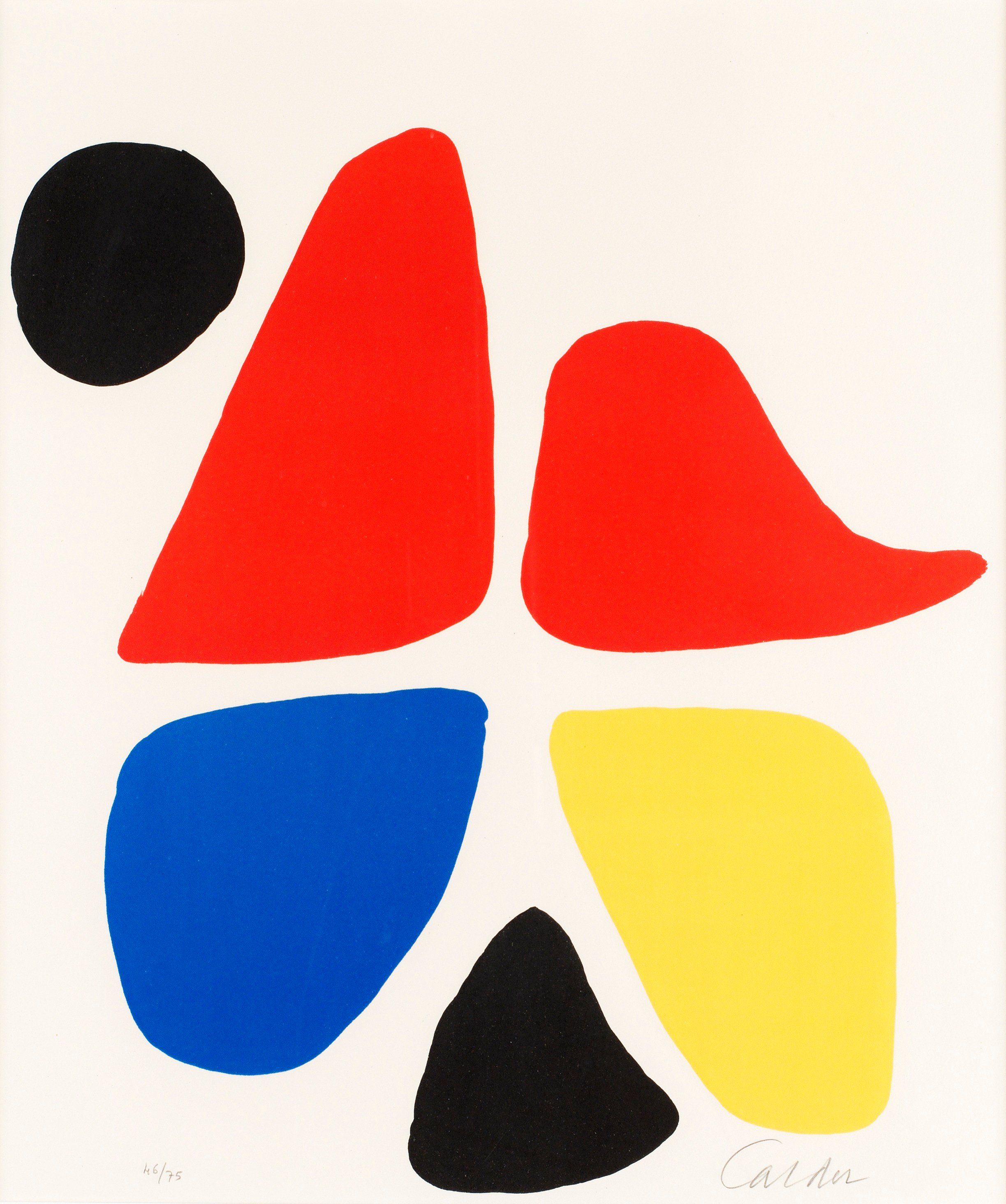
Alexander Calder [kawl-der] (1898 – 1976) was an American sculptor and artist most famous for inventing the mobile.
In addition to mobile and stabile sculpture, Alexander Calder also created paintings, lithographs, toys, tapestry, jewelry and household objects.
read more »
Posted in Art, Money, Technology |
Leave a Comment »
March 15, 2011


Pininfarina is an Italian car design firm and coachbuilder in Cambiano, Italy. Founded in 1930 by automobile designer and builder Battista ‘Pinin’ Farina, the company has been employed by a wide variety of high-end automobile manufacturers, including Ferrari, Maserati, Rolls-Royce, Cadillac, Jaguar, Volvo, Alfa Romeo, and Lancia. It also has designed trams in France, high-speed trains in Holland, and trolleys in the USA.
read more »
Posted in Art, Money, Technology |
Leave a Comment »
March 15, 2011
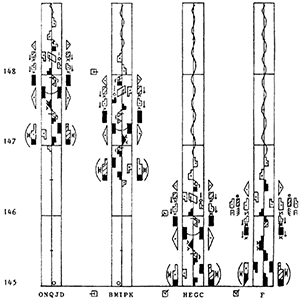

Laban [ley-buhn] Movement Analysis is a way and language for interpreting, describing, visualizing and notating all ways of human movement. Created by Rudolf Laban, LMA draws on his theories of effort and shape to describe, interpret and document human movement. Used as a tool by dancers, athletes, physical and occupational therapists, it is one of the most widely used systems of human movement analysis.
Rudolf Laban (1879–1958) was a dance artist and theorist whose work laid the foundations for dance notation. He is considered to be one of the most important figures in the history of dance and fencing.
Posted in Art, Education, Games |
Leave a Comment »
March 14, 2011
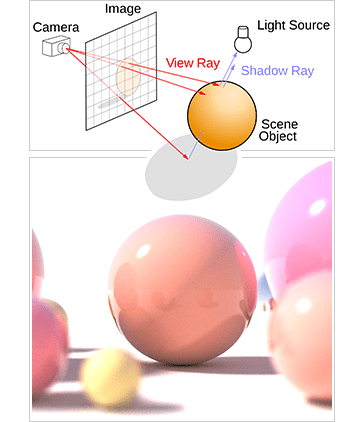
In computer graphics, ray tracing is a technique for generating an image by tracing the path of light through pixels in an image plane and simulating the effects of its encounters with virtual objects. The technique is capable of producing a very high degree of visual realism, usually higher than that of typical scanline rendering methods, but at a greater computational cost.
This makes ray tracing best suited for applications where the image can be rendered slowly ahead of time, such as in still images and film and television special effects, and more poorly suited for real-time applications like video games where speed is critical.Ray tracing is capable of simulating a wide variety of optical effects, such as reflection and refraction, scattering, and chromatic aberration.
Posted in Art, Technology |
Leave a Comment »
March 14, 2011

Rendering is the process of generating an image from a model by means of computer programs. Renders contain geometry, viewpoint, texture, lighting, and shading information as a description of a virtual scene. The term ‘rendering’ may be by analogy with an ‘artist’s rendering’ of a scene. Rendering is one of the major sub-topics of 3D computer graphics, and in practice always connected to the others. In the graphics pipeline, it is the last major step, giving the final appearance to the models and animation.
Rendering may be done slowly, as in pre-rendering, or in real time. Pre-rendering is a computationally intensive process that is typically used for movie creation, while real-time rendering is often done for 3D video games which rely on the use of graphics cards with 3D hardware accelerators.
Posted in Art, Language, Technology |
Leave a Comment »
March 11, 2011


Kruder & Dorfmeister is an Austrian duo most known for their downtempo-dub remixes of pop, hip-hop and drum and bass songs. Their mixes are usually flavored with sampler-processed vocals, deep bassline dub, trip-hop elements, bossa grooves and smoothly-shaped echoes. Some of their better-known works include ‘High Noon,’ ‘Original Bedroom Rockers’ and remixes of Madonna’s ‘Nothing Really Matters,’ Depeche Mode’s ‘Useless,’ Count Basic’s ‘Speechless’ and Roni Size’s ‘Heroes.’
Many of their remixes are collected on the double album ‘The K & D Sessions.’ Although best known internationally for their remixing work, the duo gained their primary reputation in Europe for their live DJ performances and ‘DJ-Kicks’ album. Peter Kruder and Richard Dorfmeister have their own record studio, G Stone Recordings in Vienna, through which they release many of their own albums.
Posted in Art, Money, World |
Leave a Comment »
March 10, 2011

Otaku is a Japanese term used to refer to people with obsessive interests, particularly anime (animation) and manga (graphic novels). The term is derived from a Japanese word for another’s house or family. It appears to have been coined by the humorist and essayist Akio Nakamori in 1983. Common uses are anime otaku, manga otaku, pasokon otaku (personal computers enthusiasts), gēmu otaku (video game players), and wota otaku (extreme fans of idols, heavily promoted singing girls). There are also tetsudō otaku or denshamania (railfans) or gunji otaku (military geeks).
While these are the most common uses, the word can be applied to anything (music otaku, martial arts otaku, cooking otaku, etc.). Some of Japan’s otaku use the term to describe themselves and their friends semi-humorously, accepting their position as fans, and some even use the term proudly, attempting to reclaim it from its negative connotations. In general colloquial usage however, most Japanese would consider it undesirable to be described in a serious fashion as ‘otaku’; many even consider it to be an offensive term.
Posted in Art, Language, World |
Leave a Comment »
March 10, 2011

Takashi Murakami is a prolific contemporary Japanese artist who works in both fine arts media—such as painting—as well as digital and commercial media. He blurs the boundaries between high and low art by appropriating popular themes from mass media and pop culture, and turning them into thirty-foot sculptures, ‘Superflat’ paintings, or marketable commercial goods such as figurines or phone caddies.
read more »
Posted in Art, Money, World |
Leave a Comment »
March 10, 2011

The Solomon R. Guggenheim Museum is an art museum located on the Upper East Side of Manhattan in New York City, United States. It is the permanent home to a renowned collection of Impressionist, Post-Impressionist, early Modern, and contemporary art and also features special exhibitions throughout the year.
Designed by Frank Lloyd Wright, it is one of the 20th century’s most important architectural landmarks. It is located at the corners of 89th Street and Fifth Avenue (overlooking Central Park). It opened in October of 1959, ten years after the death of Solomon Guggenheim and six months after the death of Frank Lloyd Wright.
read more »
Posted in Art, Money |
Leave a Comment »
March 10, 2011

Boss Hog is an American punk blues band including the husband and wife duo of Jon Spencer (guitar) and Cristina Martinez (vocals) along with Jens Jurgensen (bass), Hollis Queens (drums) and Mark Boyce (keyboard). Their name derives from a slang term amongst bikers for a desirable ‘boss’ motorcycle ‘hog.’
The band achieved some notoriety, not only due to their abrasive sound, but more to Martinez’s confrontational use of full nudity on the band’s debut live performance and record sleeves. Their releases were relatively sporadic, but comprised three full length albums, a mini-album, an EP and a number of singles in an 11 year history. Jon Spencer’s other bands include Pussy Galore, of which Martinez became a peripheral member, and The Jon Spencer Blues Explosion which existed in parallel to Boss Hog and now continues under the name Blues Explosion.
Posted in Art |
Leave a Comment »