January 31, 2011

Omar Little is a fictional character on the HBO drama The Wire, portrayed by Michael K. Williams.
Omar is a renowned stick-up man who lives by a strict moral code and never deviates from his rules, foremost of which is that he never robs or menaces people who are not involved in ‘the game.’ Omar is gay, and the only major character on the series who claims to make a point of not using profanity.
Posted in Art |
Leave a Comment »
January 31, 2011

The Wire is an American television drama series set and produced in and around Baltimore, Maryland. Created and primarily written by author and former police reporter David Simon. The series was broadcast by HBO from 2002 – 2008, comprising sixty episodes over five seasons. The show is recognized for its realistic portrayal of urban life, its literary ambitions, and its uncommonly deep exploration of sociopolitical themes. Each season focuses on a different facet of the city of Baltimore. They are, in chronological order: the illegal drug trade, the seaport system, the city government and bureaucracy, the school system, and the print news media.
The large cast consists mainly of character actors who are little known for their other roles. Simon has said that despite its presentation as a crime drama, the show is ‘really about the American city, and about how we live together. It’s about how institutions have an effect on individuals. Whether one is a cop, a longshoreman, a drug dealer, a politician, a judge or a lawyer, all are ultimately compromised and must contend with whatever institution they are committed to.’
Posted in Art, Drugs, Politics |
1 Comment »
January 31, 2011

Vajazzling is the act of applying glitter and jewels to a woman’s nether regions for aesthetic purposes.
Posted in Art, Money, Sex |
Leave a Comment »
January 31, 2011

Rejected is a surrealist animated short comedy film by Don Hertzfeldt that was nominated for an Academy Award for Best Animated Short Film in 2000. A fictional frame story explains that Hertzfeldt was commissioned to do animated segments for commercials and television network interstitials, but they were all rejected upon receipt. Towards the end of the short the animator begins to break down mentally and the animated world he created literally begins to fall apart, brutally killing all of his characters in the process.
Posted in Art, Humor |
Leave a Comment »
January 31, 2011

Photoshop tennis is a game played through sequential alternating photoshopping of an image. Photoshop tennis originated in graphics-related internet forums in the late-1990s/early-2000s. The game was made popular by art director Jim Coudal, and the matches on coudal.com have since been renamed Layer Tennis, as they are no longer restricted to the use of Adobe Photoshop. Each match of Photoshop tennis is generally played with two competing players. The players pick a starting image, or one is ‘served’ by a player, then another player makes some sort of alteration to the image in any chosen image editor (matches are not exclusive to Adobe Photoshop).
He or she then sends that altered image to the other player or players, usually via e-mail or by posting the image to a Photoshop tennis forum, who then edits that image and sends it back to the first player. This process goes back and forth until a predetermined number of rounds have elapsed, or the players otherwise wish to end the game. When the final round is over, there may be an independent judge who determines who has played the best shots, and declares that person the winner, or players may play without a clear winner. Sometimes extra rules can be enforced, such as sticking to one particular software package, or keeping to a particular theme.
Posted in Art, Games, Humor |
Leave a Comment »
January 31, 2011

Exquisite corpse is a method by which a collection of words or images is collectively assembled. Each collaborator adds to a composition in sequence, either by following a rule (e.g. ‘The adjective noun adverb verb the adjective noun’) or by being allowed to see the end of what the previous person contributed. The name is derived from a phrase that resulted when the game was first played, ‘Le cadavre exquis boira le vin nouveau.’ (‘The exquisite corpse will drink the new wine.’) The technique was invented by Surrealists and is similar to an old parlor game called ‘Consequences’ in which players write in turn on a sheet of paper, fold it to conceal part of the writing, and then pass it to the next player for a further contribution.
Surrealist André Breton reported that it started in fun, but became playful and eventually enriching. Breton said the diversion started about 1925, but Pierre Reverdy wrote that it started much earlier, at least before 1918. Later the game was adapted to drawing and collage, producing a result similar to children’s books in which the pages were cut into thirds, the top third pages showing the head of a person or animal, the middle third the torso, and the bottom third the legs, with children having the ability to ‘mix and match’ by turning pages.
Posted in Art, Games, Language |
Leave a Comment »
January 31, 2011

Christian Louboutin (b. 1964) is a footwear designer who launched his line of high-end women’s shoes in France in 1991. Since 1992, his designs have incorporated the shiny, red-lacquered soles that have become his signature. In 2007 Louboutin filed an application for U.S. trademark protection of this red sole design.
Louboutin received inspiration for his lethal-looking stilettos from an incident that occurred in his early 20s. He had visited a museum and noticed that there was a sign forbidding women wearing sharp stilettos from entering for fear of damage to the extensive wood flooring. This image stayed in his mind, and he later used this idea in his designs. ‘I wanted to defy that,’ Louboutin has said. ‘I wanted to create something that broke rules and made women feel confident and empowered.’
Posted in Art, Money |
Leave a Comment »
January 31, 2011
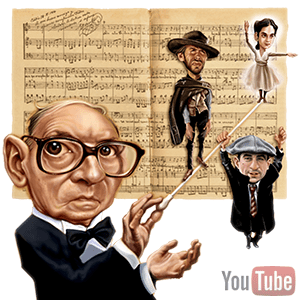
Ennio [en-yo] Morricone [mor-ee-cone-ay] (b. 1928) is an Italian composer and conductor, considered one of the most prolific and influential film composers of his era. He is well-known for his long-term collaborations with international acclaimed directors such as Sergio Leone, Brian De Palma, Barry Levinson, and Giuseppe Tornatore.
He wrote the characteristic film scores of Leone’s Spaghetti Westerns A Fistful of Dollars (1964), For a Few Dollars More (1965), The Good, the Bad and the Ugly (1966) and Once Upon a Time in the West (1968). In the 80s, Morricone composed the scores for John Carpenter’s horror movie The Thing (1982), Leone’s Once Upon a Time in America (1984), Roland Joffé’s The Mission (1986), Brian De Palma’s The Untouchables (1987) and Giuseppe Tornatore’s Cinema Paradiso (1988).
Posted in Art, Money |
Leave a Comment »
January 31, 2011

Spaghetti Western, also known as Italo-western, is a nickname for a broad sub-genre of Western film that emerged in the mid-1960s, so named because most were produced and directed by Italians. The typical team was made up of an Italian director, Italo-Spanish technical staff, and a cast of Italian and Spanish actors, sometimes a fading Hollywood star and sometimes a rising one like the young Clint Eastwood in three of Sergio Leone’s films. The films were typically shot in inexpensive locales resembling the American Southwest, primarily the Andalusia region of Spain, Almería, Sardinia, and Abruzzo.
Because of the desert setting and the readily available low-cost southern Spanish or southern Italian extras, typical themes in spaghetti westerns include the Mexican Revolution, Mexican bandits, and the border region shared by Mexico and the United States. Originally, spaghetti westerns were characterized by their production in the Italian language, low budgets, and a recognizable highly fluid and minimalist cinematography which eschewed many of the conventions of earlier Westerns. This was partly intentional and partly the context of a different cultural background.
Posted in Art, Money, World |
Leave a Comment »
January 29, 2011

Duck Sauce is an American-Canadian DJ duo consisting of Armand Van Helden and A-Trak. The duo are signed to Fool’s Gold Records.
In the summer of 2010, Duck Sauce released a track ‘Barbra Streisand,’ named for the singer of the same name. The track heavily samples Gotta Go Home by Boney M, which is based upon the original tune Hallo Bimmelbahn by the German band Nighttrain.
Posted in Art |
Leave a Comment »
January 29, 2011

The Valknut (Old Norse for ‘slain warriors knot’) is a symbol consisting of three interlocked triangles, and appears on various Germanic objects. A number of theories have been proposed for its significance. The name is an unattested modern invention used to describe the symbol, and was not used contemporaneously when the symbol was used. The Valknut has been compared to the three-horned symbol found on the 9th century Snoldelev runestone and may be related to it.
The symbol plays a role in modern Germanic Neopagan faiths, where numerous explanations and interpretations of the symbol are given. The Swedish paper manufacturer Svenska Cellulosa Aktiebolaget uses a triquetra Valknut as their logo. The symbol has also been used by a number of neo-Nazi groups. It is also represented in the Deutscher Fußball-Bund logo for the Germany national football team.
Posted in Art, Language, Philosophy |
Leave a Comment »
January 26, 2011

The Shard is an 87-story skyscraper in London that forms part of the London Bridge Quarter development. The Shard’s construction began in 2009 and finished in late 2012. Standing approximately 306 metrs (1,004 ft) high, it is currently the tallest building in the European Union. It is the second-tallest freestanding structure in the UK, after the concrete tower at the Emley Moor transmitting station.
It was designed by the Italian architect Renzo Piano, and replaced Southwark Towers, a 24-story office block built on the site in Southwark in 1975. The Shard was developed by Sellar Property on behalf of LBQ Ltd, and is jointly owned by Sellar Property and the State of Qatar.
Posted in Art, Money, Technology |
Leave a Comment »



 The Daily Omnivore