February 9, 2011

Between Two Ferns With Zach Galifianakis is an interview series on Funny or Die hosted by Zach Galifianakis. Zach conducts interviews with popular celebrities between two potted ferns. The show is filmed to resemble a low-budget amateur production fit for public access television. He maintains an awkward and sometimes antagonistic demeanor with his guests, asking them bizarre and inappropriate questions mixed with off-handed non sequiturs.
Posted in Art, Humor |
Leave a Comment »
February 9, 2011

A bat phone, in business jargon, is a private telephone number that is handled at a higher priority than a public line. The name derives from Commissioner Gordon’s secure line to the ‘Batphone’ in the Batman television show of 1966–68. Bat phones are common in many industries. The phone numbers are typically given to key customers so that they may reach important individuals in case of emergencies or critical situations. Bat phones can also provide direct access to politicians or notable people.
Another example of their use is for Internet service providers offering a selection of Internet services that range from dial-up access to secure web server hosting. Customers using the secure web hosting facility would be given access to a 24-hour bat phone for prompt resolution of technical issues, while dialup customers seeking technical support would be required to wait on hold and/or call only during business hours.
Posted in Art, Language, Technology |
Leave a Comment »
February 8, 2011
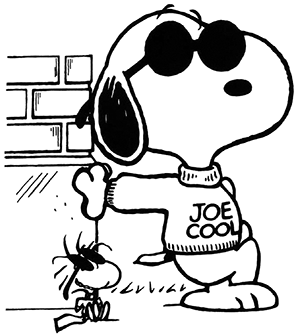
Joe Cool could refer to: Snoopy of Peanuts fame, whose aliases included Joe Cool, generally while wearing dark sunglasses and hanging around the student union. Joe Montana, a former NFL quarterback who earned the nickname for his undaunted poise in adverse, high-pressure game situations. Or, a New-York-based jazz-fusion band of the 1980’s featuring Rob Mounsey, Jeff Mironov, Will Lee, and Christopher Parker.
Posted in Art, Humor, Language |
Leave a Comment »
February 8, 2011
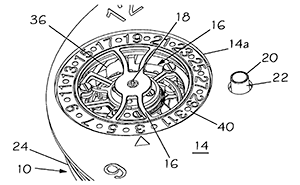

A tourbillon [tor-bee-yon] (French for ‘whirlwind’) is an addition to the mechanics of a watch escapement (the device which converts continuous rotational motion into an oscillating or back and forth motion; the source of the ‘ticking’ sound produced by watches and clocks).
Developed around 1795 by the French – Swiss watchmaker Abraham-Louis Breguet from an earlier idea by the English chronometer maker John Arnold a tourbillon counters the effects of gravity by mounting the escapement and balance wheel in a rotating cage. Originally an attempt to improve accuracy, tourbillons are still included in some expensive modern watches as a novelty and demonstration of watchmaking virtuosity. The mechanism is usually exposed for display on the watch’s face.
Posted in Art, Money, Technology |
Leave a Comment »
February 8, 2011

Bo Burnham (b. 1990) is an American comedian and musician. He performs satirical songs with a politically incorrect slant, and rose to fame on YouTube.
Posted in Art, Humor |
1 Comment »
February 8, 2011
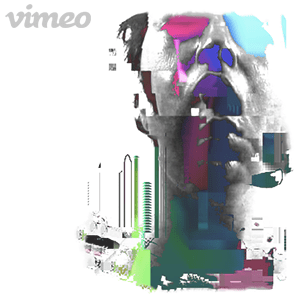
Compression artifacts may intentionally be used as a visual style, sometimes known as glitch art. In still images, an example is Jpegs, by German photographer Thomas Ruff, which intentionally uses JPEG artifacts.
In video art, one technique is datamoshing – mixing two videos sources, or exploiting the way different video codecs process motion and color information. The technique was pioneered by artists Sven König, Takeshi Murata and Paul B. Davis in collaboration with an American art collective called Paperrad.
Posted in Art, Language, Technology |
Leave a Comment »
February 7, 2011

Andreas Gursky (b. 1955) is a German visual artist known for his enormous architecture and landscape color photographs, some ten feet or more wide, and most employing a high point of view. As of early 2007, Gursky holds the record for highest price paid at auction for a single photographic image. His print 99 Cent II, Diptych, sold for GBP 1.7 million (USD $3.3 million) at Sotheby’s, London. Before the 1990s, Gursky did not digitally manipulate his images.
In the years since, Gursky has been frank about his reliance on computers to edit and enhance his pictures, creating an art of spaces larger than the subjects photographed. Visually, Gursky is drawn to large, anonymous, man-made spaces—high-rise facades at night, office lobbies, stock exchanges, the interiors of big box retailers (See his print 99 Cent II Diptychon). His style is described by art critics as enigmatic and deadpan. There is little to no explanation or manipulation on the works. His photography is straightforward.
Posted in Art, Money, Technology |
Leave a Comment »
February 7, 2011

A guy-cry film is the masculine version of the chick flick genre, a film that addresses a male audience, but has strong emotional material. Sports films are important to the guy-cry genre, but sports action is not necessarily essential to qualify a film as a genuine guy-cry. Some notable sports films that could be defined as guy-cry would be Field of Dreams, Rudy, Brian’s Song, and The Wrestler.
While it may seem that ‘guy-cry’ is a neologism, it is a genre that has been around for many years and is now receiving critical attention from scholars and trade publications. Early popular guy-cry films date back to the early 1970s with films such as Five Easy Pieces and One Flew Over the Cuckoo’s Nest. Important themes to the guy-cry genre are concepts of brotherhood, sacrifice, loyalty, and family.
Posted in Art, Humor, Language |
Leave a Comment »
February 7, 2011

Full-spectrum light is light that covers the electromagnetic spectrum from infrared through near-ultraviolet, or all wavelengths that are useful to plant or animal life; in particular, sunlight is considered full spectrum, even though the solar spectral distribution reaching Earth changes with time of day, latitude, and atmospheric conditions. ‘Full-spectrum’ is not a technical term when applied to an electrical light bulb but rather a marketing term implying that the product emulates natural light.
Some products marketed as ‘full-spectrum’ may produce light throughout the entire spectrum, but not with an even spectral distribution, and may not even differ substantially from lights not marketed as ‘full-spectrum.’
read more »
Posted in Art, Health, Technology |
Leave a Comment »
February 3, 2011
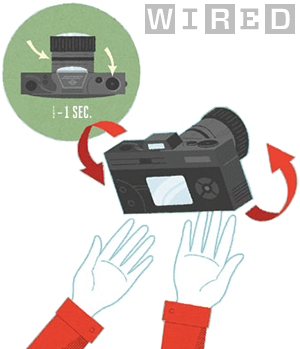
Kinetic photography is an experimental technique such as holding and shaking the wrist strap of the camera, dropping the camera, throwing or spinning the camera up in the air, or rigorously moving the camera while taking a picture. As the photographer has surrendered control over the camera to physical forces, this technique tends to produce abstract, random or blurred-motion photographs.
Perhaps the most risky field of kinetic photography is that of camera tossing, in which the photographer literally throws their equipment into the air in hopes of producing an artistic looking image. Many camera tosses take place at night, when the camera is able to capture light with a long exposure, resulting in streaks of hypnotizing light patterns. The pioneer of camera tossing, Ryan Gallagher, hosts a blog on the subject.
Posted in Art, Technology |
Leave a Comment »
February 3, 2011
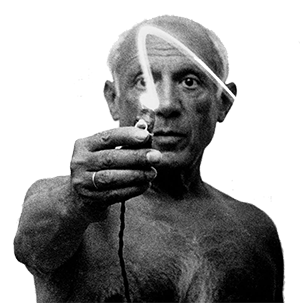
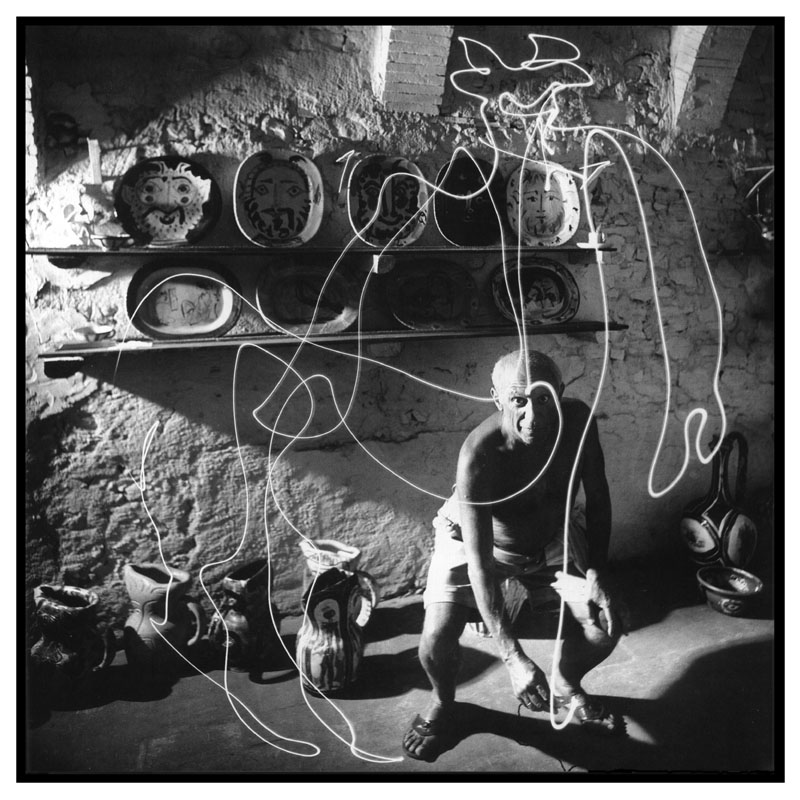
Light painting, also known as light graffiti, is a photographic technique in which exposures are made usually at night or in a darkened room by moving a hand-held light source or by moving the camera. In many cases the light source itself does not have to appear in the image. The first known photographer to use this technique was Man Ray in his series ‘Space Writing’ created in 1935.
In 1949 Pablo Picasso was visited by Gjon Mili, known photographer and lighting innovator, who introduced him to some of his photographs of ice skaters with lights attached to their skates. Immediately Picasso started making images in the air with a small flashlight in a dark room. This series of photos became known as Picasso’s ‘light drawings.’ Of these photos, the most celebrated and famous is known as ‘Picasso draws a centaur in the air.’
Posted in Art, Technology |
Leave a Comment »
February 3, 2011
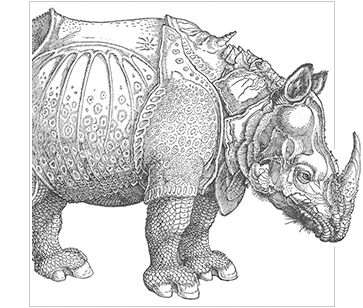
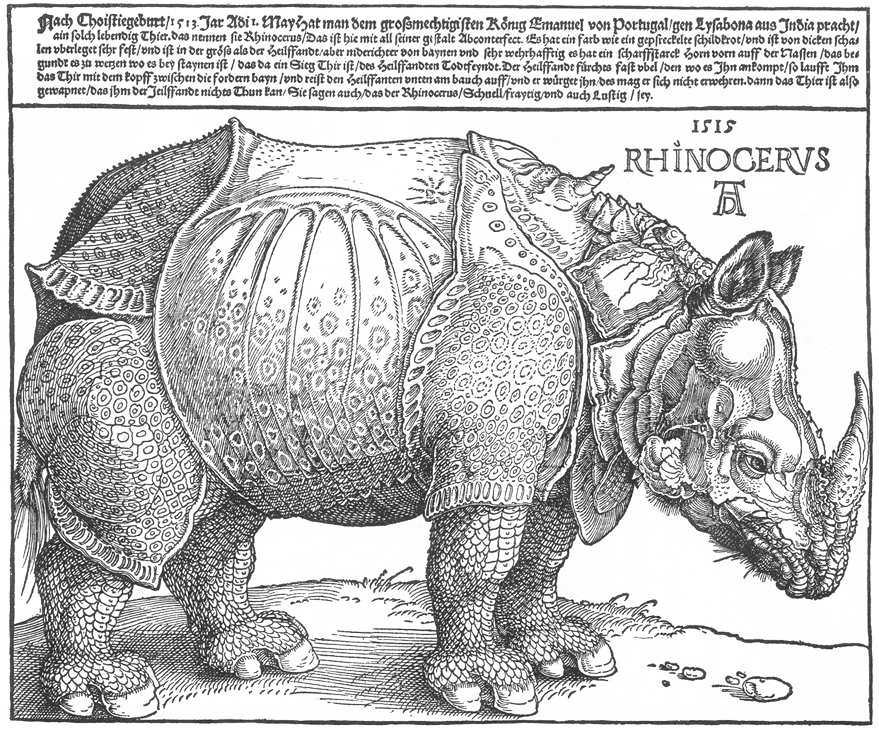
Dürer’s [door-ers] Rhinoceros is the name commonly given to a woodcut created by German painter and printmaker Albrecht Dürer in 1515. The image was based on a written description and brief sketch by an unknown artist of an Indian rhinoceros that had arrived in Lisbon earlier that year. Dürer never saw the actual rhinoceros, which was the first living example in Europe since Roman times. In late 1515, the King of Portugal, Manuel I, sent the animal as a gift for Pope Leo X, but it died in a shipwreck off the coast of Italy in early 1516. A live rhinoceros was not seen again in Europe until a second specimen arrived from India at the court of Sebastian of Portugal in 1577, being later inherited by Philip II of Spain around 1580.
Dürer’s woodcut is not an entirely accurate representation of a rhinoceros. He depicts an animal with hard plates that cover its body like sheets of armor, with a gorget at the throat, a solid-looking breastplate, and rivets along the seams; he also places a small twisted horn on its back, and gives it scaly legs and saw-like rear quarters. Despite these anatomical inaccuracies, it was a very popular woodcut in Europe and was copied many times in the following three centuries. It was regarded as a true representation of a rhinoceros into the late 18th century, when it was supplanted by more realistic drawings and paintings, particularly those of Clara the rhinoceros, who toured Europe in the 1740s and 1750s.
Posted in Art, Science |
Leave a Comment »