January 26, 2011


Henry Charles Bukowski (1920 – 1994) was a German-American poet, novelist and short story writer.
His writing was influenced by the social, cultural and economic ambience of his home city of Los Angeles. It is marked by an emphasis on the ordinary lives of poor Americans, the act of writing, alcohol, relationships with women and the drudgery of work. Bukowski wrote thousands of poems, hundreds of short stories and six novels, eventually having over 60 books in print. In 1986 Time called Bukowski a ‘laureate of American lowlife.’
read more »
Posted in Art, Drugs, Language |
1 Comment »
January 26, 2011

Henry Charles ‘Hank’ Chinaski is a semi-autobiographical protagonist of several works by the American writer Charles Bukowski. He appears in five of Bukowski’s novels, a number of his short stories and poems, the 1987 film ‘Barfly’ (played by Mickey Rourke and featuring a script written by Bukowski), and the 2005 film ‘Factotum’ (portrayed by Matt Dillon).
The works featuring him are ‘Confessions of a Man Insane Enough to Live With the Beasts’ (1965), ‘Post Office’ (1971), ‘South of No North’ (1973), ‘Factotum’ (1975), ‘Women’ (1978), ‘Ham on Rye’ (1982), ‘Hot Water Music’ (1983), ‘Hollywood’ (1989), and ‘Septuagenarian Stew’ (1990). He is also mentioned briefly in the beginning of Bukowski’s last novel, ‘Pulp.’
Posted in Art, Drugs, Language |
Leave a Comment »
January 26, 2011
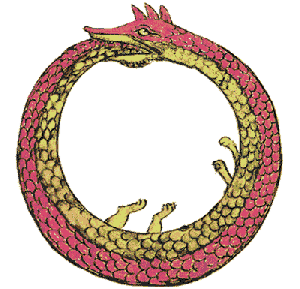
The Ouroboros [or-oh-bohr-ohs] is an ancient symbol depicting a serpent or dragon eating its own tail, which often represents self-reflexivity or cyclicality, especially in the sense of something constantly re-creating itself, the eternal return, and other things perceived as cycles that begin anew as soon as they end (compare with phoenix). It can also represent the idea of primordial unity related to something existing in or persisting before any beginning with such force or qualities it cannot be extinguished.
The ouroboros has been important in religious and mythological symbolism, but has also been frequently used in alchemical illustrations, where it symbolizes the circular nature of the alchemist’s opus. It is also often associated with Gnosticism, and Hermeticism. The earliest known representation of the Ouroboros is contained in the Egyptian Book of the Netherworld. The self-begetting sun god Atum is said to have ascended from chaos-waters with the appearance of a snake, the animal renewing itself every morning, and the deceased wishes to turn into the shape of the snake Sato (‘son of the earth’), the embodiment of Atum.
Posted in Art, Language, Philosophy |
1 Comment »
January 25, 2011

An upturned collar (or popped collar) is an otherwise flat, protruding collar of either a shirt, jacket, or coat that has been turned upward. Before the early 20th century, most shirt collars were turned up in some manner. Men and women alike wore tall, stiff collars (as much as three inches tall), not unlike a taller version of a clerical collar, made either of starched linen, cotton, or lace. The writer H. G. Wells remarked in his 1902 book ‘Kipps’ that these ‘made [the] neck quite sore and left a red mark under [the] ears.’
Between the late 19th and mid-20th centuries, men’s collars were often detachable from their shirts, connected only by two removable collar studs (one in front and one in back). Detachable collars were very stiff, and either stood straight up (Hamilton collar) or were pressed over at an ironed-in, starched crease (Fremont collar). After WWII, mass-production gradually phased out detachable collars from ordinary dress shirts. Occasionally, one can still find detachable collar formal shirts, designed to be worn with a tuxedo or evening dress.
read more »
Posted in Art, Games |
Leave a Comment »
January 25, 2011

‘Ambient 1: Music for Airports‘ is an ambient album by Brian Eno released in 1978. Of four albums released on Eno’s own, then new, Ambient label, ‘Music for Airports’ was the first to carry explicitly the name ‘ambient’ – a term which he coined to differentiate his minimalistic approach to the album’s material and ‘the products of the various purveyors of canned music.’ Notice of similarly quiet, unobtrusive music had been given on his albums such as ‘Evening Star,’ ‘Discreet Music,’ ‘Music for Films,’ and Harold Budd’s ‘The Pavilion of Dreams’ (which Eno produced), but in this album it was given precedence as a fully developed concept.
The music was designed to be continuously looped as a sound installation, with the intent to defuse the tense, anxious atmosphere of an airport terminal. Eno conceived this idea while being stuck at Cologne Bonn Airport in Germany in the mid 70s. He had to spend several hours there and was extremely annoyed by the uninspired sound atmosphere. It was installed at the Marine Air Terminal of New York’s LaGuardia Airport.
Posted in Art, Money, Technology |
Leave a Comment »
January 24, 2011

A keytar is a relatively lightweight keyboard that is supported by a strap around the neck and shoulders, similar to the way a guitar is supported by a strap. Keytars allow players a greater range of movement compared to conventional keyboards, which are placed on stands. The instrument has a musical keyboard for triggering musical notes and sounds. Controls for pitch bends, vibrato, portamento, and sustain are placed on the instrument’s ‘neck.’ Keytars may either contain their own synthesizers, or simply be controllers, triggering notes on another MIDI capable synthesizer.
In early 1970s, Edgar Winter often performed with keyboards slung around his neck, but they were not technically keytars because they had no ‘neck.’ One of the earliest keytars commercially released and widely known was be the Moog Liberation in 1980. Notable manufacturers of keytar models have included Moog, Roland, Yamaha, Korg and Casio. As of 2010, the Roland AX-Synth and the Roland Lucina are the only mass-manufactured keytars on the market, but with the Synthpop revival of the late 2000s, keytars are enjoying a mild resurgence.
Posted in Art, Technology |
Leave a Comment »
January 24, 2011

Electro (short for either electro-funk or electro-boogie) is a genre of electronic music directly influenced by the use of funk samples, Roland TR-808 synthesizers, and Moog keytars. Records in the genre typically feature drum machines and heavy electronic sounding deprived of vocals in general, although if present, they are delivered in a deadpan manner, often through an electronic distortion such as vocoding.
This is the main distinction of electro from previously prominent late-1970s genres such as disco and boogie, in which electronic sound was only part of the instrumentation rather than basis of the whole song. In 1982, Bronx based producer Afrika Bambaataa released the seminal track ‘Planet Rock,’ which contained elements of Kraftwerk’s Trans-Europe Express and ‘Numbers’ (from Kraftwerk’s Computer World album). ‘Planet Rock’ is widely regarded as a turning point in the electro genre.
read more »
Posted in Art, Language |
Leave a Comment »
January 21, 2011
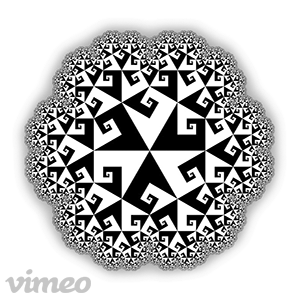
A fractal [frak-tl] is any equation or pattern, that when seen as an image, produces a picture, which can be zoomed into infinity and will still produce the same picture. The word fractal was made by Benoît Mandelbrot in 1975 from the Latin word fractus, which means ‘broken’ or ‘fractured.’ Some fractals exist only for artistic reasons, but others are very useful. Fractals are very efficient shapes for radio antennas and are used in computer chips to efficiently connect all the components.
A simple example is a tree that branches infinitely into smaller branches, and those branches into smaller branches and so on. Fractals are not only beautiful, but also have many practical applications. There are many types of fractals, made in a large variety of ways. There are also many natural examples of fractals in nature including trees, snowflakes, some vegetables and coastlines.
Posted in Art, Science |
Leave a Comment »
January 21, 2011

Pantone is a corporation headquartered in Carlstadt, New Jersey, best known for its Pantone Matching System (PMS), a proprietary color space used in a variety of industries, primarily printing, though sometimes in the manufacture of colored paint, fabric, and plastics. The idea behind the PMS is to allow designers to ‘color match’ specific colors when a design enters production stage—regardless of the equipment used to produce the color.
The company provides Pantone Guides, which consist of a large number of small (approximately 6×2 inches or 15×5 cm) thin cardboard sheets, printed on one side with a series of related color swatches and then bound into a small ‘fan deck.’ Pantone recommends that PMS Color Guides be purchased annually as their inks become more yellow over time. Color variance also occurs within editions based on the paper stock used (coated, matte or uncoated), while interedition color variance occurs when there are changes to the specific paper stock used.
Posted in Art, Money, Technology |
Leave a Comment »
January 21, 2011

A disco ball is a decorative object that reflects light directed at it in many directions, producing a complex display. Its surface consists of hundreds or thousands of mirrored facets, nearly all of approximately the same shape and size. Usually it is suspended from a device that causes it to rotate steadily on a vertical axis, and illuminated by spotlights. What are now sometimes called ‘disco balls’ were first widely used in nightclubs in the 1920s. They were already in existence and use before then, appearing in a description of a ballroom dance in 1897 in Boston. An early example can be seen in the nightclub sequence of ‘Berlin: Die Sinfonie der Großstadt,’ a German silent film from 1927.
Pink Floyd used a glitter ball on their 1987 and 1994 world tours. The glitter ball used on the 1987 tour was somewhat larger than normal but nowhere near as large as the glitter ball used on the 1994 tour. This particular glitter ball is one of the largest in the world at 16 feet in diameter. Madonna used a 2-ton glitter ball that was embellished by 2 million dollars’ worth of Swarovski crystals for her Confessions Tour in 2006. The world’s largest disco ball can be found on the promenade in Blackpool, United Kingdom; it weighs 4.5 tons and is 20 feet in diameter. With the emergence of infrared networks, glitter balls have found a new application, as a method of dispersing the infrared signals.
Posted in Art |
Leave a Comment »
January 21, 2011

The Technics SL-1200 are a series of turntables manufactured since October 1972 by Matsushita under the brand name of Technics. Originally released as a high fidelity consumer record player, it quickly became adopted among radio and club disc jockeys. Since its release in 1978, SL-1200MK2 and its successors have been the most common turntable for DJing and scratching.
The MK2 presented several improvements, including to the motor and casing. Since 1972, more than 3 million units have been sold. It is widely regarded as one of the most durable and reliable turntables ever produced. Many of the models manufactured in the 1970s are still in heavy use. In the autumn of 2010, Panasonic announced that the series was to be discontinued due to marketplace conditions.
read more »
Posted in Art, Technology |
Leave a Comment »
January 21, 2011

David Elsewhere (b. 1979) is an illusionary dancer from Santa Ana, California. He became known through a viral video of his participation in the 2001 edition of the Korean American talent show ‘Kollaboration,’ dancing to Kraftwerk’s song ‘Expo 2000.’ The clip showcased Bernal’s characteristic take on the contemporary dance styles of popping and abstract waving. Performances of these dances were rare at the time, and the clip became very popular when it circulated on the internet.
Bernal was later hired to participate in advertisements for Heineken (dancing to ‘Cobrastyle’ by the Teddybears), Volkswagen, Apple iPod, 7-Eleven Slurpee, Pepsi, Puma, and Doritos. He also made a cameo appearance in the movie ‘You Got Served.’ Computer graphics technology were used in several of the commercials Bernal took part in, superimposing others’ faces (old, young, male, female) onto his body so that they appeared to dance like him. In one of his most popular ads, a commercial for the Volkswagen Golf GTI created in January of 2005, Gene Kelly’s head was superimposed onto Bernal’s body in a re-enactment of ‘Singin’ in the Rain’ remixed by Manchester group Mint Royale.
Posted in Art |
Leave a Comment »




 The Daily Omnivore