November 4, 2010

The Cremaster Cycle is an art project consisting of five feature length films, together with related sculptures, photographs, drawings, and artist’s books; it is the best-known work of American visual artist and filmmaker Matthew Barney.
The films were made over a period of eight years (1994–2002) and culminated in a major museum exhibition organized by Nancy Spector of the Solomon R. Guggenheim Museum in New York City, which traveled to the Museum Ludwig in Cologne and the Musée d’art Moderne in Paris from 2002-03. Barney’s longtime collaborator Jonathan Bepler composed and arranged the soundtracks for the films.
read more »
Posted in Art, Philosophy, Sex |
Leave a Comment »
November 4, 2010

The Qatsi trilogy is the informal name given to a series of three films produced by Godfrey Reggio and scored by Philip Glass: Koyaanisqatsi: Life out of balance (1983), Powaqqatsi: Life in transformation (1988), and Naqoyqatsi: Life as war (2002). The titles of all three films are words from the language of the Hopi people; ‘qatsi’ means life. See Also: Baraka (1992) – an experimental documentary film directed by Ron Fricke, cinematographer on Koyaanisqatsi, and Chronos (1985) – an experimental film about the passage of time on different scales, also by Fricke.
Posted in Art, Philosophy, World |
1 Comment »
November 4, 2010

Balloon Dog is a sculpture by American artist, Jeff Koons. It is over ten feet tall, and constructed of high chromium stainless steel with a transparent color coating. It is part of the ‘Celebration’ series, which Koons began working on in 1993. Other forms in the series of sculptures and paintings include Valentine hearts, diamonds, and Easter eggs. Some of the pieces are still being fabricated. Each of the 20 different sculptures in the series comes in five differently colored ‘unique versions.’
read more »
Posted in Art, Money, Politics |
Leave a Comment »
November 4, 2010

Master Shake is a fictional character on Adult Swim’s television series, Aqua Teen Hunger Force. Like the other main characters, Meatwad and Frylock, Master Shake originally appeared in the Space Ghost Coast to Coast episode ‘Baffler Meal,’ and then made his first official appearance in the show’s first episode, ‘Rabbot’ Voice actor Dana Snyder provides Shake’s voice throughout the entire series. Master Shake lives next door to Carl Brutananadilewski in a suburban neighborhood in New Jersey with his roommates, Meatwad and Frylock. He spends most of his time watching TV, causing mischief, talking about women, sex, breasts, and porn.
He is also fond of playing cruel pranks on Meatwad. In ‘Video Ouija’ Shake commits suicide just so he can haunt Meatwad through his new video game. In ‘Reedickyoulus’ Shake kills Meatwad’s innocent kitten, in a microwave, just to upset Meatwad. His behavior is highly irregular, blaming others for his numerous mistakes, antagonizing Meatwad for pleasure, putting material goods above necessities, concocting poor lies to cover and justify his actions even when caught red-handed, and having an overall lack of empathy and regard for the safety of others. Shake has no official power, except his ability to shoot a substance from his straw, and almost every thing he throws to the ground explodes.
Posted in Art, Humor |
Leave a Comment »
November 4, 2010

A labret [ley-bret] is form of body piercing; taken literally, it is any type of adornment that is attached to the facial lip (labrum). However, the term usually refers to a piercing that is below the bottom lip, above the chin. It is sometimes referred to as a ‘tongue pillar.’ Among the ancient Aztecs and Mayans, labret piercing was reserved for male members of the higher castes. The name derives from the Latin labrum ‘lip’ and the diminutive suffix -et. However, many in the body-piercing industry incorrectly give it a French pronunciation, though it is not a French word.
There are several different labret variations based on precisely where the piercing is positioned on the lower lip. These include a vertical labret (through the top of the lower lip), snake bites (dual piercings close together reminiscent of fangs), spiderbites (dual piercings very close together on the same side of the face), and a lowbret, which is placed as low as possible toward the chin. The initial piercing is usually done at 1.2 , 1.6 or 2.0 mm diameter. After initial healing, the piercing can then be (gradually) further stretched. Some people chose to stretch to sizes over 10 mm, and the jewelry worn at these larger sizes is then usually a round or oval ‘labret plug.’
Posted in Art, Language |
12 Comments »
November 2, 2010
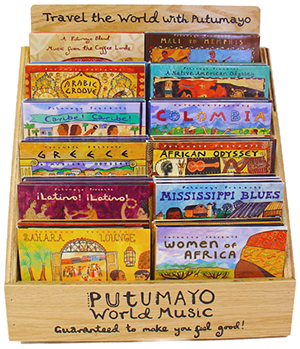
Putumayo [poo-too-mah-yaw] World Music is a New York City based record label, specializing in compilations of music from various nations, regions or musical styles which may be classified as world music. Every release features the distinctive art of English artist Nicola Heindl. The label was established in 1993 and grew out of the Putumayo clothing company, founded by Dan Storper in 1975 and sold in 1997. The name of the company comes from the Putumayo river which delineates the border between Peru and Colombia.
The company claims to be committed to helping the communities in the countries where the music they profit from originates, resulting in donations to non-profit organizations including Oxfam, Mercy Corps, Make-A-Wish and Amnesty International. However, limited information about the company’s philanthropic activities is available on Putumayo’s official website, and the company does not publish its financial information.
Posted in Art, Money, World |
Leave a Comment »
November 2, 2010
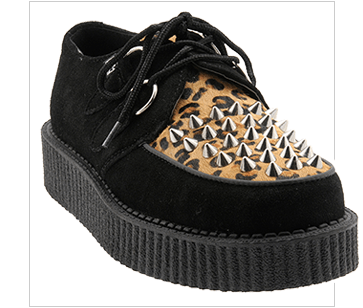
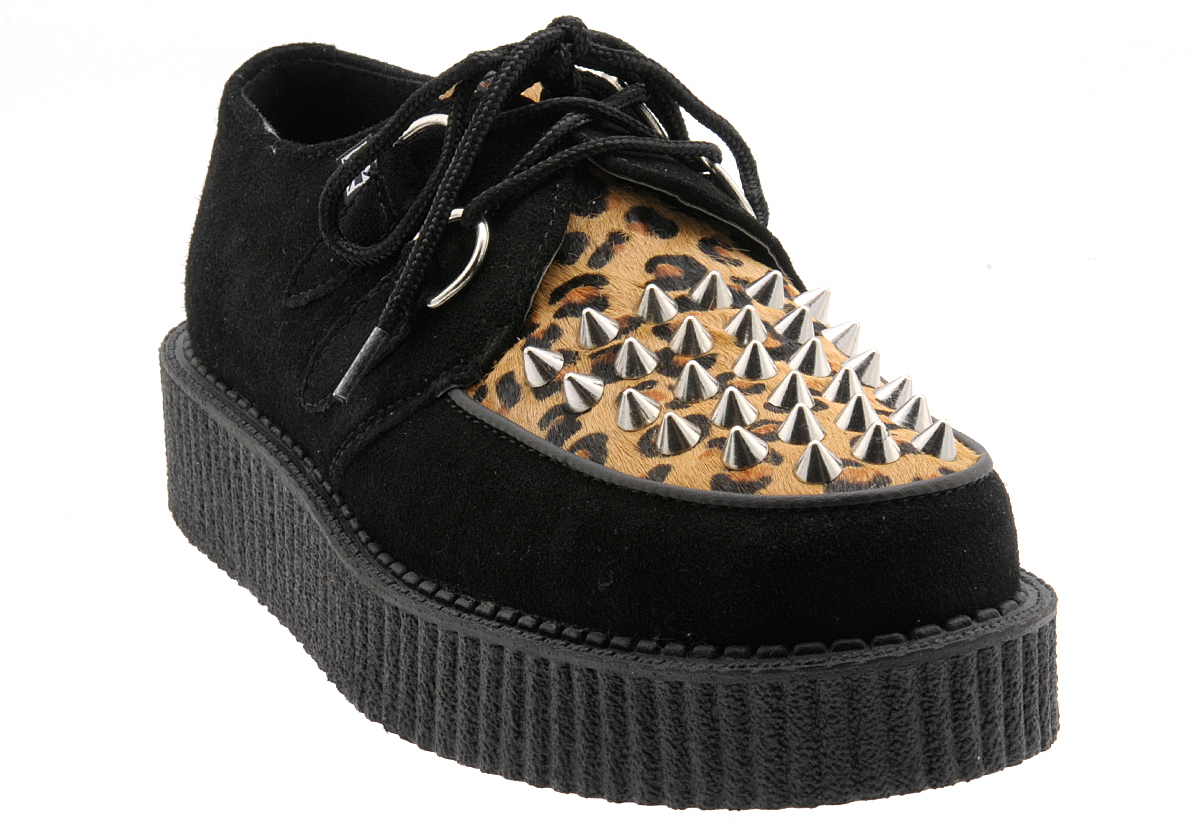
Creepers or brothel creepers are a type of shoe. They found their beginnings in the years following World War II, as soldiers based in the deserts in North Africa wore suede boots with hardwearing crepe soles because of the climate and environment. Having left the army, many of these ex-soldiers found their way to the nightspots of London wearing the same crepe soled shoes. Those became known as Brothel Creepers.
In the late 1950s, these shoes were appropriated by the Teddy Boys subculture in the UK along with drainpipe trousers, draped jackets, bolo ties, quiff and pompadour haircuts, and velvet or electric blue clothes. The shoe has since been adopted by other subcultures such as ska, punk, new wavers, psychobilly, greasers, goth, and Japanese Visual Kei.
Posted in Art |
Leave a Comment »
November 2, 2010

Moai [moh-aye] are monolithic human figures carved from rock on the Polynesian island of Easter Island, Chile between the years 1250 and 1500. Nearly half are still at Rano Raraku, the main moai quarry, but hundreds were transported from there and set on stone platforms called ahu around the island’s perimeter. Almost all moai have overly large heads three-fifths the size of their bodies. The moai are chiefly the living faces (aringa ora) of deified ancestors.
The 887 statues’ production and transportation is considered a remarkable creative and physical feat. The tallest moai erected, called Paro, was almost 10 metres (33 ft) high and weighed 75 tons; the heaviest erected was a shorter but squatter moai at Ahu Tongariki, weighing 86 tons; and one unfinished sculpture, if completed, would have been approximately 21 metres (69 ft) tall with a weight of about 270 tons.
Posted in Art, World |
Leave a Comment »
November 2, 2010


Luxottica is the world’s largest eyewear company. Its best known brands include Ray-Ban, Oliver Peoples, Revo, and Oakley. It also makes sunglasses and prescription frames for a multitude of designer brands such as Chanel and Prada, whose designs and trademarks are used under license. Leonardo Del Vecchio started the company in 1961, in Agordo north of Venice, Italy; today the company is headquartered in Milan. Its prime competitor is Safilo, which was founded in 1939 also in northern Italy. Del Vecchio began his career as the apprentice to a tool and die maker in Milan, but decided to turn his metalworking skills to making spectacle parts. So in 1961 he moved to Agordo in the province of Belluno, which is home to most of the Italian eyewear industry.
In 1967 he started selling complete eyeglass frames under the Luxottica brand. Convinced of the need for vertical integration, in 1974 he acquired Scarrone, a distribution company. The company listed in New York in 1990, and in Milan in December 2000, joining the MIB-30 (now S&P/MIB) index in September 2003. The listing enhanced the company’s ability to acquire other brands, starting with Italian brand Vogue in 1990, Persol and US Shoe Corporation (LensCrafters) in 1995, Ray-Ban in 1999 and Sunglass Hut, Inc. in 2001. They went looking for more retail companies, acquiring Sydney-based OPSM in 2003, Pearle Vision in 2004, Surfeyes in 2006, and Cole National in 2004. Most recently, it acquired Oakley in a US$2.1bn deal in November 2007.
Posted in Art, Money, World |
Leave a Comment »
October 28, 2010
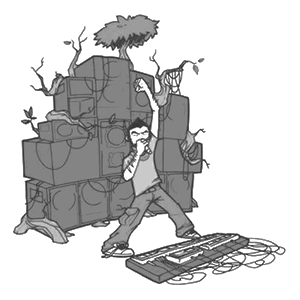
Dub FX (real name Benjamin Stanford) is a worldwide street performer and studio recording artist from Australia. His trademark is creating live music using only his own voice, Live looping, and effects pedals.
His music is based on hip hop, reggae and drum and bass rhythms. Stanford travels and performs with his fiancée, Flower Fairy (real name Shoshana Sadia).
Posted in Art, Money, Technology |
2 Comments »
October 28, 2010

Funky Forest: The First Contact, also known as Naisu no mori is a 2005 Japanese movie written and directed by Katsuhito Ishii, Hajimine Ishimine and Shunichiro Miki. The movie is a collection of several surreal, non-sequitur shorts. Dance numbers, pillow fights, animation, comedy, and science fiction all combine to create a unique and disorienting viewing experience featuring such highlights as an absurdist tribute to David Cronenberg, an ass-television, and a girl who fires lasers from her forehead in order to battle a floating space blob which emits spinning, spherical projectiles.
Posted in Art, Humor, World |
Leave a Comment »
October 28, 2010
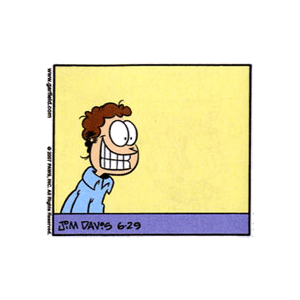
Garfield Minus Garfield is a webcomic created by Dan Walsh. Each strip consists of a reprint of a past episode from the comic strip Garfield, from which the character of Garfield himself has been removed through photo manipulation. Though Walsh admits that he was not the first to come up with this idea, he was the first to popularize it. The resulting strips thus consist mostly of Garfield’s owner, Jon Arbuckle, interacting with himself, rather than with his pet cat.
The strip’s website characterizes this result as ‘a journey deep into the mind of an isolated young everyman as he fights a losing battle against loneliness and depression in a quiet American suburb.’ Garfield artist Jim Davis has commented on the webcomic, stating that he is an occasional reader and finds it ‘fascinating’ and an ‘inspired thing to do.’
Posted in Art, Humor |
1 Comment »




 The Daily Omnivore