November 15, 2010
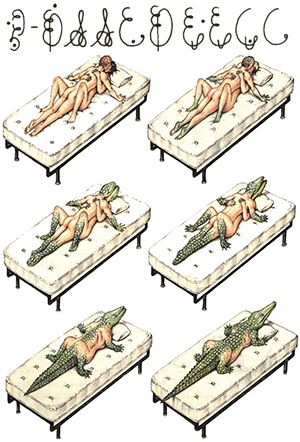

The Codex Seraphinianus is a book written and illustrated by the Italian artist, architect and industrial designer Luigi Serafini during thirty months, from 1976 to 1978. The book is a visual encyclopedia of an unknown world, written in one of its languages, a thus-far undeciphered alphabetic writing. The Codex is divided into eleven chapters, partitioned into two sections. The first section appears to describe the natural world, dealing with flora, fauna, and physics. The second deals with the humanities, the various aspects of human life: clothing, history, cuisine, architecture and so on. The illustrations are often surreal parodies of things in our world: bleeding fruit; a plant that grows into roughly the shape of a chair and is subsequently made into one; a lovemaking couple that metamorphoses into an alligator; etc.
The language of the codex has defied complete analysis by linguists for decades. The number system used for numbering the pages, however, has been discovered to be a variation of base 21. In a talk at the Oxford University Society of Bibliophiles held in 2009, Serafini stated that the script of the Codex is asemic, that his own experience in writing it was closely similar to automatic writing, and that what he wanted his alphabet to convey to the ‘reader’ is the sensation that children feel in front of books they cannot yet understand, although they see that their writing does make sense for grown-ups.
Posted in Art, Humor, Language |
2 Comments »
November 11, 2010

The Eames [eemz] Lounge Chair, officially titled Eames Lounge (670) and Ottoman (671), were released in 1956 after years of development by designers Charles and Ray Eames for the Herman Miller furniture company. It was the first chair the Eames designed for a high-end market. They are made of molded plywood and leather, and examples of these furnishings are part of the permanent collection of New York’s Museum of Modern Art. They are prized for comfort, aesthetics, and for the pioneering use of new materials and manufacturing methods.
There is a decent used market for these chairs. Some collectors are willing to pay high prices for earlier chairs made with Brazilian Rosewood veneer, which is no longer available due to a worldwide embargo since 1992. Prices for original rosewood chairs have recently reached as much as $7,000 in auction. A new Eames Lounge Chair and ottoman starts at $3,200 for a Herman Miller model. In 2006, to commemorate the 50th anniversary of the chair, Herman Miller released models using a sustainable Palisander Rosewood veneer.
Posted in Art, Money, Technology |
Leave a Comment »
November 9, 2010

Jay Pinkerton (born June 15, 1977) is a nationally published humorist and a former editor of both CRACKED.com and Cracked magazine. Prior to joining Cracked, Pinkerton served as the managing editor of NationalLampoon.com. Since joining Cracked, Pinkerton has helped make CRACKED.com a leading comedy site, including by bringing in new contributors.
Jay Pinkerton initially registered his website, Jaypinkerton.com, to be a portfolio of his comedy and artwork. Afterwards, Pinkerton joined the forums of the Internet humor website ‘Pointless Waste of Time’ (PWOT), and took the attention of the site’s owner, David Wong, with whom Pinkerton worked with on a series of comedy articles. It was around this time that he first published his redone Spider-Man comics, spawning an Internet phenomenon. In addition to Cracked, Pinkerton’s work has also appeared on McSweeney’s Internet Tendency, Modern Humorist, CollegeHumor.com and numerous other sites. He has also been hired by Valve Software to write some of the sequel to Portal, Portal 2.
Posted in Art, Humor |
Leave a Comment »
November 4, 2010

The Roland TR-808 Rhythm Composer was one of the first programmable drum machines. Introduced by the Roland Corporation in early 1980, it was originally manufactured for use as a tool for studio musicians to create demos. Like earlier Roland drum machines, it does not sound very much like a real drum kit.
One of the machine’s earliest mainstream hits in the United States was on Marvin Gaye’s ‘Sexual Healing.’ A TR-808 was also David Byrne’s sole accompaniment (apart from his acoustic guitar) at the beginning of ‘Stop Making Sense.’
read more »
Posted in Art, Technology |
Leave a Comment »
November 4, 2010

Reason is a music software program developed by Swedish software developers Propellerhead Software. It emulates a rack of hardware synthesizers, samplers, signal processors, sequencers and mixers, all of which can be freely interconnected in an arbitrary manner. Reason can be used either as a complete virtual music studio, or as a collection of virtual instruments to be played live or used with other sequencing software. As of August 2010 Reason was at version 5.0, version 1.0 was released in November 2000.
Posted in Art, Technology |
Leave a Comment »
November 4, 2010
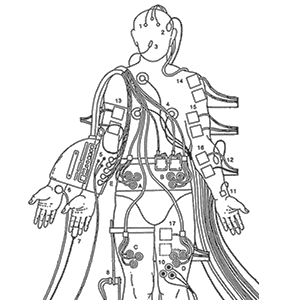
Stelarc (Stelios Arkadiou) is a Greek-Australian performance artist whose works focuses heavily on extending the capabilities of the human body. As such, most of his pieces are centred around his concept that the human body is obsolete. He is currently a visiting Professor in the School of Arts at Brunel University, West London.
In 2007, Stelarc had a cell-cultivated ear surgically attached to his left arm. In 2005, MIT Press published ‘Stelarc: The Monograph’ which is the first extensive study of his prolific work.
Posted in Art, Science, Technology |
Leave a Comment »
November 4, 2010

The Cremaster Cycle is an art project consisting of five feature length films, together with related sculptures, photographs, drawings, and artist’s books; it is the best-known work of American visual artist and filmmaker Matthew Barney.
The films were made over a period of eight years (1994–2002) and culminated in a major museum exhibition organized by Nancy Spector of the Solomon R. Guggenheim Museum in New York City, which traveled to the Museum Ludwig in Cologne and the Musée d’art Moderne in Paris from 2002-03. Barney’s longtime collaborator Jonathan Bepler composed and arranged the soundtracks for the films.
read more »
Posted in Art, Philosophy, Sex |
Leave a Comment »
November 4, 2010

The Qatsi trilogy is the informal name given to a series of three films produced by Godfrey Reggio and scored by Philip Glass: Koyaanisqatsi: Life out of balance (1983), Powaqqatsi: Life in transformation (1988), and Naqoyqatsi: Life as war (2002). The titles of all three films are words from the language of the Hopi people; ‘qatsi’ means life. See Also: Baraka (1992) – an experimental documentary film directed by Ron Fricke, cinematographer on Koyaanisqatsi, and Chronos (1985) – an experimental film about the passage of time on different scales, also by Fricke.
Posted in Art, Philosophy, World |
1 Comment »
November 4, 2010

Balloon Dog is a sculpture by American artist, Jeff Koons. It is over ten feet tall, and constructed of high chromium stainless steel with a transparent color coating. It is part of the ‘Celebration’ series, which Koons began working on in 1993. Other forms in the series of sculptures and paintings include Valentine hearts, diamonds, and Easter eggs. Some of the pieces are still being fabricated. Each of the 20 different sculptures in the series comes in five differently colored ‘unique versions.’
read more »
Posted in Art, Money, Politics |
Leave a Comment »
November 4, 2010

Master Shake is a fictional character on Adult Swim’s television series, Aqua Teen Hunger Force. Like the other main characters, Meatwad and Frylock, Master Shake originally appeared in the Space Ghost Coast to Coast episode ‘Baffler Meal,’ and then made his first official appearance in the show’s first episode, ‘Rabbot’ Voice actor Dana Snyder provides Shake’s voice throughout the entire series. Master Shake lives next door to Carl Brutananadilewski in a suburban neighborhood in New Jersey with his roommates, Meatwad and Frylock. He spends most of his time watching TV, causing mischief, talking about women, sex, breasts, and porn.
He is also fond of playing cruel pranks on Meatwad. In ‘Video Ouija’ Shake commits suicide just so he can haunt Meatwad through his new video game. In ‘Reedickyoulus’ Shake kills Meatwad’s innocent kitten, in a microwave, just to upset Meatwad. His behavior is highly irregular, blaming others for his numerous mistakes, antagonizing Meatwad for pleasure, putting material goods above necessities, concocting poor lies to cover and justify his actions even when caught red-handed, and having an overall lack of empathy and regard for the safety of others. Shake has no official power, except his ability to shoot a substance from his straw, and almost every thing he throws to the ground explodes.
Posted in Art, Humor |
Leave a Comment »
November 4, 2010

A labret [ley-bret] is form of body piercing; taken literally, it is any type of adornment that is attached to the facial lip (labrum). However, the term usually refers to a piercing that is below the bottom lip, above the chin. It is sometimes referred to as a ‘tongue pillar.’ Among the ancient Aztecs and Mayans, labret piercing was reserved for male members of the higher castes. The name derives from the Latin labrum ‘lip’ and the diminutive suffix -et. However, many in the body-piercing industry incorrectly give it a French pronunciation, though it is not a French word.
There are several different labret variations based on precisely where the piercing is positioned on the lower lip. These include a vertical labret (through the top of the lower lip), snake bites (dual piercings close together reminiscent of fangs), spiderbites (dual piercings very close together on the same side of the face), and a lowbret, which is placed as low as possible toward the chin. The initial piercing is usually done at 1.2 , 1.6 or 2.0 mm diameter. After initial healing, the piercing can then be (gradually) further stretched. Some people chose to stretch to sizes over 10 mm, and the jewelry worn at these larger sizes is then usually a round or oval ‘labret plug.’
Posted in Art, Language |
12 Comments »
November 2, 2010

Putumayo [poo-too-mah-yaw] World Music is a New York City based record label, specializing in compilations of music from various nations, regions or musical styles which may be classified as world music. Every release features the distinctive art of English artist Nicola Heindl. The label was established in 1993 and grew out of the Putumayo clothing company, founded by Dan Storper in 1975 and sold in 1997. The name of the company comes from the Putumayo river which delineates the border between Peru and Colombia.
The company claims to be committed to helping the communities in the countries where the music they profit from originates, resulting in donations to non-profit organizations including Oxfam, Mercy Corps, Make-A-Wish and Amnesty International. However, limited information about the company’s philanthropic activities is available on Putumayo’s official website, and the company does not publish its financial information.
Posted in Art, Money, World |
Leave a Comment »





