August 9, 2013
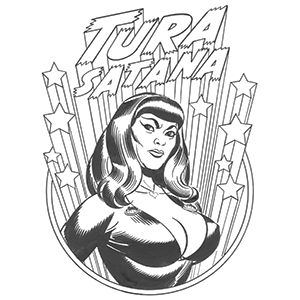
Faster, Pussycat! Kill! Kill! is a 1965 exploitation film directed by Russ Meyer, who also wrote the script with Jack Moran. It stars Tura Satana, Haji, and Lori Williams. Consistent with the genre, the film features gratuitous violence, sexuality, provocative gender roles, and camp dialogue. It is one of Meyer’s more boldly titled and unflinchingly exploitative films; however, there is no nudity. The film was shot in the extreme western parts of the Mojave Desert and outside Baker, California).
The film depicts three thrill-seeking go-go dancers (Billie, Rosie, and their leader, Varla) who encounter a young couple in the desert while racing their sports cars. After killing the boyfriend with her bare hands, Varla drugs, binds, gags and kidnaps his girlfriend, Linda. On a desolate highway, the four stop at a gas station, where they see a wheelchair-bound old man and his muscular, dimwitted son, Vegetable. The gas station attendant tells the women that the old man and his two sons live on a decrepit ranch with a hidden cache of money. Intrigued, Varla hatches a scheme to rob the lecherous old man.
Posted in Art, Sex |
Leave a Comment »
August 9, 2013
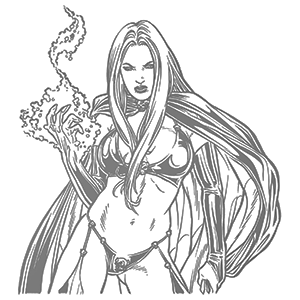
Bad girl art is a superheroines art form genre coined after the analogy of ‘good girl art’ (‘girl art’ that is ‘good’) which also includes strong female characters in comic books. Bad girls are typically tough and violent superheroines.
While the ‘good’ in ‘good girl art’ refers to the art itself, the ‘bad’ in ‘bad girl art’ refers to the girls: anti-heroine characters, often portrayed as cruel, mercenary, or demonic, although it may also be intended to reflect on the crude mannerisms and exaggerated anatomy of the drawing style associated with those characters. While Good Girl Art was common in the 1940s and 1950s, Bad Girl Art arose in the comic book market of the 1980s and 1990s. During the heyday of the style, some 50 titles within the subgenre were being published, with ‘Lady Death’ as the best selling title.
read more »
Posted in Art, Language, Sex |
Leave a Comment »
August 9, 2013
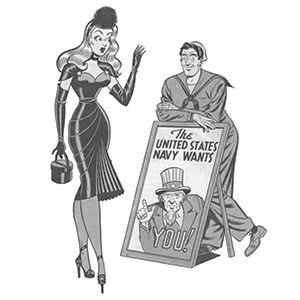
Good girl art (GGA) is found in drawings or paintings which feature a strong emphasis on attractive women no matter what the subject or situation. GGA was most commonly featured in comic books, pulp magazines and crime fiction. When cited as an art movement, it is usually capitalized as Good Girl Art.
The term describes the work of illustrators skilled at creating sexy female figure art; it is ‘girl art’ which is ‘good.’ Popular culture historian Richard A. Lupoff defined it as: ‘A cover illustration depicting an attractive young woman, usually in skimpy or form-fitting clothing, and designed for erotic stimulation. The term does not apply to the morality of the ‘good girl,’ who is often a gun moll, tough cookie or wicked temptress.’
read more »
Posted in Art, Sex |
Leave a Comment »
August 8, 2013
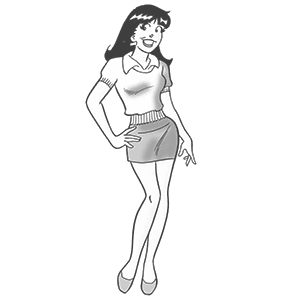
Veronica Lodge (first appearance ‘Pep Comics’ #26 in 1942) is a fictional character in the ‘Archie Comics’ books series. She is called both by her name Veronica and her nickname Ronnie. Bob Montana, creator of the original Archie characters, knew the Lodges, because he had once painted a mural for them. Montana combined that name with actress Veronica Lake to create the character of Veronica Lodge. Her character was added just months after Archie Andrews, Betty Cooper, and Jughead Jones debuted, and just a few months before Reggie Mantle.
Veronica is the only child of Hiram Lodge, the richest man in Riverdale, and his wife Hermione Lodge. She is tall, slender and attractive with long black hair. Veronica favors expensive, up-to-the-minute fashion. In some comics, Mr. Lodge claimed that he moved his family to Riverdale in order to avoid Veronica becoming spoiled, like many of the children he knew and grew up with.
read more »
Posted in Art, Language, Money |
Leave a Comment »
August 8, 2013

Women have been portrayed in comic books since the medium’s beginning, and their portrayals are often the subject of controversy. Sociologists with an interest in gender roles and stereotyping have outlined the role of women as both supporting characters and as potential leaders finding limited success at being accepted as equals.
Another point of study has been the depiction of women in comics, in which, as in other forms of popular culture, body types are unrealistically portrayed.
read more »
Posted in Art, Politics, Sex |
1 Comment »
August 6, 2013
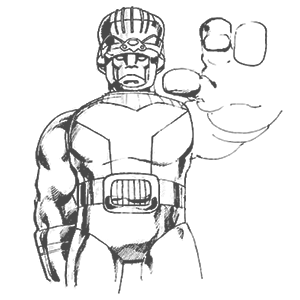
Master Mold is a fictional character, a robot supervillain in the Marvel Universe. Since his primary purpose was to act as a portable Sentinel-creating factory, and the Sentinel robots were primarily used to hunt mutants, Master Mold has almost exclusively appeared in the ‘X-Men’ and related, mutant-themed, comic books.
The Master Mold first appeared in ‘X-Men’ #15 (1965), and was created by Stan Lee and Jack Kirby. In the 1960s, out of fear of a race of superhuman mutants that could dominate the whole world and enslave normal human beings, Dr. Bolivar Trask makes Master Mold, a supercomputer, in the shape of a giant Sentinel robot, that will control and facilitate the construction of the Sentinels (mechanical warriors that are programmed to hunt and capture all superhuman mutants.)
read more »
Posted in Art |
Leave a Comment »
August 6, 2013

Sentinels are a fictional variety of mutant-hunting robots, appearing in the Marvel Comics Universe. Created by Stan Lee and Jack Kirby, they first appeared in ‘The X-Men’ (vol. 1) #14 (1965). Sentinels are programmed to locate mutants and capture or kill them using energy weapons and restraining devices; they are capable of flight, and can detect mutants at long range. Several groups of the robots have been created or led by a single, massive Sentinel, called Master Mold.
Because Sentinels are designed to hunt mutants (who often represent the protagonists of Marvel stories) they are usually employed as supervillains or as the tools of other villains. While many are capable of tactical thought, only a handful are self-aware. In the ‘Days of Future Past’ story, which takes place in an alternate future, the ‘Omega Sentinels’ have advanced technologically and become the de facto rulers of the United States. The most powerful among them is Nimrod.
Posted in Art |
Leave a Comment »
August 6, 2013

Bolivar Trask is a fictional character appearing in publications by Marvel Comics. He is a military scientist who is well known as the creator of the Sentinels (mutant-hunting robots). His appearance is modeled on that of Walt Disney. Bolivar Trask was an anthropologist who saw the rise of mutants as a threat to humanity. Bolivar was also the father of Larry Trask, who ironically is revealed to be a mutant precognitive. When Bolivar realized this he gave his son a medallion which suppresses his power.
Bolivar’s other child, Tanya, was also a mutant and her ability to travel through time causes her to vanish. Tanya would be rescued by Rachel Summers in a far future and become a part of the Askani under the alias Madame Sanctity. Tanya’s travels through time would result in property damage to Trask’s land. This mysterious situation would only further cement his attitudes.
read more »
Posted in Art |
Leave a Comment »
August 6, 2013
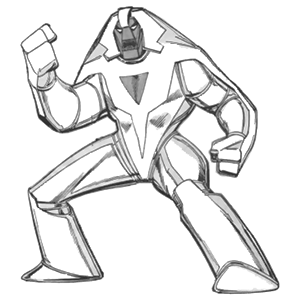
‘Days of Future Past‘ is a popular storyline in the Marvel Comics comic book ‘The Uncanny X-Men’ issues #141 and #142, published in 1981. It deals with a dystopian alternative future in which mutants are incarcerated in internment camps. An adult Kate Pryde transfers her mind into her younger self, the present-day Kitty Pryde, who brings the X-Men to prevent a fatal moment in history which triggers anti-mutant hysteria.
The storyline was very popular at the time and was produced during the franchise’s rapid rise to popularity due to the writer/artist team of Chris Claremont, John Byrne and Terry Austin. As a result of the storyline’s popularity, the dark future seen in the story has been revisited numerous times. This reality in which the story occurs is designated ‘Earth-811’ in the Marvel Multiverse.
Posted in Art |
Leave a Comment »
August 6, 2013

Weapon X is a fictional clandestine government genetic research facility project in Marvel Comics. They are conducted by the Canadian Government’s Department K, which turns willing and unwilling beings into living weapons. The project often captures mutants and experiments on them to enhance their superpowers, turning them into weapons. They also mutate baseline humans. The Weapon X Project produced Wolverine, Leech, and other characters such as Deadpool and Sabretooth.
Experiment X, or the brutal adamantium-skeletal bonding process, written by Barry Windsor-Smith in his classic story ‘Weapon X’ (originally published in ‘Marvel Comics Presents’ #72-84 in 1991), was eventually revealed as part of the ‘Weapon X Project.’ Grant Morrison’s run on ‘New X-Men’ in 2002 further revealed that Weapon X was only the tenth of an entire series of such projects, collectively known as the Weapon Plus Program. The first project, Weapon I, pertained to the Super Soldier Project that created Captain America.
read more »
Posted in Art |
Leave a Comment »
August 6, 2013
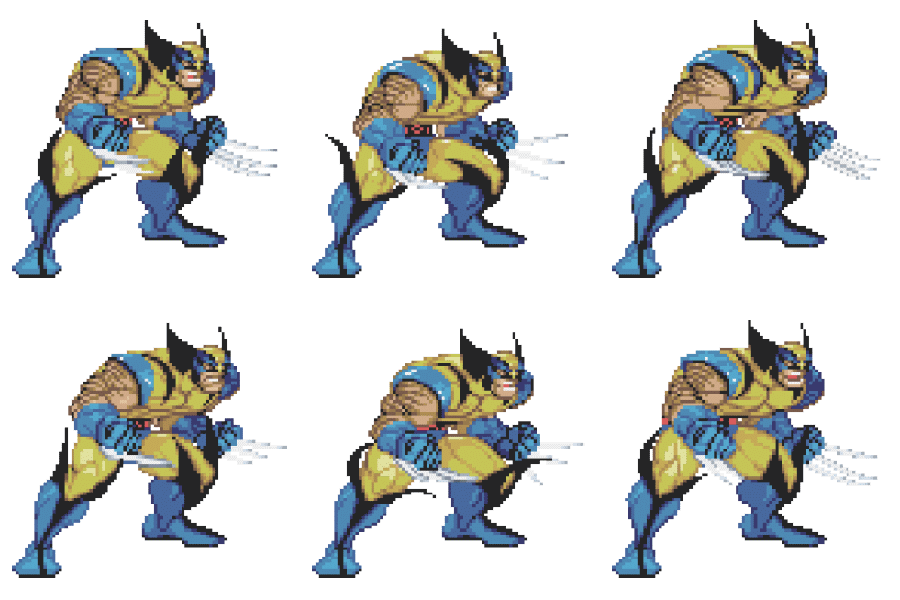
Adamantium is a fictitious indestructible metal alloy in the Marvel Comics Universe. It is best known for being the substance bonded to the character Wolverine’s skeleton and bone claws. The first use of the term adamantium in Marvel Comics was in ‘Avengers’ #66 (1969), where it refers to part of Ultron’s outer shell.
In the Marvel Universe, adamantium is a group of man-made metal alloys of varying durability, but are all nearly indestructible. Adamantium was inadvertently invented by the American metallurgist Dr. Myron MacLain in an attempt to recreate his prior discovery, a unique alloy of steel and vibranium (which required an unknown catalyst for its manufacture) that was used to create Captain America’s shield.
read more »
Posted in Art |
Leave a Comment »
August 6, 2013

Blockbuster, as applied to film, theater, and sometimes also video games, denotes a very popular or successful production. The term began to appear in the American press in the early 1940s, describing the largest of aerial bombs: single bombs capable of destroying a city block, also known as ‘cookies’ during the firebombing of Hamburg. Later figurative use referred to anything making a public impact:
‘Broadway reacted to the request of War Mobilization Director Byrnes to close all places of entertainment by midnight Feb. 26 as if a blockbuster had landed on Manhattan’ (1945). Some entertainment histories cite it as originally referring to a play that is so successful that competing theaters on the block are ‘busted’ and driven out of business, but the OED cites a 1957 use which is simply as a term of ‘biggest,’ after the bombs.
read more »
Posted in Art, Language, Money |
Leave a Comment »


 The Daily Omnivore