July 13, 2013

‘Everytime‘ is a 2004 song by pop star Britney Spears from her fourth album, ‘In the Zone.’ After Spears ended her relationship with singer Justin Timberlake in 2002, she made friends with her backing vocalist Annet Artani.
They started writing songs together at Spears’s house in Los Angeles, and then traveled to Lombardy, Italy, where ‘Everytime’ was written. Spears composed the music on her piano, and she developed the lyrics with Artani. According to Artani, the song was written as a response to Timberlake’s 2002 single ‘Cry Me a River’ and various of his radio interviews. Spears has neither confirmed nor denied these allegations.
read more »
Posted in Art |
Leave a Comment »
July 9, 2013

Lennie Briscoe is a fictional character on NBC’s long-running police procedural and legal drama television series ‘Law & Order.’ He was portrayed by Jerry Orbach for 12 season. The character was introduced in the 1992 episode ‘Point of View’ as the new senior detective in the NYPD’s 27th Detective Squad in the 27th Police Precinct’s Station House. His boss during his first season on the show is Capt. Don Cragen; a year later, Lt. Anita Van Buren takes over the 27th Squad.
He was previously assigned as a detective in the 116th Det. Squad in Queens. Briscoe joins the squad after Det. Mike Logan’s (Chris Noth) partner, Sgt. Phil Cerreta (Paul Sorvino), is shot by a black market arms dealer, and Logan transfers to a desk job in another precinct. After Logan is transferred to Staten Island in 1995, Det. Rey Curtis (Benjamin Bratt) becomes Briscoe’s partner. Four years later, Curtis goes into early retirement to take care of his multiple sclerosis–stricken wife, and he is replaced by Det. Ed Green (Jesse L. Martin) in 1999.
read more »
Posted in Art, Politics |
Leave a Comment »
July 8, 2013
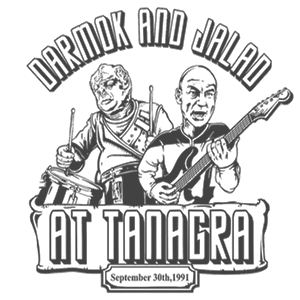
‘Darmok‘ is the 102nd episode of the science fiction television series ‘Star Trek: The Next Generation,’ the second episode of the fifth season. The episode features Paul Winfield, who previously played Captain Terrell in ‘Star Trek II: The Wrath of Khan.’
The senior crew discuss their latest mission: to make contact with the Tamarian race who have been transmitting signals toward Federation space for weeks. The Enterprise makes contact with a Tamarian ship in orbit around the planet El-Adrel. Though the universal translator can translate their words, the Tamarians only communicate through metaphor which baffles the Enterprise crew. Likewise, the Tamarians cannot understand Picard’s straightforward use of language.
read more »
Posted in Art, Language |
Leave a Comment »
July 2, 2013

‘My Cousin Vinny‘ is a 1992 American comedy film written by Dale Launer (‘Dirty Rotten Scoundrels,’ ‘Ruthless People’), directed by Jonathan Lynn (‘Clue,’ ‘The Whole Nine Yards’), and starring Joe Pesci, Ralph Macchio, Marisa Tomei, and Fred Gwynne (best known for playing Herman Munster; the film was Gwynne’s final role before his death the following year).
‘My Cousin Vinny’ is the story of two young New Yorkers traveling through rural Alabama who are put on trial for a murder they did not commit, and the comic attempts of a cousin, Vincent Gambini, a newly minted lawyer, to defend them. Much of the humor comes from the contrasting personalities of the brash Italian-American New Yorkers, Vinny and his fiancée Mona Lisa Vito, and the more reserved Southern townspeople.
read more »
Posted in Art, Humor, Politics |
6 Comments »
June 14, 2013
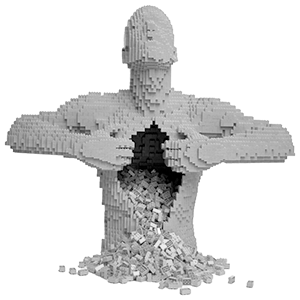
Nathan Sawaya (b. 1973), is a New York-based artist who builds custom three-dimensional sculptures and large-scale mosaics from popular everyday items and is best known for his work with standard LEGO toy bricks.
His unique art creations are commissioned by companies, charities, individuals, museums and galleries all over the world.
read more »
Posted in Art, Humor |
Leave a Comment »
June 11, 2013

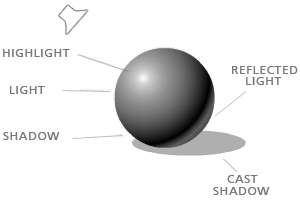
Chiaroscuro [kee-ahr-uh-skyoor-oh] (Italian: ‘light-dark’) in art is the use of strong contrasts between light and dark, usually bold contrasts affecting a whole composition. Chiaroscuro is also a technical term used by artists and art historians for using contrasts of light to achieve a sense of volume in modelling three-dimensional objects such as the human body. Similar effects in the lighting of cinema and photography are also often called chiaroscuro.
Further related specialized uses of the term include chiaroscuro woodcut, for coloured woodcuts printed with different blocks, each using a different coloured ink; and chiaroscuro drawing for drawings on coloured paper with drawing in a dark medium and white highlighting.
read more »
Posted in Art |
Leave a Comment »
June 7, 2013

David Lynch (b. 1946) is an American filmmaker known for his surrealist films. He has developed his own unique cinematic style, which has been dubbed ‘Lynchian,’ characterized by dream imagery and meticulous sound design. The surreal, and in many cases, violent, elements contained within his films have been known to ‘disturb, offend or mystify’ audiences.
His work often exposes dark undercurrents in seemingly mundane people and places: ‘My childhood was elegant homes, tree-lined streets, the milkman, building backyard forts, droning airplanes, blue skies, picket fences, green grass, cherry trees. Middle America as it’s supposed to be. But on the cherry tree there’s this pitch oozing out – some black, some yellow, and millions of red ants crawling all over it. I discovered that if one looks a little closer at this beautiful world, there are always red ants underneath. Because I grew up in a perfect world, other things were a contrast.’
read more »
Posted in Art |
Leave a Comment »
June 7, 2013
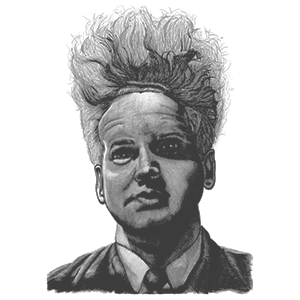
Eraserhead is a 1977 surrealist body horror film written and directed by American filmmaker David Lynch. Shot in black-and-white, Eraserhead is Lynch’s first feature-length film, coming after several short works.
The film was produced with the assistance of the American Film Institute (AFI) during the director’s time studying there. It tells the story of Henry Spencer who is left to care for his deformed child in a desolate industrial landscape. Throughout the film, Spencer experiences dreams or hallucinations, featuring his child and the Lady in the Radiator.
read more »
Posted in Art |
1 Comment »
June 7, 2013
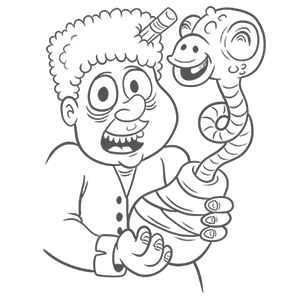
A coloring book is a type of book containing line art to which a child may add color using crayons (however, adult coloring products exist as well, including pornograhic, horror, and medical books).
Some coloring books have perforated edges so their pages can be removed from the books and used as individual sheets. Others may include a storyline and so are intended to be left intact. Coloring books may also incorporate other activities such as connect the dots, mazes, and other puzzles. Some coloring books also incorporate the use of stickers.
read more »
Posted in Art, Education, Language |
Leave a Comment »
June 7, 2013

Really Big Coloring Books, Inc (RBCB) is an American publisher based in St. Louis, Missouri. The company develops, publishes and distributes children’s coloring and activity books, many of which are over two feet tall. Some of their products have been controversial due to their political content.
The company was established in 1981 by publisher Wayne Bell. The company is best known for its politically themed coloring books, covering subjects such as Barack Obama, the Tea Party Movement, and Occupy Wall Street.
read more »
Posted in Art, Politics, Sex |
Leave a Comment »
June 6, 2013

Inscape, in visual art, is a term especially associated with certain works of Chilean artist Roberto Matta, but it is also used in other senses within the visual arts. Though the term has been applied to stylistically diverse artworks, it usually conveys some notion of representing the artist’s psyche as a kind of interior landscape. The word inscape can therefore be read as a kind of portmanteau, combining interior (or inward) with landscape.
According to Professor Claude Cernuschi, Matta’s use of the term inscape for a series of landscape-like abstract or surrealist paintings reflects ‘the psychoanalytic view of the mind as a three-dimensional space: the ‘inscape.” The ‘inscape’ concept is particularly apt for Matta’s works of the late 1930s. As art historian Dawn Ades writes, ‘A series of brilliant oil paintings done during the years of his [Matta’s] first association with the Surrealists explore visual metaphors for the mental landscape.’
read more »
Posted in Art, Language, Philosophy |
Leave a Comment »
June 6, 2013
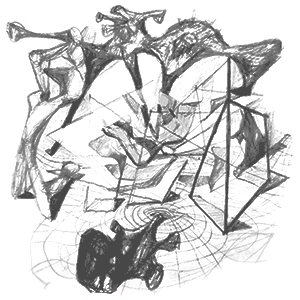
Roberto Matta (1911 – 2002) was one of Chile’s best-known painters and a seminal figure in 20th century abstract expressionist and surrealist art. Born in Santiago, he initially studied architecture at the Pontificia Universidad Católica de Chile in Santiago, but became disillusioned with this occupation and left for Paris in 1933. His travels in Europe and the USA led him to meet artists such as Arshile Gorky, René Magritte, Salvador Dalí, André Breton, and Le Corbusier. Matta was of Spanish, Basque, and French descent.
It was Breton who provided the major spur to the Chilean’s direction in art, encouraging his work and introducing him to the leading members of the Paris Surrealist movement. Matta produced illustrations and articles for Surrealist journals such as ‘Minotaure.’ During this period he was introduced to the work of many prominent contemporary European artists, such as Pablo Picasso and Marcel Duchamp.
read more »
Posted in Art, World |
Leave a Comment »



