May 21, 2012

Magic realism is an aesthetic style or genre of fiction in which magical elements blend with the real world. The story explains these magical elements as real occurrences, presented in a straightforward manner that places the ‘real’ and the ‘fantastic’ in the same stream of thought. One example, is when a character in the story continues to be alive beyond the normal length of life and this is subtly depicted by the character being present throughout many generations.
On the surface the story has no clear magical attributes and everything is conveyed in a real setting, but such a character breaks the rules of our real world. The author may give precise details of the real world such as the date of birth of a reference character and the army recruitment age, but such facts help to define an age for the fantastic character of the story that would turn out to be an abnormal occurrence like someone living for two hundred years.
read more »
Posted in Art, Language, World |
Leave a Comment »
May 21, 2012
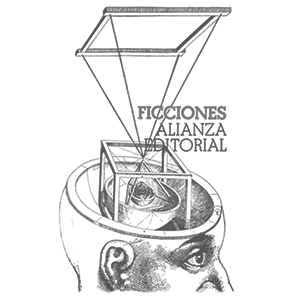
Jorge Luis Borges [bawr-hes] (1899 – 1986) was an Argentine writer whose work embraces the ‘character of unreality in all literature’; his most famous books, ‘Ficciones’ (1944) and ‘The Aleph’ (1949), are compilations of short stories interconnected by common themes such as dreams, labyrinths, libraries, mirrors, animals, fictional writers, religion, and God.
His works have contributed to the genre of science fiction and magic realism (a reaction against the realism/naturalism of the nineteenth century). In fact, critic Angel Flores, the first to use the term, set the beginning of this movement with Borges’s ‘Historia universal de la infamia’ (‘A Universal History of Infamy’) (1935). Scholars have also suggested that Borges’s progressive blindness helped him to create innovative literary symbols through imagination. His late poems dialogue with such cultural figures as Spinoza, Camões, and Virgil.
read more »
Posted in Art, Language, Politics |
Leave a Comment »
May 16, 2012

Verner Panton (1926 – 1998) is considered one of Denmark’s most influential 20th-century furniture and interior designers. During his career, he created innovative, funky and futuristic designs in a variety of materials, especially plastics, and in vibrant and exotic colors.
His style was very ‘1960s’ but regained popularity at the end of the 20th century; as of 2004, Panton’s most well-known furniture models are still in production (at Vitra, among others).
read more »
Posted in Art, Money, Technology |
Leave a Comment »
May 16, 2012

Martin Sharp (b. 1942) is an Australian artist, underground cartoonist, songwriter and film-maker. His famous psychedelic posters of Bob Dylan, Donovan, and others, rank as classics of the genre, alongside the work of Rick Griffin, Hapshash and the Coloured Coat, and Milton Glaser.
His covers, cartoons and illustrations were a central feature of ‘Oz’ magazine, both in Australia and in London. Martin co-wrote one of Cream’s most famous songs, ‘Tales of Brave Ulysses,’ created the cover art for Cream’s ‘Disraeli Gears’ and ‘Wheels of Fire’ albums, and in the 1970s, he became a champion of singer Tiny Tim, and of Sydney’s embattled Luna Park.
read more »
Posted in Art, Language |
Leave a Comment »
May 15, 2012

Acid Western is a sub-genre of the Western film that emerged in the 1960s and 1970s that combines the metaphorical ambitions of top-shelf Westerns, like ‘Shane’ and ‘The Searchers,’ with the excesses of the Spaghetti Westerns and the outlook of the counter-culture. Acid Westerns subvert many of the conventions of earlier Westerns to ‘conjure up a crazed version of autodestructive white America at its most solipsistic, hankering after its own lost origins.’
The term ‘Acid Western’ was coined in 1996 by Jonathan Rosenbaum in a review of Jim Jarmusch’s film, ‘Dead Man.’ Rosenbaum expanded upon the idea in a subsequent interview with Jarmusch for ‘Cineaste’ and later in the book ‘Dead Man’ from BFI Modern Classics. In the book, Rosenbaum illuminates several aspects of this re-revisionist Western: from Neil Young’s haunting score to the role of tobacco, to Johnny Depp’s performance, to the film’s place in the acid-Western genre.
read more »
Posted in Art, Drugs |
Leave a Comment »
May 15, 2012
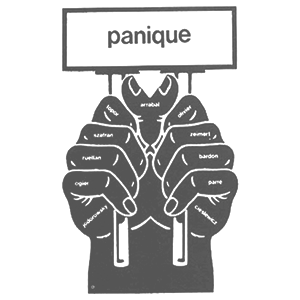
Panic Movement (‘Mouvement panique’) was a collective formed by Fernando Arrabal, Alejandro Jodorowsky, and Roland Topor in Paris in 1962. Inspired by and named after Pan (Greek god of the wild), and influenced by Luis Buñuel and Antonin Artaud’s ‘Theatre of Cruelty,’ the group concentrated on chaotic and surreal performance art, as a response to surrealism becoming petite bourgeoisie.
The movement’s violent theatrical events were designed to be shocking, and to release destructive energies in search of peace and beauty. One four-hour performance known as ‘Sacramental Melodrama’ was staged in 1965 at the Paris Festival of Free Expression. The ‘happening’ starred Jodorowsky dressed in motorcyclist leather and featured him slitting the throats of two geese, taping two snakes to his chest and having himself stripped and whipped. Other scenes included ‘naked women covered in honey, a crucified chicken, the staged murder of a rabbi, a giant vagina, the throwing of live turtles into the audience, and canned apricots.’
Posted in Art, Philosophy |
Leave a Comment »
May 15, 2012
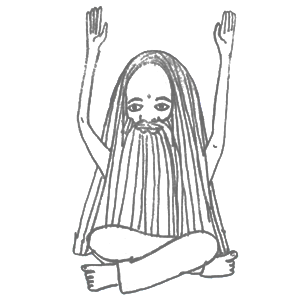
Alejandro [ali-hahn-dro] Jodorowsky [ho-dor-row-ski] (b. 1929) is a Chilean-French filmmaker and spiritual guru. Best known for his avant-garde films, he has been ‘venerated by cult cinema enthusiasts’ for his work which ‘is filled with violently surreal images and a hybrid blend of mysticism and religious provocation.’
Dropping out of college, he became involved in theater and in particular mime, working as a clown before founding his own theater troupe in 1947. After moving to Paris in the early 1950s he turned to cinema, directing the short film ‘Les têtes interverties’ in 1957. From 1960 he divided his time between Paris and Mexico City, in the former becoming a founding member of the anarchistic avant-garde Panic Movement of performance artists.
read more »
Posted in Art, Philosophy |
Leave a Comment »
May 14, 2012

Tattoos are commonly used among criminals to show gang membership and record the wearer’s personal history—such as his or her skills, specialties, accomplishments, and convictions. They are also used as a means of personal expression. Certain designs have developed recognized coded meanings. The code systems can be quite complex and because of the nature of what they encode, the tattoos are not widely recognized.
Tattooing is forbidden in most prisons. It is therefore done in secret, with makeshift equipment. For example, tattoos done in a Russian prison often have a distinct bluish color (due to being made with ink from a ballpoint pen) and usually appear somewhat blurred because of the lack of instruments to draw fine lines. The ink is often created from burning the heel of a shoe and mixing the soot with urine (for sterilization), and injected into the skin utilizing a sharpened guitar string attached to an electric shaver.
read more »
Posted in Art, Politics, World |
2 Comments »
May 14, 2012

Prison tattoos often signal gang membership, form a code, or have hidden meanings. However, due to the lack of proper equipment and sterile environments in prison, the practice poses health risks.
Tattooing in prison is illegal in the U.S., but inmates find ways to create their own tattooing devices out of their belongings. Improvised equipment is assembled from mechanical pencils, magnets, radio transistors, staples, paper clips, guitar strings, and other common items.
read more »
Posted in Art, Health, Politics |
6 Comments »
May 14, 2012
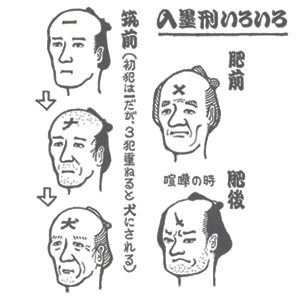
Irezumi [ee-reh-zoo-mee] (literally ‘insert ink’) refers to the insertion of ink under the skin to leave a permanent, usually decorative mark; a form of Japanese tattooing. Tattooing for spiritual and decorative purposes in Japan is thought to extend back to the paleolithic period (approximately 10,000 BCE). Some scholars have suggested that the distinctive cord-marked patterns observed on the faces and bodies of figures dated to that period represent tattoos, but this claim is controversial. There are similarities, however, between such markings and the tattoo traditions observed in other contemporaneous cultures.
In the following Yayoi period (c. 300 BCE–300) tattoo designs were observed and remarked upon by Chinese visitors. Such designs were thought to have spiritual significance as well as functioning as a status symbol. Starting in the Kofun period (300–600) tattoos began to assume negative connotations. Instead of being used for ritual or status purposes, tattooed marks began to be placed on criminals as a punishment (this was mirrored in ancient Rome, where slaves were known to have been tattooed with mottoes such as ‘I am a slave who has run away from his master’). The Ainu people, the indigenous people of Japan, are known to have used tattoos for decorative and social purposes, but there is no known relation to the development of irezumi.
read more »
Posted in Art, Politics, World |
Leave a Comment »
May 11, 2012

Himanshu Kumar Suri aka Heems is an American rapper from Queens best known for being part of the alternative hip hop group Das Racist. Suri is also the founder of Greedhead Entertainment, an independent record label. In 2012, he released his first solo mixtape, ‘Nehru Jackets’ on his Greedhead imprint and in conjunction with SEVA NY, a community-based organization from Queens of which Suri is a board member. Suri has also written about music and all things South Asian for the ‘Village Voice,’ ‘Death and Taxes’ magazine, ‘Fuse,’ ‘Stereogum,’ and ‘Alternet.’ Suri graduated from Stuyvesant High School in 2003, where he was vice president when the September 11 attacks happened two blocks away. Suri then attended Wesleyan University where he studied economics.
In 2008, Suri formed Das Racist with his college friend Victor Vazquez. Shortly thereafter, Suri’s high school friend Ashok Kondabolu joined as their hype man. Das Racist first found success on the internet with their 2008 song ‘Combination Pizza Hut and Taco Bell,’ and then quickly established themselves within the underground rap scene with their 2010 mixtapes ‘Shut Up, Dude’ and ‘Sit Down, Man,’ both of which earned them critical acclaim.
Posted in Art |
Leave a Comment »
May 11, 2012
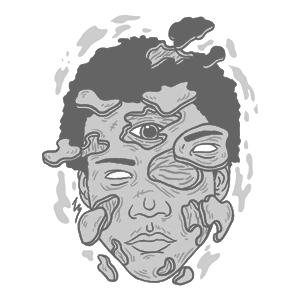
Donald Glover (b. 1983) is an American actor, writer, comedian, and musician. Glover first came to attention for his work in the sketch group Derrick Comedy. He is best known for being a writer for ’30 Rock,’ and for his role the NBC comedy series ‘Community.’ In 2011, Glover signed to Glassnote Records under the stage name Childish Gambino; his first studio album, ‘Camp,’ was released in 2011. Glover DJs and produces his own music under the moniker ‘mcDJ.’
His music is of the electronic/remix variety and is often made available for free download via his official site. Glover raps as Childish Gambino, a name he found from a Wu-Tang Clan name generator. His work touches on family issues, schoolyard bullying, troubled romantic relationships, suicidal thoughts, and alcoholism. He has disowned his 2005 album, ‘The Younger I Get,’ as the too-raw ramblings of what he calls a ‘decrepit Drake.’
Posted in Art, Humor |
Leave a Comment »


 The Daily Omnivore