May 24, 2012

Frame rate is the frequency (rate) at which an imaging device produces unique consecutive images called frames. The term applies equally well to computer graphics, video cameras, film cameras, and motion capture systems. Frame rate is most often expressed in frames per second (FPS), and is also expressed in progressive scan monitors as hertz (Hz).
The human visual system can process 10 to 12 separate images per second, perceiving them individually. The visual cortex holds onto one image for about one-fifteenth of a second, so if another image is received during that period an illusion of continuity is created, allowing a sequence of still images to give the impression of motion.
read more »
Posted in Art, Money, Technology |
Leave a Comment »
May 24, 2012
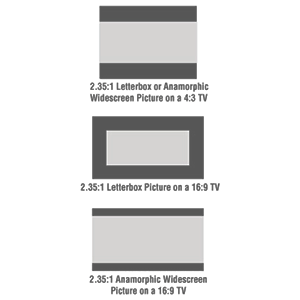
Letterboxing is the practice of transferring film shot in a widescreen aspect ratio to standard-width video formats while preserving the film’s original aspect ratio. The resulting videographic image has mattes (black bars) above and below it; these mattes are part of the image (i.e., of each frame of the video signal). LTBX is the identifying abbreviation for films and images so formatted. The term refers to the shape of a letter box, a slot in a wall or door through which mail is delivered, being rectangular and wider than it is high.
Letterboxing is used as an alternative to a full-screen, pan-and-scan transfer of a widescreen film, in which the original image is cropped to the narrower aspect ratio of the destination format, usually the 1.33:1 (4:3) ratio of the standard television screen, whereas letterboxing preserves the film’s original image composition as seen in the cinema. Letterboxing was developed for use in 4:3 television displays before widescreen television screens were available, but it is also necessary to represent on a 16:9 widescreen display the unaltered original composition of a film with a wider aspect ratio, such as Panavision’s 2.35:1 ratio.
read more »
Posted in Art, Money, Technology |
5 Comments »
May 22, 2012
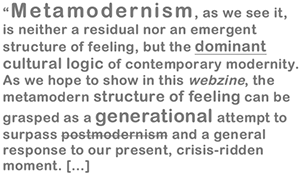
Metamodernism is a term employed to situate and explain recent developments across current affairs, critical theory, philosophy, architecture, art, cinema, music and literature which are emerging from and reacting to postmodernism.
The term metamodernism was introduced as an intervention in the post-postmodernism debate by the cultural theorists Timotheus Vermeulen and Robin van den Akker in 2010. In their article ‘Notes on metamodernism’ they assert that the 2000s are characterized by the return of typically modern positions without altogether forfeiting the postmodern mindsets of the 1990s and 1980s.
read more »
Posted in Art, Language, Philosophy |
Leave a Comment »
May 22, 2012

Postmodernism is an era and a broad movement that developed in the mid to late 20th century that rejects the idea of objective truth and universal social progress. Starting with the 18th century Enlightenment, and for more than a century there was widespread belief that science and knowledge would improve the world; social progress would be inevitable. Modernism in particular held these beliefs. Postmodernism challenges that notion.
Although the term was first used around 1870, its modern appearance was to express criticism of modern architecture in 1949, leading to the postmodern architecture movement (a return to surface ornament, historical reference in decorative forms, and less boxy shapes). Postmodernism is not a method, but rather a way of approaching traditional ideas and practices in non-traditional ways that deviate from pre-established modes. Postmodernism gained significant popularity in the 1950s and dominated literature and art by the 1960s.
read more »
Posted in Art, Language, Philosophy |
Leave a Comment »
May 21, 2012

Adventure Time is an American animated television series created by Pendleton Ward (a former writer and storyboard artist of ‘The Marvelous Misadventures of Flapjack’) and produced by Frederator Studios for Cartoon Network. The series follows the adventures of Finn, a 14-year old boy whose best friend is Jake, a dog with magical powers such as growing and shrinking or stretching into many shapes. Finn and Jake live in the post-apocalyptic Land of Ooo.Ward describes Finn as a ‘fiery little kid with strong morals,’ while Jake is based on Bill Murray’s character in the movie ‘Meatballs.’ The series is based on a short produced for Frederator’s Nickelodeon animation incubator series ‘Random! Cartoons.’ After the short became a viral hit on the Internet, Cartoon Network picked it up for a full-length series that premiered in 2010.
According to Ward, the show’s style was influenced by his time at CalArts and his work as a storyboard artist on ‘The Marvelous Misadventures of Flapjack.’ He tries to include ‘beautiful’ moments like those in Hayao Miyazaki’s ‘My Neighbor Totoro’ and some subversive humor, inspired by series like ‘The Simpsons’ and ‘Pee-wee’s Playhouse.’ Executive producer Fred Seibert compares the show’s animation style to that of ‘Felix the Cat’ and the Max Fleischer cartoons (e.g. ‘Betty Boop,’ ‘Popeye’) but says its world is also equally inspired by ‘Dungeons and Dragons’ and video games. Ward intends the show’s world to have a certain physical logic instead of ‘cartoony slapstick’ — even though magic exists in the story, the show’s writers try to create an internal consistency in how the characters interact with the world.
Posted in Art, Humor |
Leave a Comment »
May 21, 2012

The drop is the point in a track where a switch of rhythm or bass line occurs and usually follows a recognizable build section and break. In Hip-Hop and electronic music, the reintroduction of the full bass line and drums is known as the drop. In Dubstep, the drop involves a full bass line and commonly a ‘wobble’ bass or ‘vowel’ bass accompanied by a strong shuffling beat.
In Metalcore sub-genres, bass drops are often utilized under the first chord of a breakdown, to emphasize the breakdown and give it a pronounced presence. In drum and bass, DJs sometimes perform what is called the ‘double drop’: beat matching two tracks in a way that the drop, and hence the respective climaxes, occur at the same time.
Posted in Art, Language |
1 Comment »
May 21, 2012

Magic realism is an aesthetic style or genre of fiction in which magical elements blend with the real world. The story explains these magical elements as real occurrences, presented in a straightforward manner that places the ‘real’ and the ‘fantastic’ in the same stream of thought. One example, is when a character in the story continues to be alive beyond the normal length of life and this is subtly depicted by the character being present throughout many generations.
On the surface the story has no clear magical attributes and everything is conveyed in a real setting, but such a character breaks the rules of our real world. The author may give precise details of the real world such as the date of birth of a reference character and the army recruitment age, but such facts help to define an age for the fantastic character of the story that would turn out to be an abnormal occurrence like someone living for two hundred years.
read more »
Posted in Art, Language, World |
Leave a Comment »
May 21, 2012
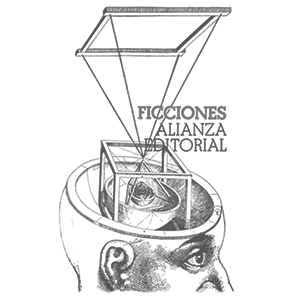
Jorge Luis Borges [bawr-hes] (1899 – 1986) was an Argentine writer whose work embraces the ‘character of unreality in all literature’; his most famous books, ‘Ficciones’ (1944) and ‘The Aleph’ (1949), are compilations of short stories interconnected by common themes such as dreams, labyrinths, libraries, mirrors, animals, fictional writers, religion, and God.
His works have contributed to the genre of science fiction and magic realism (a reaction against the realism/naturalism of the nineteenth century). In fact, critic Angel Flores, the first to use the term, set the beginning of this movement with Borges’s ‘Historia universal de la infamia’ (‘A Universal History of Infamy’) (1935). Scholars have also suggested that Borges’s progressive blindness helped him to create innovative literary symbols through imagination. His late poems dialogue with such cultural figures as Spinoza, Camões, and Virgil.
read more »
Posted in Art, Language, Politics |
Leave a Comment »
May 16, 2012

Verner Panton (1926 – 1998) is considered one of Denmark’s most influential 20th-century furniture and interior designers. During his career, he created innovative, funky and futuristic designs in a variety of materials, especially plastics, and in vibrant and exotic colors.
His style was very ‘1960s’ but regained popularity at the end of the 20th century; as of 2004, Panton’s most well-known furniture models are still in production (at Vitra, among others).
read more »
Posted in Art, Money, Technology |
Leave a Comment »
May 16, 2012

Martin Sharp (b. 1942) is an Australian artist, underground cartoonist, songwriter and film-maker. His famous psychedelic posters of Bob Dylan, Donovan, and others, rank as classics of the genre, alongside the work of Rick Griffin, Hapshash and the Coloured Coat, and Milton Glaser.
His covers, cartoons and illustrations were a central feature of ‘Oz’ magazine, both in Australia and in London. Martin co-wrote one of Cream’s most famous songs, ‘Tales of Brave Ulysses,’ created the cover art for Cream’s ‘Disraeli Gears’ and ‘Wheels of Fire’ albums, and in the 1970s, he became a champion of singer Tiny Tim, and of Sydney’s embattled Luna Park.
read more »
Posted in Art, Language |
Leave a Comment »
May 15, 2012

Acid Western is a sub-genre of the Western film that emerged in the 1960s and 1970s that combines the metaphorical ambitions of top-shelf Westerns, like ‘Shane’ and ‘The Searchers,’ with the excesses of the Spaghetti Westerns and the outlook of the counter-culture. Acid Westerns subvert many of the conventions of earlier Westerns to ‘conjure up a crazed version of autodestructive white America at its most solipsistic, hankering after its own lost origins.’
The term ‘Acid Western’ was coined in 1996 by Jonathan Rosenbaum in a review of Jim Jarmusch’s film, ‘Dead Man.’ Rosenbaum expanded upon the idea in a subsequent interview with Jarmusch for ‘Cineaste’ and later in the book ‘Dead Man’ from BFI Modern Classics. In the book, Rosenbaum illuminates several aspects of this re-revisionist Western: from Neil Young’s haunting score to the role of tobacco, to Johnny Depp’s performance, to the film’s place in the acid-Western genre.
read more »
Posted in Art, Drugs |
Leave a Comment »
May 15, 2012
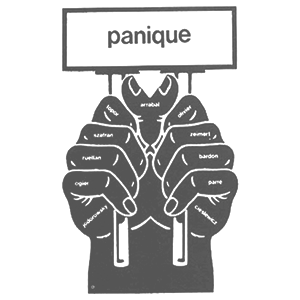
Panic Movement (‘Mouvement panique’) was a collective formed by Fernando Arrabal, Alejandro Jodorowsky, and Roland Topor in Paris in 1962. Inspired by and named after Pan (Greek god of the wild), and influenced by Luis Buñuel and Antonin Artaud’s ‘Theatre of Cruelty,’ the group concentrated on chaotic and surreal performance art, as a response to surrealism becoming petite bourgeoisie.
The movement’s violent theatrical events were designed to be shocking, and to release destructive energies in search of peace and beauty. One four-hour performance known as ‘Sacramental Melodrama’ was staged in 1965 at the Paris Festival of Free Expression. The ‘happening’ starred Jodorowsky dressed in motorcyclist leather and featured him slitting the throats of two geese, taping two snakes to his chest and having himself stripped and whipped. Other scenes included ‘naked women covered in honey, a crucified chicken, the staged murder of a rabbi, a giant vagina, the throwing of live turtles into the audience, and canned apricots.’
Posted in Art, Philosophy |
Leave a Comment »



