April 26, 2012
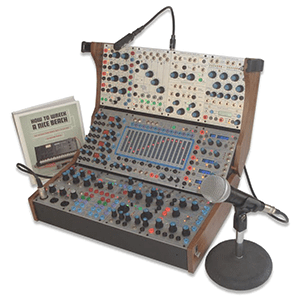
Don Buchla (b. 1937) is a pioneer in the field of sound synthesizers, releasing his first units months after Robert Moog’s first synthesizers. Buchla formed his electronic music equipment company, Buchla and Associates, in 1962 in Berkeley, California. Buchla was commissioned by avant garde music composers Morton Subotnick and Ramon Sender, both of the San Francisco Tape Music Center (which studies the incorporation of electric sound production into compositional practice), to create an electronic instrument for live performance. Under a grant from the Rockefeller Foundation Buchla completed his first modular synthesizer in 1963. The result was the Buchla Series 100, which he began selling in 1966. Buchla’s synthesizers experimented in control interfaces, such as touch-sensitive plates. In 1969 the Series 100 was sold to CBS, who soon after dropped the line, not seeing the synthesizer market as a profitable area.
In 1970 the Buchla 200 series Electric Music Box was released and was manufactured until 1985. Buchla created the Buchla Series 500, the first digitally controlled analog synthesizer, in 1971. Shortly after, the Buchla Series 300 was released, which combined the Series 200 with microprocessors. The Music Easel, a small, portable, all-in-one synthesizer was released in 1972. The Buchla 400 was released in 1982, which featured a video display. In 1987 the fully MIDI enabled Buchla 700 was released. Beginning in the 1990s, Buchla began designing alternative MIDI controllers, such as the Thunder, Lightning, and Marimba Lumina. With the recent resurgence of interest in analog synthesizers Buchla has released a revamped 200 series called the 200e.
Posted in Art, Money, Technology |
Leave a Comment »
April 26, 2012
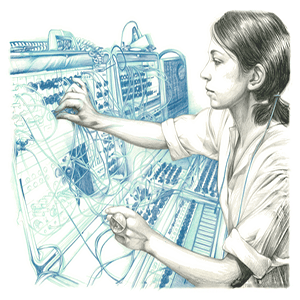
Suzanne Ciani [cha-nee] (b. 1946) is an Italian American pianist and music composer who found early success with innovative electronic music. She received classical music training at Wellesley College and obtained her M.A. in music composition in 1970 at University of California, Berkeley where she met and was influenced by the synthesizer designer, Don Buchla. She studied computer generated music with John Chowning and Max Mathews at Stanford’s Artificial Intelligence Labs in the early 1970s.
In 1974 she formed her own company, Ciani/Musica, and, using a Buchla Analog Modular Synthesizer, composed scores for television commercials for corporations such as Coca-Cola, Merrill Lynch, AT&T, and General Electric. Besides music, her specialty was reproducing sound effects on the synthesizer that recording engineers had found difficult to record properly; the sound of a bottle of Coca-Cola being opened and poured was one of Ciani’s most widely recognized works, and was used in a series of radio and television commercials in the late 1970s.
read more »
Posted in Art, Money, Technology |
1 Comment »
April 25, 2012

Copenhagen Distortion is a festival for club culture in the streets of Copenhagen, Denmark, and in dozens of unusual locations around city, every year during the week of the first Saturday in June. The festival’s cultural focus is on club culture, upfront dance music, street life, contemporary art (only when related to nightlife or public space), social art and Copenhagen’s new independent media (print and web).
Copenhagen Distortion is ‘a celebration of streetlife & nightlife’ orchestrating 150+ dancefloors hosted by 150+ local and international icons of streetlife and nightlife (people, shops, clubs, galleries, labels, and magazines). The characteristic Distortion atmosphere involves high-energy impulsive chaos with a strong ‘streetlife freedom’ feel. The music selection is sharp and upfront: names like Hot Chip, Simian Mobile Disco, Spank Rock, and Sebastien Tellier were booked for Distortion events before they had become underground heroes of international scope. The festival has always been a Copenhagen leader in the field of using urban space and unusual locations.
Posted in Art, World |
1 Comment »
April 23, 2012

The Force is a binding, metaphysical, and ubiquitous power in the fictional universe of the ‘Star Wars’ galaxy created by George Lucas. Mentioned in the first film in the series, it is integral to all subsequent incarnations of Star Wars, including the expanded universe of comic books, novels, and video games. Within the franchise, it is the object of the Jedi and Sith monastic orders. Lucas has attributed the origins of ‘The Force’ to a 1963 abstract film by Arthur Lipsett, called ’21-87,’ which sampled from many sources. One of the audio sources Lipsett sampled was a conversation between artificial intelligence pioneer Warren S. McCulloch and Roman Kroitor, a cinematographer who went on to develop IMAX.
In the face of McCulloch’s arguments that living beings are nothing but highly complex machines, Kroitor insists that there is something more: ‘Many people feel that in the contemplation of nature and in communication with other living things, they become aware of some kind of force, or something, behind this apparent mask which we see in front of us, and they call it God.’ When asked if this was the source of ‘the Force,’ Lucas confirms that his use of the term in ‘Star Wars’ was ‘an echo of that phrase in ’21-87.’ The idea behind it, however, was universal: ‘Similar phrases have been used extensively by many different people for the last 13,000 years to describe the ‘life force,” he says.
read more »
Posted in Art, Philosophy |
Leave a Comment »
April 23, 2012
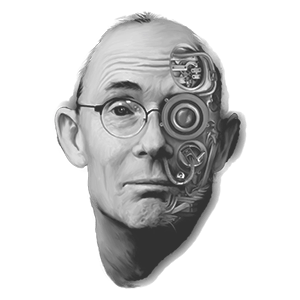
In William Gibson’s fiction, the Sprawl is a colloquial name for the Boston-Atlanta Metropolitan Axis (BAMA), an urban sprawl environment on a massive scale, and a fictional extension of the real Northeast Megalopolis. The novels ‘Neuromancer’ (1984), ‘Count Zero’ (1986), and ‘Mona Lisa Overdrive’ (1988) (collectively known as the Sprawl trilogy) take place in this environment, as do the short stories ‘Johnny Mnemonic,’ ‘New Rose Hotel,’ ‘Burning Chrome,’ and ‘Fragments of a Hologram Rose.’
The Sprawl is a visualization of a future where virtually the entire East Coast of the United States, from Boston to Atlanta, has melded into a single mass of urban sprawl. It has been enclosed in several geodesic domes and merged into one megacity. The city has become a separate world with its own climate, no real night/day cycle, and an artificial sky that is always grey. It is said of the Sprawl that ‘the actors change but the play remains the same.’
Posted in Art, Language, Technology |
Leave a Comment »
April 22, 2012

Liquid funk is a sub-genre of drum and bass. While it uses similar basslines and bar layouts to other styles, it contains fewer bar-oriented samples and more instrumental layers (both synthesized and natural), harmonies, and ambience, producing a calmer atmosphere directed at both home listeners and nightclub audiences. In 2000, Fabio began championing a new form of drum and bass he called ‘Liquid funk,’ with a compilation release of the same name on his Creative Source label. This was characterized by influences from disco and house music, and widespread use of vocals. Although slow to catch on at first, the style grew massively in popularity around 2003–2004, and by 2005 it was established as one of the biggest-selling subgenres in drum and bass.
Liquid funk is very similar to intelligent drum and bass, but has subtle differences. Liquid funk has stronger influences from soca, latin, disco, jazz, and funk music, while IDB creates a calmer yet more synthetic sound, using smooth synth lines and samples in place of the organic element achieved by use of real instruments.
Posted in Art |
Leave a Comment »
April 21, 2012

Noisia, stylized as NOISIΛ (‘VISION’ rotated 180°), is a Dutch electronic music trio consisting of Nik Roos, Martijn van Sonderen, and Thijs de Vlieger from The Netherlands. They produce drum and bass, dubstep, breakbeat, and house music.
For a time between 2005 and 2009, NOISIΛ also released tracks under the name ‘Drifter,’ encompassing the lighter side of Drum and Bass known as ‘Liquid Funk,’ as well as releasing a EP under the name ‘Hustle Athletics.’ They later decided to go back to releasing all their music under the name ‘NOISIΛ’ so as to not confuse the audience and to avoid being pigeonholed into different genres with different names.
Posted in Art |
Leave a Comment »
April 20, 2012


A demo (demonstration) is a non-interactive multimedia presentation made within the computer subculture known as the demoscene. Demogroups create demos to demonstrate their abilities in programming, music, drawing, and 3D modeling.
The key difference between a classical animation and a demo is that the display of a demo is computed in real time, making computing power considerations the biggest challenge. Demos are mostly composed of 3D animations mixed with 2D effects and full screen effects.
read more »
Posted in Art, Games, Technology |
Leave a Comment »
April 19, 2012

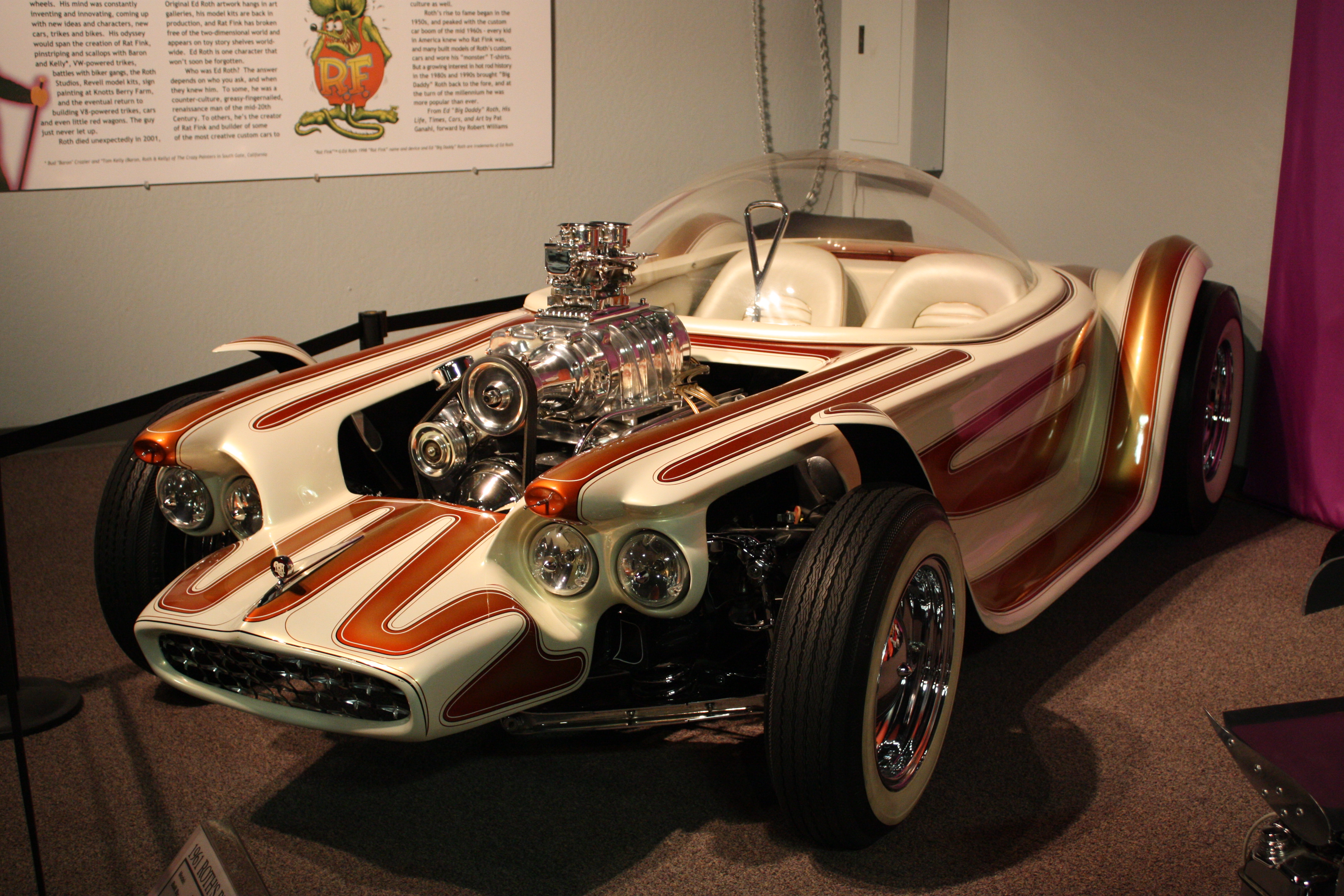
The Beatnik Bandit is a custom car created in 1961 by ‘Big Daddy’ Ed Roth, originally as a project for ‘Rod & Custom magazine’; instead of a steering wheel, it was controlled by a joystick.
A Hot Wheels car was made based on the Beatnik Bandit. The car is a representation of ‘Kustom Kulture,’ a neologism used to describe the oeuvre of those who drove and built custom cars and motorcycles in the US from the 1950s through today.
Posted in Art, Technology |
Leave a Comment »
April 19, 2012


Beatmatching is a disc jockey technique of pitch shifting or timestretching a track to match its tempo to that of the currently playing track e.g. the kicks and snares in two house records hit at the same time when both records are played simultaneously. Beatmatching is a component of mixing which employs beatmatching combined with equalization, attention to phrasing, and track selection in an attempt to make a single mix that flows together and has a good structure.
The technique was developed to keep people from leaving the dancefloor at the end of a song. Currently, it is considered basic among DJs in electronic dance music genres, and it is standard practice in clubs to keep the constant beat through the night, even if DJs change in the middle. Beatmatching is no longer considered a novelty, and new digital mixers have made the technique much easier to master.
read more »
Posted in Art |
Leave a Comment »
April 18, 2012

Quentin Tarantino (b. 1963) is an American film director, screenwriter, producer, cinematographer, and actor. In the early 1990s, he began his career as an independent filmmaker with films employing nonlinear storylines and the aestheticization of violence.
His films include ‘Reservoir Dogs’ (1992), ‘Pulp Fiction’ (1994), ‘Jackie Brown’ (1997), ‘Kill Bill’ (2003, 2004), ‘Death Proof’ (2007), and ‘Inglourious Basterds’ (2009). His movies are generally characterized by stylistic influences from grindhouse, kung fu, and spaghetti western films. Tarantino also frequently collaborates with his friend and fellow filmmaker Robert Rodriguez.
read more »
Posted in Art |
1 Comment »
April 17, 2012

Lorin Ashton, better known by the stage name Bassnectar, is a freeform electronic music and dubstep artist, DJ, and producer based in San Francisco. He is best known for his live performances, light shows, and community engagement. Bassnectar was originally influenced by heavy metal and grunge groups such as Metallica, Megadeth, and Nirvana, bringing these influences with him into his own musical career. He’s also mentioned that early IDM and Ambient artists like Orbital also played a major influence.
He has been creating genre-bending music since the 1990s, using a variety of programs such as Vision/OpCode, Reason, and Ableton Live. Bassnectar describes his music as amorphous and ever-changing, which is reflected in the distinct sounds and personalities of his numerous albums, EPs, and podcasts. He has collaborated with and remixed a host of artists and producers, including Lupe Fiasco, Ellie Goulding, Gogol Bordello, Sound Tribe Sector 9, Datsik, ill.Gates, and Jantsen, among others.
Posted in Art, Technology |
1 Comment »