April 17, 2012

Neo-psychedelia is music that emulates or is heavily influenced by the psychedelic music of the 1960s. It began to be revived among British post-punk bands of the later 1970s and early 1980s and was taken up by groups including bands of the Paisley Underground and Madchester scenes, as well as occasional interest from mainstream artists and bands into the new millennium.
Neo-psychedelic acts borrowed a variety of elements from 1960s psychedelic music. Some emulated the psychedelic pop of bands like The Beatles and early Pink Floyd, others adopted the jangly guitars of folk rock bands like the Byrds-influenced guitar rock, or distorted free-form jams and sonic experimentalism of late 1960s acid rock. Some neo-psychedelia has been explicitly focused on drug use and experiences, while other bands have used it to accompany surreal or political lyrics.
read more »
Posted in Art, Drugs, World |
Leave a Comment »
April 16, 2012

The Residents are an American art collective best known for avant-garde music and multimedia works. The first official release under the name of The Residents was in 1972, and the group has since released over sixty albums, numerous music videos and short films, three CD-ROM projects and ten DVDs. They have undertaken seven major world tours and scored multiple films. Throughout the group’s existence, the individual members have ostensibly attempted to operate under anonymity, preferring instead to have attention focused on their art output.
Much outside speculation and rumor has focused on this aspect of the group. In public, the group appears silent and costumed, often wearing eyeball helmets, top hats and tuxedos – a long-lasting costume now recognized as their signature iconography. Their albums generally fall into two categories: deconstructions of Western popular music, or complex conceptual pieces, composed around a theme, theory or plot. They are noted for surrealistic lyrics and sound, disregard for conventional music composition, and the over the top, theatrical spectacle of their live performances.
read more »
Posted in Art, Humor |
Leave a Comment »
April 12, 2012


A calligram [kal-uh-gram] is a poem, phrase, or word in which the typeface, calligraphy, or handwriting is arranged in a way that creates a visual image. The image created by the words expresses visually what the word, or words, say. In a poem, it manifests visually the theme presented by the text of the poem.
Guillaume Apollinaire was a famous calligram writer and author of a book of poems called ‘Calligrammes.’ His poem written in the form of the Eiffel Tower is an example of a calligram.
Posted in Art, Language |
Leave a Comment »
April 12, 2012

Eye music (often referred to in English by its exact German translation ‘Augenmusik’) describes graphical features of scores that when performed are unnoticeable by the listener. A clear definition of eye music is elusive, for the border between eye music, word painting, and representations of melody and form depends on the relationships of composer, performer, and listener. Word painting (also known as tone painting or text painting) is writing music that reflects the literal meaning of a song (r.g. ascending scales would accompany lyrics about going up; slow, dark music would accompany lyrics about death).
To a person well-versed in the style of Baroque music, word painting is, as intended, noticed. But someone unused to Baroque musical style may not appreciate that musical effect – to them they are merely notes and lyrics. In this case, word painting is no longer the issue. For them, the ‘leaps’ of written notes are unhearable, but are visible only to the composer or performer: a definition of eye music.
read more »
Posted in Art, Language |
Leave a Comment »
April 12, 2012
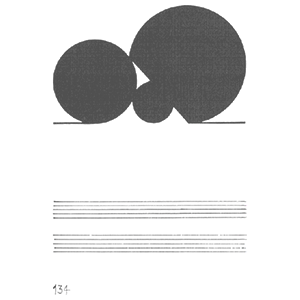
Graphic notation is the representation of music through the use of visual symbols outside the realm of traditional music notation. Graphic notation evolved in the 1950s, and it is often used in combination with traditional music notation. Composers often rely on graphic notation in experimental music, where standard musical notation can be ineffective. A common aspect of graphic notation is the use of symbols to convey information to the performer about the way the piece is to be performed. These symbols first began to appear in the works of avant-garde composers such as Morton Feldman, Karlheinz Stockhausen, and Krzysztof Penderecki, as well as the works of experimental composers such as John Cage and Earle Brown during the 1950s and 60s. In the late 1970s, the Brazilian composer Emanuel Dimas de Melo Pimenta started producing graphic notation in four dimensions, inside virtual reality.
After working as Stockhausen’s assistant, Cornelius Cardew began work on a massive graphic score, which he titled ‘Treatise.’ The piece consists of 193 pages of highly abstract scores. The score itself is almost its own separate work of art. In 2008, Theresa Sauer edited a compendium featuring graphic scores by composers from over fifty countries, demonstrating how widespread the practice has become. Notable graphic scores(in which the music is represented using symbols and illustrations) include: Hans-Christoph Steiner’s score for ‘Solitude,’ created using the Pure Data programming language. Altered Notation can be seen in George Crumb’s work, where he uses traditional notation but presents the music on the page in a graphic or nontraditional manner such as spirals or circles.
Posted in Art, Language |
Leave a Comment »
April 11, 2012
Vidding is the fan labor practice in media fandom of creating music videos from the footage of one or more visual media sources, thereby exploring the source itself in a new way. The creator may explore a single character, support a particular romantic pairing between characters, criticize or celebrate the original text, or point out an aspect of the TV show or film that they find under-appreciated. The creators refer to themselves as ‘vidders,’ their product as ‘vids,’ ‘fanvids,’ or ‘songvids,’ and the act itself as ‘vidding.’
Vidding can occur within a fandom; however, it is also often considered its own fandom, as vidding fans will often watch vids simply because they are vids. (This is distinct from fan fiction readers and other fans, for instance, who tend to choose what to engage based on source text more than form.) Accordingly, vidding has its own dedicated fan convention, Vividcon. Fan videos within the world of anime fandom are distinct from the videos created by vidders. A fan-made music video using anime footage fans is called an anime music video or AMV, not a fanvid. While a large number of anime video makers are male, the bulk of vidders in media fandom are women.
read more »
Posted in Art, Money, Technology |
1 Comment »
April 11, 2012

ccMixter.org is a community music site that promotes remix culture and makes samples, remixes, and a cappella tracks licensed under Creative Commons available for download and re-use in creative works. Visitors are able to listen to, sample, mash-up, or interact with music in a variety of ways including the download and use of tracks and samples in their own remixes.
Most sampling or mash-up web sites on the Internet stipulate that users forgo their rights to the new song once it is created. By contrast, the material on ccMixter.org is generally licensed to be used in any arena, not just the ccMixter site or a specific contest. The ccMixter site contains over 10,000 samples from a wide range of recording artists, including high profile artists such as Beastie Boys and David Byrne.
read more »
Posted in Art, Money, Politics |
Leave a Comment »
April 11, 2012
WhoSampled is a website and database of information about sample-based music founded in London. WhoSampled compares original songs with covered songs or songs that ‘borrowed’ samples, it serves as a historical line of where songs have come from and where they’re going. Registered users can submit information about a sample, remix or cover and subject, waiting for moderator’s approval that will let the entry to be published on the site.
The visitor of the site gets a comprehensive list of who that artist has sampled and how, and how that artist him/herself has been sampled. The comparison of original song and the song that sampled, covered or remixed it, is done side by side with embedded tracks or videos. All audio and video clips shown on the site are embedded links to content hosted by third party services, such as YouTube or DailyMotion. The process and idea of the site of being a tool for research and music discovery, is similar to another project called Music Genome Project, both wanting to ‘explore the DNA of music.’
Posted in Art, Money, Politics |
Leave a Comment »
April 11, 2012


A remix is an alternative version of a recorded song, made from an original version. Sometimes this term is also used for alterations of media or recreation other than song (film, literature, beverages etc.). In remixing, a person (often a recording engineer or record producer) takes a familiar song, splits it into different parts called tracks, and changes the song’s music, instruments, layout, and or vocals to create a new version of the same song.
It is called remixing due to mixing being the putting together of all the parts of a song, and remixing being the putting together of the parts of the song differently than the original. Remixers, that is, people who remix, are musicians who use a variety of tools, primarily electronic, to create the new song versions. Remixing can be simply moving song parts around; it can also be creating new music for an old song lyric. The most popular types of remixing are production remixing, where new instruments are used with the old song vocal, and mashups, in which two old songs are mixed together.
read more »
Posted in Art, Money, Politics |
1 Comment »
April 10, 2012

Dr. Horrible’s Sing-Along Blog is a 2008 musical tragicomedy miniseries in three acts, produced exclusively for Internet distribution. Filmed and set in Los Angeles, the show tells the story of Dr. Horrible (played by Neil Patrick Harris), an aspiring supervillain; Captain Hammer (Nathan Fillion), his nemesis; and Penny (Felicia Day), their shared love interest.
The movie was written by writer/director Joss Whedon, his brothers Zack Whedon (a television writer) and Jed Whedon (a composer), and Jed’s wife, actress Maurissa Tancharoen. The team wrote the musical during the 2007–2008 Writers Guild of America strike. The idea was to create something small and inexpensive, yet professionally done, in a way that would circumvent the issues that were being protested during the strike.
Posted in Art, Humor, Money |
1 Comment »
April 10, 2012

The Second City is an improvisational comedy enterprise which originated in Chicago’s Old Town neighborhood. The Second City Theatre opened in late 1959 and has since expanded its presence to several other cities, including Toronto and Los Angeles.
The Second City has produced television programs in both the United States and Canada including ‘SCTV,’ ‘Second City Presents’, and ‘Next Comedy Legend,’ as well as being heavily involved in the creation of the satirical 1969 science fiction film ‘The Monitors.’ Since its debut, the Second City has consistently been a starting point for comedians, award winning actors, directors, and others in show business.
read more »
Posted in Art, Games, Humor |
Leave a Comment »
April 10, 2012

The Compass Players (or Compass Theater) was a cabaret revue show started by alumni, dropouts and hangers-on from the University of Chicago from 1955-1958 in Chicago and St. Louis. Several of the members went on to form The Second City Theater in 1959. Founded by David Shepherd, the original idea was to produce a new play derived through improvisation from outlines (in the tradition of the Italian commedia dell’arte) or scenarios written by members of the ensemble.
Shepherd turned to director Paul Sills to head this venture based on his experience working with Sills on an earlier Chicago theater effort. He noticed that Sills in rehearsal employed theater games, structures designed to create spontaneous theatrical play between actors that had been developed and named by Sills’ mother, Viola Spolin (who would later author the ‘bible’ of theater games, ‘Improvisation for the Theatre’).
read more »
Posted in Art, Games, Humor |
Leave a Comment »


 The Daily Omnivore