March 24, 2012
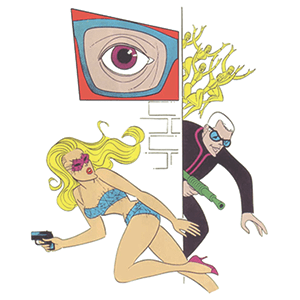
The 10th Victim (Italian: ‘La decima vittima’) is a 1965 Italian/French international co-production science fiction film directed by Elio Petri. It is based on Robert Sheckley’s 1953 short story ‘Seventh Victim.’ Sheckley later published a novelization of the film in 1966. In the near future, big wars are avoided by giving individuals with violent tendencies a chance to kill in the ‘Big Hunt.’ The Hunt is the most popular form of entertainment in the world and also attracts participants who are looking for fame and fortune. It includes ten rounds for each competitor, five as the hunter and five as the victim. The survivor of ten rounds becomes extremely wealthy and retires.
Scenes switch between the pursuit, romance between the hunter and the victim, and a narrator explaining the rules and justification of the Hunt. Caroline Meredith (Ursula Andress) is the huntress armed with a high caliber Bosch shotgun looking for her tenth victim. Marcello Poletti (Marcello Mastroianni) is the victim. He is reluctant to kill Meredith as he is not sure whether she is his hunter, but then later because they become romantically involved. To maximize financial gain, Meredith wants to get a perfect kill in front of the cameras as she has negotiated a major sponsor from the Ming Tea Company.
Posted in Art, Games, Money |
Leave a Comment »
March 24, 2012
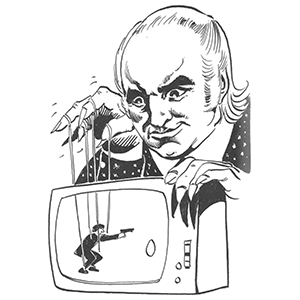
The Prize of Peril is a science fiction short-story by Robert Sheckley, written in 1958 and first published in the collection ‘Store of Infinity’ in 1960 by Bantam Books. The short story is noted for its plot’s anticipation of Reality television shows such as Survivor and Fear Factor by several decades. The screenplay for the fake German reality show ‘Das Millionenspiel’ (‘The Million Game’) was based on the story, as was the French film version of ‘Das Millionenspiel,’ ‘Le prix du danger.’ The protagonist of the story is Jim Raeder, a man only notable due to his normality, who has been a participant in many reality television-shows (given the name ‘thrill shows’) and thus become a celebrity.
In all the shows the risk of dying has been a part of the concept; he has fought a real bull in Spain, he has driven a Formula 1-car, and fought with other divers while trying to escape sharks and other sea monsters. In the story he partakes in the greatest of all reality shows; he is to be hunted by professional gangland murderers. As he is hunted, his journey is shown all over the US on TV and he receives help from the viewers; the so called Good Samaritans and the commentator, Mike Terry, makes a point of this during the show: ‘All of America is ready to help Jim!,’ but Raeder soon finds out that things are not what he expected them to be and that maybe his survival is not the main priority among the public. The story ends with Raeder winning The Prize of Peril, but being dragged away after presumably having a mental breakdown, not being ‘himself’ at the moment according to Terry.
Posted in Art, Games, Language |
Leave a Comment »
March 24, 2012

The Running Man is a science fiction novel by Stephen King, first published under the pseudonym Richard Bachman in 1982 as a paperback original. It was collected in 1985 in the hardcover omnibus ‘The Bachman Books.’ The novel is set in a dystopian United States during the year 2025, in which the nation’s economy is in ruins and world violence is rising.
The story follows protagonist Ben Richards as he participates in the game show ‘The Running Man’ in which contestants, allowed to go anywhere in the world, are chased by ‘Hunters,’ employed to kill them. ‘The Running Man’ was loosely adapted into a film with the same name, which was released five years after the book in 1987. The film starred Arnold Schwarzenegger as Richards.
read more »
Posted in Art, Death, Language |
Leave a Comment »
March 24, 2012
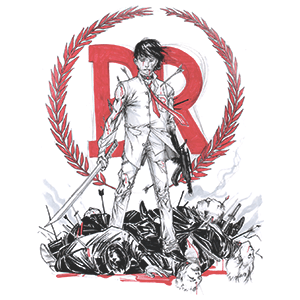
Battle Royale is a 2000 Japanese thriller film based on the novel of the same name by Koushun Takami. It was directed by Kinji Fukasaku. The film tells the story of a high-school student struggling with the death of his father who is forced by the government to compete in a deadly game, where the students must kill each other in order to win. The film aroused international controversy and was either banned or excluded from distribution in many countries, but was a domestic blockbuster, and is one of the 10-highest grossing films in Japan.
Kinji Fukasaku stated that he decided to direct the film because the novel it was adapted from reminded him of his time as a 15-year-old munitions factory worker during World War II. At that time, his class was made to work in a munitions factory. In July 1945, the factory came under artillery fire. The children could not escape so they dived under each other for cover. The surviving members of the class had to dispose of the corpses. At that point, Fukasaku realized that the Japanese government was lying about World War II, and he developed a burning hatred of adults in general that he maintained for a long time afterwards.
Posted in Art, Death, World |
1 Comment »
March 24, 2012
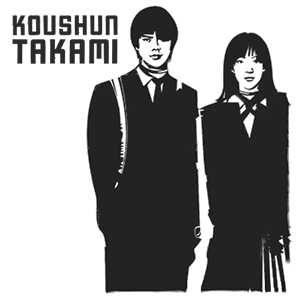
Battle Royale is a 1999 Japanese novel written by Koushun Takami about schoolchildren who are forced to fight each other to the death. The novel has been adapted into a 2000 film and a manga series. The story takes place in an alternate timeline—Japan is a member region of a totalitarian state known as the Republic of Greater East Asia. Under the guise of a ‘study trip,’ a group of students are gassed on a bus. They awaken in the Okishima Island School on an isolated, evacuated island (modeled after the island of Ogijima). They learn that they have been placed in an event called the Program.
Officially a military research project, it is a means of terrorizing the population, of creating such paranoia as to make organized insurgency impossible. The Program began in 1947. According to the rules fifty third-year high school classes are selected (prior to 1950, forty-seven classes were selected) annually to participate in the Program for research purposes. The students from a single class are isolated and are required to fight the other members from their class to the death. The Program ends when only one student remains, with that student being declared the winner.
Posted in Art, Death, Language |
Leave a Comment »
March 23, 2012

Dorodango is a Japanese art form in which earth and water are molded to create a delicate shiny sphere, resembling a marble or billiard ball. The phrase is derived from ‘doro’ (‘mud’) and ‘dango’ (a round dumpling, created from pressed rice flour). Making the basic dorodango is a traditional pastime for school children.
More recently the process has been refined into the art of the ‘hikaru’ (‘shining’) dorodango, which has a glossy or patterned surface. The core of the ball is made of basic mud, and further dusted with finer-grained soil before the water is drawn out through various methods- even sealing the ball inside a plastic bag and letting the water evaporate and then condense. Once the ball is fully tempered and hardened, it is polished by hand and displayed.
Posted in Art, Games, World |
Leave a Comment »
March 22, 2012
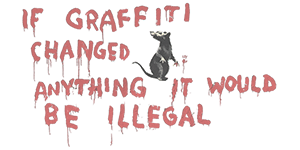
Street art is art, specifically visual art, developed in public spaces — that is, ‘in the streets’ — though the term usually refers to unsanctioned art, as opposed to government sponsored initiatives. The term can include traditional graffiti artwork, sculpture, stencil graffiti, sticker art, wheatpasting and street poster art, video projection, art intervention, guerrilla art, and street installations.
Typically, the term street art or the more specific post-graffiti is used to distinguish contemporary public-space artwork from territorial graffiti, vandalism, and corporate art. Artists have challenged art by situating it in non-art contexts. ‘Street’ artists do not aspire to change the definition of an artwork, but rather to question the existing environment with its own language. They attempt to have their work communicate with everyday people about socially relevant themes in ways that are informed by aesthetic values without being imprisoned by them. NYC based artist John Fekner defines street art as ‘all art on the street that’s not graffiti.’
read more »
Posted in Art, Politics, World |
Leave a Comment »
March 22, 2012

Giant Robot is a bi-monthly magazine of Asian and Asian American popular culture founded in 1994. It covers history, art, music, film, books, toys, technology, food and skateboarding. The publication grew from its original format—a small, photocopied zine, folded and stapled by hand—to its current full-color format. ‘Giant Robot’ was one of the earliest American publications to feature prominent Asian film stars such as Chow Yun-fat and Jet Li, as well as Asian musicians from indie and punk rock bands. Today, the coverage has expanded into art, design, Asian American issues, travel, and more.
In the late 1990s, Giant Robot expanded their endeavor to an online retail store selling artist goods, designer vinyl dolls, mini-figures, plush dolls, stationeries, art, t-shirts, and many creative goods. The success of the commercial website enabled the establishment of a brick-and-mortar retail store in 2001; first in Los Angeles and later in San Francisco. A third store, called GR2, was opened in Los Angeles, and features work by young contemporary artists. Giant Robot further expanded to a fourth store in New York City, and a fifth in Silverlake, as well as a restaurant called gr/eats, also in Los Angeles. The GR2, San Francisco, and New York locations feature monthly art exhibitions from up and coming and established artists.
Posted in Art, Language, World |
Leave a Comment »
March 22, 2012
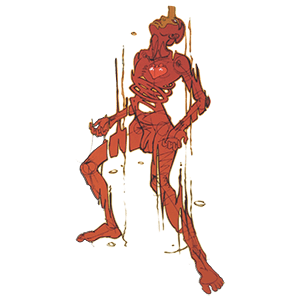
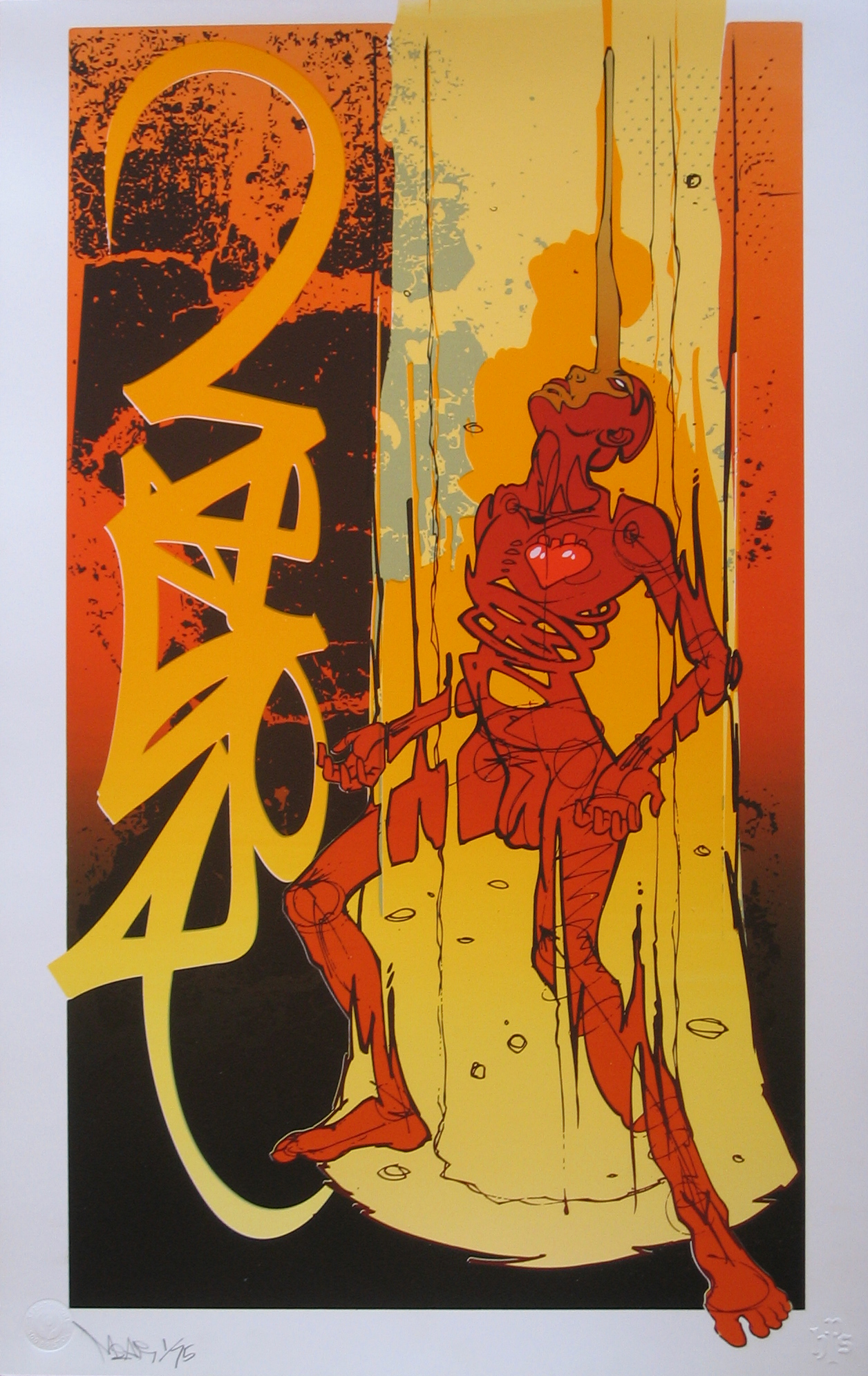
Mear One, real name Kalen Ockerman (b. 1971), is a Los Angeles-based artist, famously known for his often-political street graffiti art. Commonly referred to as the ‘Michelangelo’ of graffiti, Mear One is commonly associated with CBS (Can’t Be Stopped – City Bomb Squad) and WCA (West Coast Artist) crews. As a graphic designer, Mear One has designed apparel for Conart, Kaotic, as well as his own Reform brand.
Mear One has done album covers for artists like Non Phixion, Freestyle Fellowship, Alien Nation, Limp Bizkit, Busdriver and Daddy Kev. In 2004, Mear One joined artists Shepard Fairey and Robbie Conal to create a series of ‘anti-war, anti-Bush’ posters for a street art campaign called ‘Be the Revolution’ for the art collective ‘Post Gen.’ As a famed L.A. street artist and prolific graffiti writer for over 20 years his partners have included Skate One, Az Rock, Tren, Item, Anger, Yem, and Cisco.
Posted in Art, Politics |
Leave a Comment »
March 22, 2012

‘Dirty Hands: The Art and Crimes of David Choe’ is a 2008 documentary film about painter and graffiti artist David Choe, directed by his long time friend Harry Kim. Over more than a decade, Kim filmed the most intimate and dramatic moments of his best friend David Choe’s colorful life as an artist.
Dirty Hands began as a film school project, but gradually expanded into a half-hour film entitled ‘Whales and Orgies,’ then a feature-length documentary. The film premiered at the Los Angeles Film Festival in 2008, and had a theatrical premiere at the Roxie Theater in San Francisco in 2010.
Posted in Art, Politics |
Leave a Comment »
March 22, 2012

David Choe [chwae] (b. 1976) is a Korean American muralist, graffiti artist, and graphic novelist from Los Angeles. He achieved art world success with his ‘dirty style’ figure paintings—raw, frenetic works which combine themes of desire, degradation, and exaltation. Outside of galleries, he is closely identified with the bucktoothed whale he has been spray-painting on the streets since he was in his teens.
Choe’s work appears in a wide variety of urban culture and entertainment contexts. For example, he provided the cover art for Jay-Z and Linkin Park’s multi-platinum album ‘Collision Course,’ and created artwork to decorate the sets of ‘Juno’ and ‘The Glass House.’ During the 2008 presidential race, Choe painted a portrait of then-Senator Barack Obama for use in a grassroots street art campaign. The original was later displayed in the White House.
read more »
Posted in Art, Money, Politics |
Leave a Comment »
March 20, 2012

The SynthAxe is a fretted, guitar-like MIDI controller, created by Bill Aitken, Mike Dixon, and Tony Sedivy and manufactured in England in the 1980s. It uses electronic synthesizers to produce sound and is controlled through the use of an arm resembling the neck of a guitar in form and in use.
The neck of the instrument is angled upwards from the body, and there are two independent sets of strings. The fretboard is continuously scanned and sends signals to synthesizers which produce the sound. The left set determine the pitch played, through contact with the frets on the neck and by sensing the side-to-side bending of the string. The right set of strings are velocity sensitive; these strings can be plucked, strummed or damped in the same manner as a guitar’s. A keyboard made up of nine keys can also be used to trigger notes instead of the strings. An electronic tremolo bar can be used for standard whammy bar effects, or can be redefined to produce different MIDI output (e.g., filter cutoffs, volume, etc).
Posted in Art, Money, Technology |
Leave a Comment »