March 20, 2012
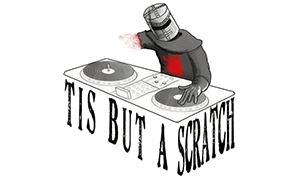

The needle drop is a technique used in hip hop deejaying. The DJ sets a record spinning, then drops the stylus on the turntable at the exact point where he wants playback to begin without previously cuing up the record. Since there is no time wasted in cuing, the needle drop allows faster movements by the DJ. The needle drop method was developed in the 1970s by Grand Wizard Theodore at around the same time that he and Grandmaster Flash were pioneering scratching.
A DJ often uses colored ‘dot’ labels to mark the sample to be used. The first step is to locate the desired sample, the second step is much more critical. The sample is located, then the record is brought about an inch or two backwards from the beginning of the sample. A ‘dot’ label is carefully placed up against the stylus (needle) and a feather touch is applied to keep the label in place. Too hard of an application may lead to the needle being misplaced on the record, slipping to the next several grooves, an undesired result. After the needle is removed from the label, the label can be pressed into place more permanently. If the DJ ever wishes to remove the label, residue can be removed from the record with widely available record cleaner solutions.
Posted in Art |
Leave a Comment »
March 20, 2012
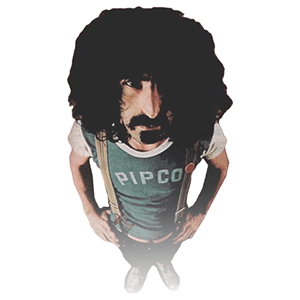
The Abnuceals Emuukha Electric Symphony Orchestra was a group of Hollywood session musicians organized by Frank Zappa in 1967 to record music for his first solo album ‘Lumpy Gravy.’ Some of these musicians are thought to have worked together in various combinations under the leadership of Ken Shroyer as far back as 1959. However, it was Zappa who gave them the name several years later.
In 1975 Zappa organized another group using the same name which involved a few of the same musicians. This group recorded music for the album ‘Orchestral Favorites.’ In 1983 soundtrack music for ‘The Chipmunks’ was recorded by yet another permutation using the same name but organized without the involvement of Zappa or Shroyer. The last appearance by this later ensemble was on the ‘Who Framed Roger Rabbit’ soundtrack in 1988.
Posted in Art |
Leave a Comment »
March 20, 2012

The Wrecking Crew was a nickname coined by the drummer Hal Blaine for a group of elite session musicians in Los Angeles, who earned wide acclaim in the 1960s. They backed dozens of popular singers, and were one of the most successful groups of studio musicians in music history. The Wrecking Crew’s members typically had backgrounds in jazz or classical music, but were highly versatile.
The talents of this group of ‘first call’ players were used on almost every style of recording, including television theme songs, film scores, advertising jingles, and almost every genre of American popular music, from The Monkees to Bing Crosby. Notable artists employing the Wrecking Crew’s talents included Nancy Sinatra, The Partridge Family, The Mamas & the Papas, The Carpenters, John Denver, The Beach Boys, Simon & Garfunkel, and Nat King Cole.
Posted in Art, Money |
1 Comment »
March 20, 2012
Phil Spector (b. 1939) is an American musician (piano, guitar), songwriter and record producer. He was co-owner of Philles Records (with then-business partner Lester Sill), and later owner of Phil Spector Records. In 2009 he was found guilty of second degree murder. Spector’s signature style was called the Wall of Sound. He used large amounts of echo, doubling and multiplying of musical instruments and the parts to be played, and overdubbing of recorded parts. The built-up effect gave his records an operatic, theatrical quality. The music sounded ‘bigger than life.’
The effect carried over especially well on AM radio, which was how most music was broadcast in the 1950s and 1960s. Spector said the Wall of Sound made ‘…little symphonies for kids…’ The recording artists who worked with Spector over the years included The Crystals (‘Then He Kissed Me’), The Ronettes (‘Be My Baby’), The Righteous Brothers (‘You’ve Lost That Lovin’ Feelin’,’ Gene Pitney (‘Every Breath I Take’), Darlene Love (‘(Today I Met) The Boy I’m Gonna Marry’), and Tina Turner (‘River Deep, Mountain High’). Sonny Bono and Cher were among his backup singers. He married Veronica (Ronnie) Bennett of the Ronettes, who took the name Ronnie Spector.
read more »
Posted in Art, Death, Money |
Leave a Comment »
March 20, 2012
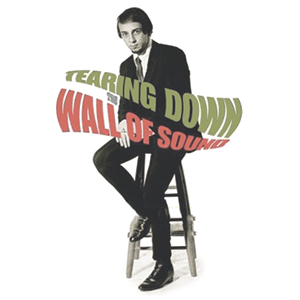
Let It Be… Naked is a remixed and edited version of the 1970 ‘Let It Be album’ by The Beatles released in 2003. The album is presented in a form which Paul McCartney considers closer to its original artistic vision: to ‘get back’ to the rock and roll sound of their early years rather than the orchestral overdubs and embellishments which were added by Phil Spector in the production of the final ‘Let It Be’ album.
McCartney in particular was always dissatisfied with the ‘Wall of Sound’ production style of the Phil Spector remixes, especially for his song ‘The Long and Winding Road,’ which he believed was ruined by the process. George Harrison gave his approval for the Naked project before he died. McCartney’s attitude contrasted with Lennon’s from over two decades earlier. In his 1971 interview with Rolling Stone magazine, Lennon had defended Spector’s work, saying, ‘He was given the shittiest load of badly recorded shit with a lousy feeling to it ever, and he made something of it.’
read more »
Posted in Art, Technology |
Leave a Comment »
March 20, 2012
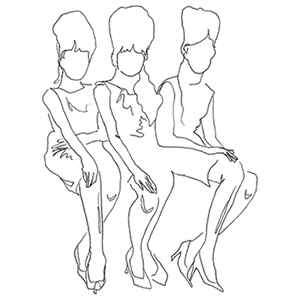
The Wall of Sound is a music production technique for pop and rock music recordings developed by record producer Phil Spector at Gold Star Studios in Los Angeles during the early 1960s. Working with such audio engineers as Larry Levine and the session musicians who became known as The Wrecking Crew, Spector created a dense, layered, reverberant sound that came across well on AM radio and jukeboxes popular in the era. He created this sound by having a number of electric and acoustic guitarists perform the same parts in unison, adding musical arrangements for large groups of musicians up to the size of orchestras, then recording the sound using an echo chamber.
To attain Spector’s signature sound, his arrangements called for large ensembles (including some instruments not generally used for ensemble playing, such as electric and acoustic guitars), with multiple instruments doubling many of the parts to create a fuller, richer sound. Spector also included orchestral instruments – strings, woodwind, brass and percussion – not previously associated with youth-oriented pop music. Spector himself called his technique ‘a Wagnerian approach to rock & roll: little symphonies for the kids.’
read more »
Posted in Art, Money, Technology |
Leave a Comment »
March 20, 2012
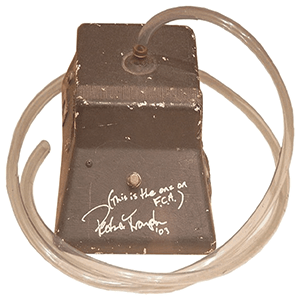
A talk box is an effects unit that allows a musician to modify the sound of a musical instrument. The musician controls the modification by lip syncing, or by changing the shape of the mouth. The effect can be used to shape the frequency content of the sound and to apply speech sounds (in the same way as singing) onto a musical instrument, typically a guitar (its non-guitar use is often confused with the vocoder) and keyboards.
A talk box is usually an effects pedal that sits on the floor and contains a speaker attached with an airtight connection to a plastic tube; however, it can come in other forms, such as the ‘Ghetto Talkbox’ (a crude homemade version). The speaker is generally in the form of a compression driver, the sound-generating part of a horn loudspeaker with the horn replaced by the tube connection.
read more »
Posted in Art, Technology |
Leave a Comment »
March 20, 2012

Auto-Tune is an audio processor created by Antares Audio Technologies, which uses proprietary software to alter pitch in vocal and instrumental performances. It was originally intended to disguise off-key inaccuracies, allowing vocal tracks to be perfectly tuned despite originally being slightly off-key. The processor slightly blends pitches to the nearest true semitone (to the exact pitch of the nearest tone in traditional equal temperament). Auto-Tune can also be used as an effect to distort the human voice when pitch is raised or lowered significantly. The overall effect to the discerning ear can be described as hearing the voice leap from note to note stepwise, like a synthesizer.
Auto-Tune was initially created by Andy Hildebrand, an engineer working for Exxon. Hildebrand developed methods for interpreting seismic data and subsequently realized that the technology could be used to detect, analyze, and modify pitch. Auto-Tune was used to produce the prominent altered vocal effect on Cher’s ‘Believe.’ Recorded in 1998, ‘Believe’ was the first commercial recording to use the software for this purpose. In an early interview, the producers claimed that they had used a Digitech Talker FX pedal, in an attempt to preserve a trade secret. After the success of the single, the technique became known as the ‘Cher Effect.’ The use of Auto-Tune as a musical effect was revived in the late-2000s by R&B singer T-Pain, who elaborated on the effect and made active use of Auto-Tune in his songs.
Posted in Art, Money, Technology |
Leave a Comment »
March 20, 2012
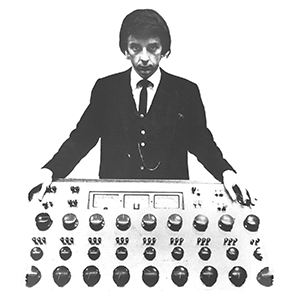
Overproduction is the excessive use of audio effects, layering, or digital manipulation in music production. Common traits include: audio processing effects such as reverb, delay, or dynamic range compression; heavy layering or multi-tracking (in the context of pop and rock music, this may refer to the addition of elements such as chorused vocals or backing strings).
Other modifications include pitch correction, time correction, and quantization (correcting to perfect notes). Records are sometimes overseen by a producer who ‘imposes’ his or her own distinctive ‘sound’ or techniques on a band or artist (producers frequently accused of this kind of ‘overproduction’ include Phil Spector and Mutt Lange). The term ‘overproduction’ implies that a producer or mastering engineer has made ‘unnecessary’ additions or changes to a record in the production process, and in doing so has decreased the quality or enjoyability of the music.
Posted in Art, Money, Technology |
Leave a Comment »
March 20, 2012
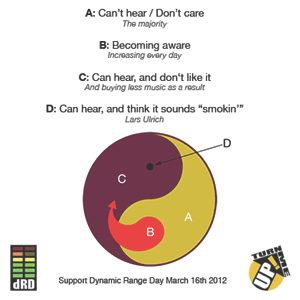
The loudness war is a pejorative term for the apparent competition to digitally master and release recordings with increasing loudness. Older music typically has a very diverse dynamic, that is, there are quiet parts of the track and much louder parts. For example, acoustic interludes leading up to the body of a song might be produced at a very quiet level, with some of the loudest sounds being snare drums and other kinds of percussion.
While the rationale for the loudness war is often described as an attempt to make the quieter parts of music more accessible to a listener, the overall effect is that that dynamic between sounds becomes leveled out, with no sound standing out from the track as a much louder sound. This results in a loss of clarity, where it’s no longer possible to experience music as a distinct interplay of louder and quieter parts.
read more »
Posted in Art, Money, Technology |
Leave a Comment »
March 20, 2012


A needle drop is a common term used to describe a version of a music album that has been transferred from a vinyl record to digital audio or other formats. Needle drops are sometimes traded among music collectors, especially when the original vinyl recording has not been released officially on a subsequent consumer format.
Other reasons for trading needle drops include the lack of availability of certain recordings on digital media, the non-availability of less compressed versions in digital form, or the lack of availability of certain versions or mixes of that record, e.g. mono or stereo versions, or the loss of the master tape. The term is thought to have been coined in 1949 by recording engineer Peter Goldmark during the first rush of transfers of lacquer and 78 rpm records to the then-new long playing 33 ⅓ RPM format.
Posted in Art, Technology |
Leave a Comment »
March 19, 2012
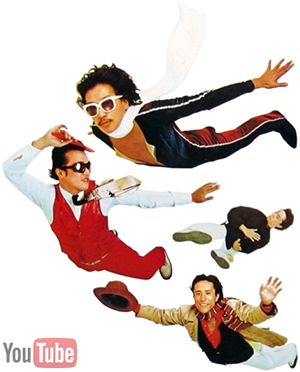
Sadistic Mika Band was a Japanese rock group formed in 1972. Its name is a parody of the ‘Plastic Ono Band.’ Produced by Masatoshi Hashiba on Toshiba-EMI Records (now EMI Music Japan), the band was led by the then husband and wife team of guitarist Kazuhiko Kato, and his wife, singer Mika Fukui. The word ‘sadistic’ is reported to be inspired by her insensitive sense of humor.
Kazuhiko Kato moved to London in 1972 and impressed by the burgeoning glam rock scene led by T. Rex and David Bowie, he set about forming a new group in Japan to emulate the style. Kato passed the album to Malcolm McLaren who at the time had a shop with Vivienne Westwood, and McLaren passed it on to Bryan Ferry, whose band Roxy Music would later support on a tour.
Posted in Art, Humor, World |
Leave a Comment »



