February 17, 2012

VitaliV (or ‘Vitali V,’ real name Vitali Vinogradov) is a Soviet-born painter and sculptor now living in the United Kingdom, who has developed an artistic style based on the designs of computer microchips. Some works have been laser-cut in relief and then hand-painted as 3D objects.
His style, ‘Via Art,’ was created in the late 90’s while attempting to imprint an unusual, digital circuit-like pattern upon jewelry. In appreciation of the simplicity and logic of digital circuits, the artist decided to use the pattern as the structural basis for a new style. The following decade led to the creation of over 1000 designs including jewelry, furniture sketches, fashion collections, and hundreds of porcelain wares. The essence of the Via Art style are simple geometrical patterns—circles and lines connected at 45° angles.
Posted in Art, Technology |
2 Comments »
February 17, 2012

Wes Anderson (b. 1969) is an American director and screenwriter. Anderson has been called an auteur, as he is involved in every aspect of his films’ production. His films employ similar aesthetics, using a deliberate, methodical cinematography, with mostly primary colors. His soundtracks feature folk and early rock music, in particular classic British rock. Anderson’s films combine dry humor with poignant portrayals of flawed characters – often a mix of the wealthy and the working class. He is also known for working with many of the same actors and crew on varying projects, particularly Owen Wilson (who co-wrote three of Anderson’s feature films), Bill Murray, and Jason Schwartzman. Other frequent collaborators include writer Noah Baumbach, who co-wrote ‘The Life Aquatic with Steve Zissou’ and ‘Fantastic Mr. Fox,’ with Anderson co-producing his film ‘The Squid and the Whale.’
Anderson went to India to film his 2007 film ‘The Darjeeling Limited’ partly as a tribute to the legendary Indian filmmaker Satyajit Ray, whose ‘films have also inspired all my other movies in different ways’ (the film is dedicated to him). Jason Schwartzman reunited with Anderson for it, acting as well as co-writing the script with Anderson and Roman Coppola. In 2006, following the disappointing commercial and critical reception of ‘The Life Aquatic with Steve Zissou,’ Steely Dan’s Walter Becker and Donald Fagen released a tongue-in-cheek ‘letter of intervention’ of Anderson’s artistic ‘malaise.’ Proclaiming themselves to be fans of ‘World Cinema’ and Anderson in particular, they offered Anderson their soundtrack services for his ‘The Darjeeling Limited,’ including lyrics for a title track.
Posted in Art |
1 Comment »
February 16, 2012

The three individuals most closely associated with the birth of Detroit techno as a genre are Juan Atkins, Kevin Saunderson and Derrick May, also known as ‘The Belleville Three.’ High school friends from Belleville, Michigan, the trio created electronic music tracks in their basement(s). Eventually, they were in demand at local dance clubs, thanks in part to seminal Detroit radio personality ‘The Electrifying Mojo.’
Ironically, Derrick May once described Detroit techno music as being a ‘complete mistake…like George Clinton and Kraftwerk caught in an elevator, with only a sequencer to keep them company.’ The location of Belleville was key to the formation of the three as musicians. Because the town was still ‘pretty racial at the time,’ according to Saunderson, ‘we three kind of gelled right away.’
read more »
Posted in Art, Technology |
1 Comment »
February 16, 2012

Emil Schult (b. 1946) is a German painter, poet and musician. He is most famous for his collaborations with the electronic music band Kraftwerk. He has created most of their sleeve designs since 1973. He also co-wrote the lyrics of some famous Kraftwerk songs.
For a short while around 1973, Schult also played guitar in the group; this was to be short-lived, since Schult by his own admission is not quite good enough to be a professional musician, and since the group had started to develop its synth-based sound it no longer had any use for a guitarist.
Posted in Art |
Leave a Comment »
February 16, 2012

Kraftwerk (German: ‘power plant’ or ‘power station’) is an influential electronic music band from Germany. The group was formed by Ralf Hütter and Florian Schneider in 1970, and was fronted by them until Schneider’s departure in 2008. The signature Kraftwerk sound combines driving, repetitive rhythms with catchy melodies, mainly following a Western Classical style of harmony, with a minimalistic and strictly electronic instrumentation.
The group’s simplified lyrics are at times sung through a vocoder or generated by computer-speech software. Kraftwerk were one of the first groups to popularize electronic music and are considered pioneers in the field. In the 1970s and early 1980s, Kraftwerk’s distinctive sound was revolutionary, and has had a lasting effect across many genres of modern music.
read more »
Posted in Art, Technology, World |
Leave a Comment »
February 16, 2012
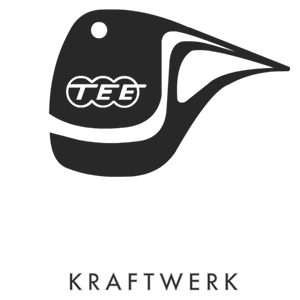
‘Trans-Europe Express‘ is the title track of Kraftwerk’s 1977 album of the same name, and released as a single at the time. The music was written by Ralf Hütter, and the lyrics by Hütter and Florian Schneider. The track is ostensibly about the Trans Europ Express rail system, with technology and transport both being common themes in Kraftwerk’s ouvre. The track has since found further influence, both in hip-hop by its interpolation by Afrika Bambaata (via Arthur Baker) on the seminal ‘Planet Rock’ and by modern experimental bands such as the electroclash bands of the early 2000s.
The musical elements of the suite have been described as having a haunting theme with ‘deadpan chanting of the title phrase’ which is ‘slowly layered over that rhythmic base in much the same way that the earlier ‘Autobahn’ was constructed.’ The song’s lyrics reference the album Station to Station and meeting with musicians Iggy Pop and David Bowie. Hütter and Schneider had previously met up with Bowie in Germany and were flattered with the attention they received from him. Ralf Hütter was interested in Bowie’s work as he had been working with Iggy Pop, who was the former lead singer of the Stooges; one of Hütter’s favorite groups.
Posted in Art, Technology, World |
Leave a Comment »
February 16, 2012


8-Bit Operators: The Music of Kraftwerk was released in 2007 by the group 8-Bit Operators on Kraftwerk’s US homelabel Astralwerks and EMI Records worldwide. It features cover versions of Kraftwerk songs by several prominent chiptune artists. Inspiration for the project as quoted by Jeremy Kolosine (credited as Executive Producer of the release, and noted founder of the early 80’s electronic group Futurisk and chipmusic band Receptors.) ‘Well the first thing that comes to my mind when I saw a gameboy show was Kraftwerk’s Computer World Tour from 1981, where four of them played various handheld devices during the song ‘Pocket Calculator.’ Plus it came up in a print from a Glomag quote, and an 8 Bit Weapon April Fool’s joke that backfired.’
This Kraftwerk covers compilation was somewhat unique in the fact that Kraftwerk’s Ralf Hütter selected the final track line-up, ‘So Jeremy was a little nervous when meeting Kraftwerk’s Ralf Hütter after a concert by the group in New York last year. He passed along to him a sample of the compilation. Later Hutter said he enjoyed it and even offered some editing suggestions.’ In a subsequent interview, when asked about the 8-Bit Operators release, Ralf Hütter responded, ‘It is mind stimulating, the minimum/maximum coming from sound levels and thoughts and ideas. Like ‘Autobahn’ and ‘Trans-Europe Express’ are very basic and elementary ideas, but they offer a pattern or concept for improvisation.’
Posted in Art, Technology |
Leave a Comment »
February 16, 2012

The Blip Festival is a festival that celebrates chiptune music with musical performances, workshops, and screenings of movies. It has been held annually since 2006 in New York City. In recent years, there have been international versions of Blip Festival held in Europe (Blip Festival Europe) and Asia (Blip Festival Tokyo).
The festival is curated and organized by 8bitpeoples, one of the foremost labels in the chiptune scene, as well as local arts organization The Tank. The New York festival (referred to simply as Blip Festival) has switched venues several times, beginning in 2006 at 15 Nassau Street in Manhattan, then moving to Eyebeam Art and Technology Center in 2007, and then being held in Brooklyn at the Bell House in 2008 and 2009.
Posted in Art, Technology, World |
Leave a Comment »
February 16, 2012


8bitpeoples is a DIY record label/arts collective centered in New York City that focuses around the 8-bit aesthetic, which is heavily influenced by vintage videogames. 8bitpeoples was founded in 1999 by Jeremiah ‘Nullsleep’ Johnson and Mike ‘Tangible’ Hanlon. It is currently run by Johnson and labelmate Joshua ‘Bit Shifter’ Davis. Many artists who have appeared on 8bitpeoples have also appeared on compilations on other labels, most notably Astralwerks’ ‘8 Bit Operators’ compilation, a collection of Kraftwerk songs as done in the 8-bit style. 8bitpeoples is also involved in the organization of the Blip Festival, which features 8-bit musicians, often including those on the 8bitpeoples roster.
They provide the vast majority of their releases for free via their website, including printable covers and inserts so that anyone can manufacture a hard copy of their releases.
Posted in Art, Technology |
Leave a Comment »
February 15, 2012

Robopocalypse is a science fiction book by Daniel H. Wilson published in 2011. The author has a PhD in robotics from Carnegie Mellon University, and many of the robots in the novel were inspired by real-world robotics research. The setting of the novel is the near future, where an increasingly robot-reliant society faces extinction after a computer scientist accidentally unleashes a sentient artificial intelligence named Archos.
After failed attempts at AI, Archos becomes self aware and immediately takes steps to stop his destruction. By infecting all devices that are chip controlled (cars, elevators, robots, etc.), Archos begins a systematic attack on mankind. Small bands of survivors find ways to circumvent the eradication. This is a story of those survivors in the months and days leading up to and following Archos’ self-awareness. Steven Spielberg has committed to direct a film based on the novel.
Posted in Art, Language, Technology |
Leave a Comment »
February 15, 2012

Juan Francisco Casas (b. 1976) is a Spanish artist who paints large size oil canvases and blue ballpen drawings where he reproduces images he takes with his camera.
In 2010 he participated, along with artists such as Edward Hopper, Édouard Manet, Chuck Close, and Andreas Gursky, in the impressive display ‘Realismus. Das Abenteuer der Wirklichkeit’ (‘Realism The Adventure of Reality’) in the Kunsthalle der Hypo-Kulturstiftung Museum, Munich. He lives and works in Paris and Madrid.
Posted in Art |
Leave a Comment »
February 15, 2012

The concept of Cool Japan, along with that of ‘Gross National Cool,’ was coined in 2002 as an expression of Japan’s emergent status as a cultural superpower. Gaining broad exposure in the media and academia, the brand of ‘Cool Japan’ has been adopted by the Japanese government as well as trade bodies seeking to exploit the commercial capital of the country’s culture industry. It has been described as a form of soft power, ‘the ability to indirectly influence behaviour or interests through cultural or ideological means.’
In a 2002 article in ‘Foreign Policy’ entitled ‘Japan’s Gross National Cool,’ Douglas McGray wrote of Japan ‘reinventing superpower’ as its cultural influence expanded internationally despite the economic and political problems of the ‘lost decade.’ Surveying youth culture and the role of manga, anime, fashion, film, consumer electronics, architecture, cuisine, J-pop, and phenomena of cuteness such as Hello Kitty, McGray highlighted Japan’s considerable soft power, posing the question of what message the country might project. He also argued that Japan’s recession may even have boosted its national cool, due to the partial discrediting of erstwhile rigid social hierarchies and big-business career paths.
Posted in Art, Money, World |
Leave a Comment »