December 11, 2011

The Millennium series (1954 – 2004) is a series of bestselling novels originally written in Swedish by the late Stieg Larsson. The primary characters in the series are Lisbeth Salander, an intelligent, eccentric woman in her twenties with a photographic memory and poor social skills, and Mikael Blomkvist, an investigative journalist and editor of a magazine called ‘Millennium.’ Blomkvist, the character, has a history similar to Larsson, the author.
There are three books in the series: ‘The Girl with the Dragon Tattoo,’ ‘The Girl Who Played with Fire,’ and ‘The Girl Who Kicked the Hornets’ Nest.’ When he died suddenly of a heart attack in 2004, Larsson left behind manuscripts of the completed but unpublished novels written as a series. He had written them for his own pleasure after returning home from his job in the evening, and had made no attempt to get them published until shortly before his death.
read more »
Posted in Art, Language |
Leave a Comment »
December 8, 2011


A spit curl is a spiral curl of hair pressed flat against the cheek, temple, or forehead, a style popular in the 1920s and made famous by actress Clara Bow and cartoon character Betty Boop.
The unglamorous name for spit curls suggests how they stayed locked on the head. Normally women would set small tendrils in the front of their hair with bobby pins, and then would position them by licking or wetting their fingers to produce the spit curls look.
Posted in Art |
Leave a Comment »
December 8, 2011
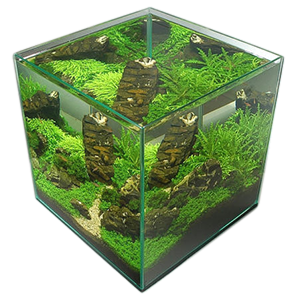
Aquascaping is the craft of arranging aquatic plants, as well as rocks, stones, cavework, or driftwood, in an aesthetically pleasing manner within an aquarium—in effect, gardening under water. Aquascape designs include a number of distinct styles, including the garden-like Dutch style and the Japanese-inspired nature style. Although the primary aim of aquascaping is to create an artful underwater landscape, the technical aspects of aquarium maintenance must also be taken into consideration.
Many factors must be balanced in the closed system to ensure the success of an aquascape, including filtration, maintaining carbon dioxide at levels sufficient to support photosynthesis underwater, substrate and fertilization, lighting, and algae control. Aquascape hobbyists trade plants, conduct contests, and share photographs and information via the internet.
read more »
Posted in Art, Games, Science |
2 Comments »
December 7, 2011

Gerd Arntz (1900 – 1988) was a German Modernist artist – famous for his black and white woodcuts. A core member of the Cologne Progressives he was also a council communist. The Cologne Progressives participated in the revolutionary unions AAUD and its offshoot the AAUE in the 1920s, and in 1928 Arntz was contributing anti-parliamentary prints to its paper ‘Die Proletarische Revolution’ which called for workers to form and participate in worker’s councils. These political prints depicted the life of worker’s and the class struggle in abstracted figures in woodcuts.
In 1926 Otto Neurath sought his collaboration in designing pictograms for the ‘Vienna Method of Pictorial Statistics’ (‘Wiener Methode der Bildstatistik’; later renamed ‘Isotype’). From the beginning of 1929 Arntz worked at the Gesellschafts- und Wirtschaftsmuseum (Social and economic museum) directed by Neurath in Vienna. Eventually, Arntz designed around 4000 pictograms. After the brief civil war in Austria in 1934 he emigrated to the Netherlands, joining Neurath and Reidemeister in The Hague, where they continued their collaboration at the International Foundation for Visual Education.
Posted in Art, Language, Politics |
Leave a Comment »
December 7, 2011

Isotype (International System of TYpographic Picture Education) is a method of showing social, technological, biological and historical connections in pictorial form.
It was first known as the Vienna Method of Pictorial Statistics, due to its having been developed at the Social and Economic Museum of Vienna (Gesellschafts- und Wirtschaftsmuseum in Wien) between 1925 and 1934. The founding director of the museum, Otto Neurath, was the initiator and chief theorist of the Vienna Method. The term Isotype was applied to the method around 1935, after its key practitioners were forced to leave Vienna by the rise of Austrian fascism.
read more »
Posted in Art, Language, Politics |
Leave a Comment »
December 3, 2011

Op art is a style of visual art that makes use of optical illusions. ‘Optical art is a method of painting concerning the interaction between illusion and picture plane, between understanding and seeing.’ Op art works are abstract, with many of the better known pieces made in only black and white. When the viewer looks at them, the impression is given of movement, hidden images, flashing and vibration, patterns, or alternatively, of swelling or warping.
Op art is derived from the constructivist practices of the Bauhaus, a German design school, founded by Walter Gropius, which stressed the relationship of form and function within a framework of analysis and rationality. Students were taught to focus on the overall design, or entire composition, in order to present unified works. When the Bauhaus was forced to close in 1933, many of its instructors fled to the US where the movement took root in Chicago and eventually at the Black Mountain College in Asheville, North Carolina, where Anni and Josef Albers would come to teach.
read more »
Posted in Art |
Leave a Comment »
December 1, 2011


The Jheri [jer-ee] curl is a hairstyle that was common and popular in the African American community especially during the 1970s and 1980s. Invented by and named for Jheri Redding, the Jheri curl gave the wearer a glossy, loosely curled look. It was touted as a ‘wash and wear’ style that was easier to care for than the other popular chemical treatment of the day, the relaxer. A Jheri curl was a two-part application that consisted of a softener (often called a ‘rearranging cream’) to loosen the hair and a solution to set the curls. The rearranging cream used pungent chemicals, causing the naturally tight curls to loosen and hang. The loose hair was then set and a chemical solution was then added to the hair to permanently curl it.
Perming the hair was time and labor-intensive and expensive to maintain. The harsh mix of chemicals required for the process caused the wearer’s natural hair to become extremely brittle and dry. To maintain the look of the Jheri curl, users were required to apply a curl activator spray and heavy moisturizers daily and to sleep with a plastic cap on their heads to keep the hairstyle from drying out. The activator in particular had the undesirable side effect of being very greasy; this would often stain clothing and furniture. The hairstyle went out of fashion by the late 1980s and was replaced in part with the hi-top fade haircut.
Posted in Art, Humor, Money |
Leave a Comment »
November 30, 2011

The demoscene is a computer art subculture that specializes in producing demos, which are non-interactive audio-visual presentations that run in real-time on a computer. The main goal of a demo is to show off programming, artistic, and musical skills. The demoscene first appeared during the 8-bit era on computers such as the Commodore 64, ZX Spectrum and Amstrad CPC, and came to prominence during the rise of the 16/32-bit home computers (the Amiga and the Atari ST). In the early years, demos had a strong connection with software cracking. When a cracked program was started, the cracker or his team would take credit with a graphical introduction called a ‘crack intro’ (shortened cracktro). Later, the making of intros and standalone demos evolved into a new subculture independent of the software (piracy) scene.
Prior to the popularity of IBM PC compatibles, most home computers of a given line had relatively little variance in their basic hardware, which made their capabilities practically identical. Therefore, the variations among demos created for one computer line were attributed to programming alone, rather than one computer having better hardware. This created a competitive environment in which demoscene groups would try to outperform each other in creating amazing effects, and often to demonstrate why they felt one machine was better than another.
read more »
Posted in Art, Games, Technology |
Leave a Comment »
November 30, 2011
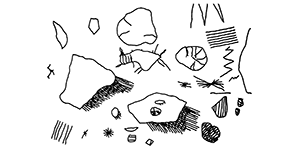

Generative art refers to art that has been generated, composed, or constructed in an algorithmic manner through the use of systems defined by computer software algorithms, or similar mathematical or mechanical or randomized autonomous processes.
Generative art is a system oriented art practice where the common denominator is the use of systems as a production method. To meet the definition of generative art, an artwork must be self-contained and operate with some degree of autonomy. The workings of systems in generative art might resemble, or rely on, various scientific theories such as Complexity science and Information theory.
read more »
Posted in Art, Technology |
Leave a Comment »
November 30, 2011

Steven Heller (b. 1950) is an American author, and editor who specializes on topics related to graphic design. He is author and co-author of many works on the history of illustration, typography, and many subjects related to graphic design. He has published more than eighty titles.
For thirty-three years Heller was a senior art director of ‘U&lc’ magazine, a publication devoted to typography. As of 2007, he is co-chair with Lita Talarico of the MFA Designer as Author program at the School of Visual Arts in New York City. He has collaborated on books with graphic designer, Louise Fili, who is his wife, as well as with others including the Design Dialogue series.
Posted in Art, Language, Money |
1 Comment »
November 30, 2011
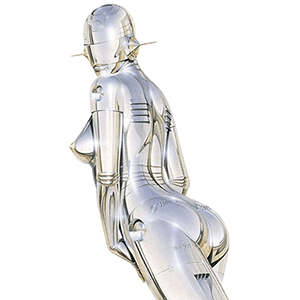
Hajime Sorayama (b.1947) is a Japanese illustrator, known for his precisely detailed, erotic airbrush portrayals of women and feminine robots. Sorayama’s work ‘Sexy Robot,’ published by Genko-sha in 1983, made his organic robotic forms famous around the world.
For the work, he used ideas from pin-up art, which in the book then appear as chrome-plated gynoids in suggestive poses. His next book, ‘Pin-up’ (1984), continues in the same line. A number of his other works similarly revolve around figures in suggestive poses, including highly realistic depictions in latex and leather. His pinups appeared frequently in the pages of ‘Penthouse’ magazine.
Posted in Art, Language, Technology |
1 Comment »
November 30, 2011

Nobukazu Takemura (b. 1968) is a Japanese musician whose style has run from jazz to house to drum and bass to chamber music to electronic glitch within less than a decade. Born in Osaka he became interested in punk and New Wave music when young. At high school, after a record store job that exposed him to Jazz and Hip hop, he had regular gigs as a battle DJ. In 1990, Takemura founded Audio Sports with Yamatsuka Eye (of The Boredoms) and Aki Onda. Their first album, ‘Era of Glittering Gas,’ was released in 1992 (after which Onda subsequently took control of the project), the same year as Takemura’s first solo album, under the name DJ Takemura. He has also released material with Spiritual Vibes (since 1993) and as Child’s View (since 1994). He is currently paired with Childisc vocalist/composer Aki Tsuyuko under the touring name of Assembler.
He founded the Lollop and Childisc labels; his voluminous releases, remixes, and collaborations make a comprehensive discography difficult, and his music often defies any easy categorization. He emerged in the US after the release of ‘Scope’ on the Thrill Jockey label in 1999, an album that features delicate melodies blossoming from oceans of white noise and staccato electronics. His unique and complex approach to melody and instrumentation has generated a catalog of collaborations with critically acclaimed artists including Issey Miyake, Zu, Steve Reich, DJ Spooky, Yo La Tengo, and Tortoise. Takemura was responsible for the sound design of Sony’s robotic dog AIBO.
Posted in Art, Technology, World |
Leave a Comment »



 The Daily Omnivore