October 29, 2011

Mickey Hart (b. 1943), real name Michael Steven Hartman, is an American percussionist and musicologist. He is best known as one of the two drummers of the rock band the Grateful Dead. He and fellow Dead drummer Bill Kreutzmann earned the nickname ‘the rhythm devils.’ Before joining the Grateful Dead, Hart and his father, Leonard Hart, a champion rudimental drummer, owned and operated Hart Music, selling drums and musical instruments in San Carlos, California. Hart joined the Grateful Dead in 1967, and left in 1971 when he extricated himself from the band, due to conflict between band management and Mickey’s father. During his sabbatical, in 1972, he recorded the album ‘Rolling Thunder.’ He returned to the Dead in 1974, and remained with the group until their official dissolution in 1995. Collaboration with the remaining members of the Grateful Dead continues, under the band name The Dead.
Alongside his work with the Grateful Dead, Mickey Hart has flourished as a solo artist, percussionist, and the author of several books. In these endeavors he has pursued a lifelong interest in ethnomusicology and in world music. His travels and his interest in all things percussion-related led him to collect percussion instruments, and to collaborate with percussion masters the world over.
read more »
Posted in Art, Health, World |
1 Comment »
October 28, 2011

Comprachicos is a compound Spanish neologism meaning ‘child-buyers,’ which was coined by Victor Hugo in his novel ‘The Man Who Laughs’ (1869). It refers to various groups in folklore who were said to change the physical appearance of human beings by manipulating growing children, in a similar way to the horticultural method of bonsai – that is, deliberate mutilation.
The most common methods said to be used in this practice included stunting children’s growth by physical restraint, muzzling their faces to deform them, slitting their eyes, dislocating their joints, and malforming their bones. The resulting human monsters made their living as mountebanks (con artists and hustlers) or were sold to lords and ladies to be used as pages or court jester.
read more »
Posted in Art, Language |
Leave a Comment »
October 28, 2011

After consuming large amounts of sugar or caffeine, Beavis sometimes undergoes a radical personality change, or psychotic break. He will raise his forearms in a 90-degree angle next to his chest, pull his shirt over his head, and then begin to yell or scream erratically, producing a stream of gibberish and strange noises, his eyes wide. This is an alter-ego named ‘Cornholio,’ a normally dormant persona. Cornholio tends to wander aimlessly while reciting ‘I am the Great Cornholio! I need TP for my bunghole!’ in an odd faux-Spanish accent. Sometimes Beavis will momentarily talk normally before resuming the persona of Cornholio. Once his Cornholio episode is over, Beavis usually has no memory of what happened.
In the guise of Cornholio, Beavis becomes a successful beat poet (Buttniks), and in ‘Vaya Con Cornholio’ he is deported to Mexico after wrongfully being subjected to immigration detention by an agent of the INS. During his detention the agent and his superior attempt to make sense of the gibberish that is Cornholio, going so far as to look up the definition of ‘bunghole.’ In that same episode, he claims to be from Lake Titicaca, but when asked where it was, he responded with ‘Nicaragua,’ despite the fact that Lake Titicaca is in Peru/Bolivia.
Posted in Art, Humor |
1 Comment »
October 26, 2011

Ubik [ew-bik] is a 1969 science fiction novel by Philip K. Dick. It has been described as ‘a deeply unsettling existential horror story, a nightmare you’ll never be sure you’ve woken up from.’ The novel takes place in the ‘North American Confederation’ of 1992, wherein technology has advanced to the extent of permitting civilians to reach the Moon and psi phenomena are common. The protagonist is Joe Chip, a debt-ridden technician for Glen Runciter’s ‘prudence organization,’ which employs people with the ability to block certain psychic powers (as in the case of an anti-telepath, who can prevent a telepath from reading a client’s mind) to enforce privacy by request. Runciter runs the company with the assistance of his deceased wife Ella, who is kept in a state of ‘half-life,’ a form of cryonic suspension that gives the deceased person limited consciousness and communication ability. In the novel Ubiq, a product whose name is derived from the word ‘ubiquity,’ has the property of preserving people who are in half-life.
Dick’s former wife Tessa remarked that ‘Ubik is a metaphor for God. Ubik is all-powerful and all-knowing, and Ubik is everywhere. The spray can is only a form that Ubik takes to make it easy for people to understand it and use it. It is not the substance inside the can that helps them, but rather their faith in the promise that it will help them.’ She also interpreted the ending by writing, ‘Many readers have puzzled over the ending of Ubik, when Glen Runciter finds a Joe Chip coin in his pocket. [It] is meant to tell you that we can’t be sure of anything in the world that we call ‘reality.’ It is possible that they are all dead and in cold pac or that the half-life world can affect the full-life world. It is also possible that they are all alive and dreaming.’
Posted in Art, Language, Technology |
Leave a Comment »
October 25, 2011

The Salon des Refusés, French for ‘exhibition of rejects,’ is generally an exhibition of works rejected by the jury of the official Paris Salon, but the term is most famously used to refer to the Salon des Refusés of 1863. During this time, Paris was a breeding ground for artists of all forms, poets, painters, and sculptors. Paris was the place to be and the capital of the art world.
Any artist who wanted to be recognized, at that time, was required to have exhibited in a Salon, or to have gone to school in France. Being accepted into these Salons was a matter of survival for some artists; reputations and careers could be started or broken, based solely upon acceptance into these exhibits. Today by extension, salon des refusés refers to any exhibition of works rejected from a juried art show.
read more »
Posted in Art, World |
1 Comment »
October 25, 2011


The Steve Allen Theater at the Center for Inquiry (CFI) Los Angeles is a multidisciplinary resident fringe theater and theater of the absurd in Hollywood developed and helmed by Founding Artistic Director, Amit Itelman. The Center for Inquiry is a nonprofit group founded by Carl Sagan and Isaac Asimov to promote science and secular humanism. When paranormal investigator James Underdown became the Executive Director of CFI West in 2003, he named the theater after Center for Inquiry supporter and television personality Steve Allen and offered Itelman an opportunity to define an artistic vision for the space.
Itelman has booked interdisciplinary acts (music, comedy and theater) that strike a brainy and idiosyncratic chord. ‘A kind of theater that bounces off the walls.’ Itelman’s artistic credo reflects CFI’s mission of ‘not accepting things as they are’ an unlikely lab for some of the freshest, strangest work in town…The bar for eccentricity may be pretty high in Hollywood, but the Steve Allen Theater clears it easily.’
Posted in Art, Humor, Philosophy |
Leave a Comment »
October 25, 2011

Fringe theatre is theater that is not of the mainstream. The term comes from the Edinburgh Festival Fringe, which was named by Robert Kemp, who described the unofficial companies performing at the same time as the second Edinburgh International Festival (1948) as a ‘fringe,’ writing: ‘Round the fringe of official Festival drama, there seems to be more private enterprise than before.’ The term has since been adopted by the Edinburgh Festival Fringe and thence by alternative theaters and alternative theater festivals.
In London, the Fringe is the term given to small scale theatres, many of them located above pubs, and the equivalent to New York’s Off-Broadway or Off-Off-Broadway theatres. There are also many unjuried theater festivals which are often called fringe festivals. These festivals, such as the Edinburgh Festival Fringe and Adelaide Fringe Festival, permit artists to produce a wide variety of works.
read more »
Posted in Art, Language, Money |
Leave a Comment »
October 25, 2011

The Theatre of the Absurd is a designation for particular plays of absurdist fiction, written by a number of primarily European playwrights in the late 1940s, 1950s, and 1960s, as well as to the style of theater which has evolved from their work. Their work expressed the belief that, in a godless universe, human existence has no meaning or purpose and therefore all communication breaks down.
Logical construction and argument gives way to irrational and illogical speech and to its ultimate conclusion, silence. Plays within this group are absurd in that they focus not on logical acts, realistic occurrences, or traditional character development; they, instead, focus on human beings trapped in an incomprehensible world subject to any occurrence, no matter how illogical. The theme of incomprehensibility is coupled with the inadequacy of language to form meaningful human connections.
read more »
Posted in Art, Humor, Philosophy |
Leave a Comment »
October 25, 2011
Duck Amuck is a surreal animated cartoon directed by Chuck Jones and produced by Warner Bros. Cartoons. The short was released in early 1953 by The Vitaphone Corporation, the short subject division of Warner Bros. Pictures, as part of the Merrie Melodies series. It stars Daffy Duck, who is tormented by a seemingly sadistic, initially unseen animator, who constantly changes Daffy’s locations, clothing, voice, physical appearance and even shape. Pandemonium reigns throughout the cartoon as Daffy attempts to steer the action back to some kind of normality, only for the animator to either ignore him or, more frequently, to over-literally interpret his increasingly frantic demands. Mel Blanc performed the voices. It was directed by Chuck Jones with a story by Michael Maltese. The film contains many examples of self-referential humor, breaking the fourth wall.
According to director Chuck Jones, this film demonstrated for the first time that animation can create characters with a recognizable personality, independent of their appearance, milieu, or voice. Although in the end, the animator is revealed to be Daffy’s rival Bugs Bunny (who famously declares ‘Ain’t I a stinker?’), according to Jones the ending is just for comedic value: Jones (the director) is speaking to the audience directly, asking ‘Who is Daffy Duck anyway? Would you recognize him if I did this to him? What if he didn’t live in the woods? Didn’t live anywhere? What if he had no voice? No face? What if he wasn’t even a duck anymore?’ In all cases, it is obvious that Daffy is still Daffy; not all cartoon characters can claim such distinctive personality.
Posted in Art, Humor |
1 Comment »
October 24, 2011
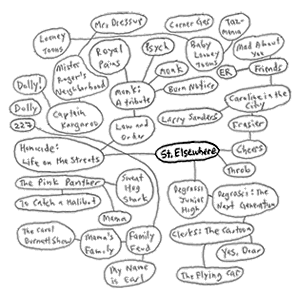
Tommy Westphall is a minor character from the drama television series ‘St. Elsewhere,’ which ran on NBC from 1982 to 1988. Westphall, who is autistic, took on major significance in the show’s final episode, where the common interpretation of that finale is that the entire St. Elsewhere storyline exists only within Westphall’s imagination. As characters from St. Elsewhere have appeared on other television shows and those shows’ characters appeared on more shows, a ‘Tommy Westphall Universe’ hypothesis was developed where a significant amount of fictional episodic television exists within Tommy Westphall’s imagined fictional universe.
The Tommy Westphall universe hypothesis, an idea discussed among some television fans, makes the claim that not only does ‘St. Elsewhere’ take place within Tommy’s mind, but so do numerous other television series which are directly and indirectly connected to ‘St. Elsewhere’ through fictional crossovers and spin-offs, resulting in a large fictional universe taking place entirely within Tommy’s mind. In 2002 writer Dwayne McDuffie wrote ‘Six Degrees of St. Elsewhere’ for the Slush Factory website, the earliest version of the hypothesis to be found online. In a 2003 article published on BBC News Online, ‘St. Elsewhere’ writer Tom Fontana was quoted as saying, ‘Someone did the math once… and something like 90 percent of all television took place in Tommy Westphall’s mind. God love him.’
read more »
Posted in Art, Humor, Language |
1 Comment »
October 24, 2011

A deus ex machina [dey-uhs-eks-mah-kuh-nuh] (Latin: ‘god out of the machine’) is a plot device whereby a seemingly inextricable problem is suddenly and abruptly solved with the contrived and unexpected intervention of some new event, character, ability, or object. The phrase comes to English usage from Horace’s ‘Ars Poetica,’ where he instructs poets that they must never resort to a god from the machine to solve their plots.
He refers to the conventions of Greek tragedy, where a crane (mekhane) was used to lower actors playing gods onto the stage. The machine referred to in the phrase could be either the crane employed in the task, a calque (loan translation) from the Greek ‘god from the machine,’ or the riser that brought a god up from a trap door. The idea is that the device of said god is entirely artificial or conceived by man.
read more »
Posted in Art, Language |
Leave a Comment »
October 24, 2011


A plot hole is a gap or inconsistency in a storyline that goes against the flow of logic established by the story’s plot, or constitutes a blatant omission of relevant information regarding the plot. These include such things as unlikely behavior or actions of characters, illogical or impossible events, events happening for no apparent reason, or statements/events that contradict earlier events in the storyline. While many stories have unanswered questions, unlikely events or chance occurrences, a plot hole is one that is essential to the story’s outcome. Plot holes are usually seen as weaknesses or flaws in a story, and writers usually try to avoid them to make their stories seem as realistic as possible. However, certain genres (and some media) which require or allow suspension of disbelief are more tolerant of plot holes.
Writers can deal with plot holes in different ways, from completely rewriting the story, to having characters acknowledge illogical or unintelligent actions, to having characters make vague statements that could be used to deflect accusations of plot holes (e.g. ‘I’ve tried everything I can think of…’ to keep critics from asking why a particular action was not taken). The nature of the plot hole and the developmental stage at which it is noticed usually determine the best course of action to take. For example, a motion picture that has already wrapped production would much more likely receive an added line of dialogue rather than an entire script rewrite.
Posted in Art, Humor, Language |
Leave a Comment »



