September 13, 2011
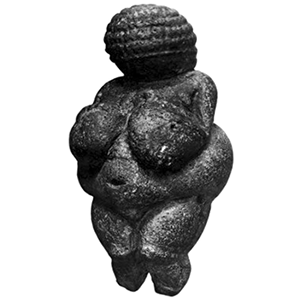
The Venus of Willendorf, also known as the ‘Woman of Willendorf,’ is an 11 cm (4.3 in) high statuette of a female figure estimated to have been made between 24,000 and 22,000 BCE. It was discovered in 1908 by archaeologist Josef Szombathy at a paleolithic site near Willendorf, a village in Lower Austria. It is carved from an oolitic limestone that is not local to the area, and tinted with red ochre. Several similar statuettes and other forms of art have been discovered, and they are collectively referred to as ‘Venus figurines,’ although they pre-date the mythological figure of Venus by millennia. The Willendorf figure was named following a model already over fifty years old, and shares many characteristics with other figures.
After a wide variety of proposed dates, following a revised analysis of the stratigraphy of its site in 1990, the figure has been estimated to have been carved 24,000–22,000 BCE. Very little is known about its origin, method of creation, or cultural significance. The Venus of Willendorf was recovered in a site that also contained a few amulets of Moldavite. The purpose of the carving is the subject of much speculation. It never had feet and does not stand on its own. The apparent large size of the breasts and abdomen, and the detail put into the vulva, have led scholars to interpret the figure as a fertility symbol. The figure has no visible face, her head being covered with circular horizontal bands of what might be rows of plaited hair, or a type of headdress. She was thought to be very healthy given her weight and size.
Posted in Art, Sex |
Leave a Comment »
September 11, 2011

Jeju Loveland is an outdoor sculpture park which opened in 2004 on Jeju Island in South Korea. The park is focused on a theme of sex, running sex education films, and featuring 140 sculptures representing humans in various sexual positions. It also has other elements such as large phallus statues, stone labia, and hands-on exhibits such as a ‘masturbation-cycle.’ The park’s website describes the location as ‘a place where love oriented art and eroticism meet.’ In 2002, graduates of Seoul’s Hongik University began creating sculptures for the park. Encompassing an area the size of two soccer fields, all of the sculptures can be viewed in approximately one hour, and there is an additional monthly rotating exhibit featuring works by different Korean artists. Visitors are required to be at least 18 years old, and a separate play area is available for minors while adults visit.
After the Korean War, the island became a popular honeymoon destination for Korean couples, due to the island’s warm climate. Many of the couples had wed because of arranged marriages, and the island also became known for being a center of sex education. According to an article in Germany’s ‘Der Spiegel’ magazine, in the late 1980s journalist and travel writer Simon Winchester reported that some hotel employees on the island performed as ‘professional icebreakers.’ In the evenings, the hotel would offer an entertainment program featuring erotic elements, to help newlyweds relax.
Posted in Art, Sex, World |
Leave a Comment »
September 8, 2011

PFFR (or Pre-natal Fighting Frightening Remembrances Forever Ltd.) is a Brooklyn based production company/art collective/electro-rock band consisting of Alyson Levy, Vernon Chatman, Jim Tozzi, and John Lee. The group has been active since 2000. The group’s portfolio of work includes albums, live performances, various art exhibits such as ‘An Attack On All Americans Or The Tyranny Of Weed’ shown at the LFL Galley in New York, and the script for the film ‘Final Flesh.’
PFFR are also active in television comedy. They wrote, directed, produced and starred in the MTV2 variety program ‘Wonder Showzen’ (2005–2006) and the Adult Swim CGI series ‘Xavier: Renegade Angel.’ For both these shows, Chatman and Lee are the directors and main voice talent, whilst Tozzi and Levy are the animation/character designer and art director, respectively. Levy provides additional voices for both shows whilst Tozzi does only for ‘Xavier.’ PFFR are also responsible for producing, directing and co-writing Jon Glaser’s Adult Swim show ‘Delocated.’
read more »
Posted in Art, Humor |
Leave a Comment »
September 8, 2011
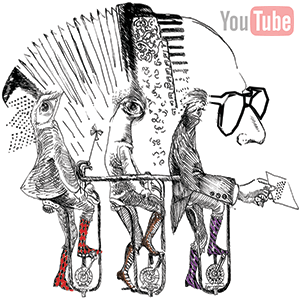
Motion Trio is a Polish accordion trio founded in 1996 by Janusz Wojtarowicz. The group has worked with such artists as Bobby McFerrin and Michał Urbaniak.
Its members consist of accordionists Janusz Wojtarowicz, Paweł Baranek, and Marcin Gałażyn.
Posted in Art, World |
Leave a Comment »
September 8, 2011
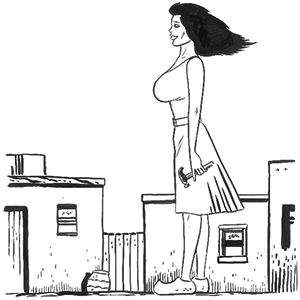
Luba is a comic book character created by Los Bros Hernandez, featured mainly in the ‘Love and Rockets’ series by these authors. She first appeared in ‘BEM,’ found in the ‘Love and Rockets’ collection ‘Music for Mechanics.’ Created by Gilbert Hernandez, Luba was the protagonist for his main contribution to Hernandez Brothers groundbreaking indie comic ‘Love and Rockets.’ Based largely in a small Central American village named Palomar, the Luba stories follow the progress of Luba and her ever increasing family through the years. Gilbert developed a rich cast of residents, who over the years developed an intricate series of relations with each other.
From the outset Luba is portrayed as a beautiful, fiery-tempered woman with enormous breasts and an eye for younger men, often depicted in random panels inexplicably carrying a hammer. This, in conjunction with Jaime Hernandez’ ‘Maggie and Hopey’ tales, differentiated ‘Love And Rockets’ from other comics in that the principal characters were all strong women who, whilst being independent, were also fallible. Through some twenty odd years Gilbert has taken the character of Luba through her infancy as the illegitimate child of a woman married into organized crime, through to life as a middle-aged migrant to America. The bulk of the tales dealt with what happened after Luba and her family moved from Palomar to California to escape the mafia and be near her half sisters Fritz and Petra. These stories comprise the books that make up the Luba Trilogy: ‘Luba in America,’ ‘The Book Of Ofelia’ and ‘The Three Daughters.’
Posted in Art, Language |
1 Comment »
September 8, 2011

Love and Rockets (often abbreviated L&R) is a black and white comic book series by Gilbert Hernandez and Jaime Hernandez, sometimes cited jointly as Los Bros Hernandez. Their brother Mario Hernandez is an occasional contributor. It was one of the first comics in the alternative comics revolution of the 1980s.
The Hernandez brothers self-published the first issue of ‘Love and Rockets’ in 1981, but since 1982 it has been published by Fantagraphics Books. The magazine temporarily ceased publication in 1996 after the release of issue #50, while Gilbert and Jaime went on to do separate series involving many of the same characters. However, in 2001 Los Bros revived the series as ‘Love and Rockets Volume 2’.
read more »
Posted in Art, Humor, Language |
Leave a Comment »
September 8, 2011

Gilberto Hernández (b. 1957), also known by the nickname Beto, is an American comics writer/artist. Along with his brothers Jaime and Mario he co-created the acclaimed independent comic book ‘Love and Rockets,’ published by Fantagraphics Books.
The style of Gilbert’s work has been described as magic realism or as a ‘magic-realist take on Central American soap opera.’ A common theme is the portrayal of independent women, and their strength, with the main example being Luba of Palomar, who character that appears in much of his work. His stories often deal with issues relevant to Latino culture in the United States.
read more »
Posted in Art, Humor, Language |
Leave a Comment »
September 7, 2011

Bowie Bonds are asset-backed securities of current and future revenues of the 25 albums (287 songs) that David Bowie recorded before 1990. Issued in 1997, the bonds were bought for US$55 million by the Prudential Insurance Company. The bonds paid an interest rate of 7.9% and had an average life of ten years. Royalties from the 25 albums generated the cash flow that secured the bonds’ interest payments. By forfeiting ten years worth of royalties, David Bowie was able to receive a payment of US$55 million up front. Bowie used this income to buy songs owned by his former manager.
The Bowie Bond issuance was perhaps the first instance of intellectual property rights securitization. The securitization of the collections of other artists, such as James Brown, Ashford & Simpson and the Isley Brothers, later followed. These Bonds are named Pullman Bonds after David Pullman, the banker who pushed the original Bowie deal. In March 2004, Moody’s Investors Service lowered the bonds from an A3 rating (the seventh highest rating) to Baa3, one notch above junk status. This downgrade was prompted by lower-than-expected revenue ‘due to weakness in sales for recorded music.’ A downgrade to an unnamed company that guarantees the issue was also cited as a reason for the downgrade. However, the success of Apple’s iTunes and other legal online music retailers has led to a renewed interest in Bowie and Pullman Bonds.
Posted in Art, Language, Money |
Leave a Comment »
September 7, 2011
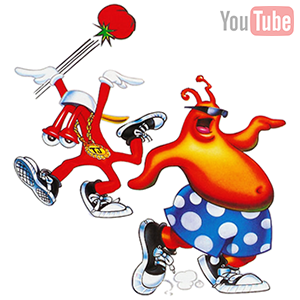
ToeJam & Earl is an action video game for the Sega Genesis (Mega Drive elsewhere). Released in 1991, it centers on the titular ToeJam and Earl—alien rappers who have crash-landed on Earth. As they attempt to escape the planet, players assume the role of either character and collect pieces of their wrecked spacecraft. ToeJam & Earl’s design was heavily influenced by the computer role-playing game Rogue, and took from it such features as the random generation of levels and items. It references and parodies 1990s urban culture and is set to a funk soundtrack. The game was positively received by critics, who praised its originality, soundtrack, humor and two-player cooperative mode. It attained sleeper hit status despite low initial sales, and its protagonists were used as mascots by Sega. Several sequels were produced for other consoles, but their commercial and critical success was mixed.
The game has been called a surreal, comic satire, and a ‘daringly misanthropic commentary on Earthly life.’ ToeJam, a red, three-legged alien, wears a large gold medallion and a backwards baseball cap, while the rotund and orange Earl is marked by high-tops and oversized sunglasses; both outfits are ‘over-the-top appropriations’ of 1990s urban culture. Their speech features California slang. The game is set to a jazz-funk and hiphop soundtrack inspired by Herbie Hancock.
read more »
Posted in Art, Games, Humor |
Leave a Comment »
September 6, 2011
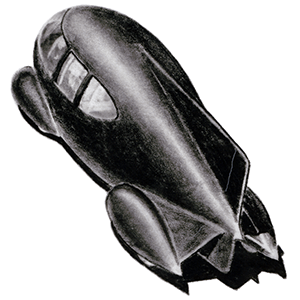
Norman Bel Geddes [bel-ged-eez] (1893 – 1958) was an American theatrical and industrial designer who focused on aerodynamics. His book ‘Horizons’ (1932) had a significant impact: ‘By popularizing streamlining when only a few engineers were considering its functional use, he made possible the design style of the thirties.’
He designed the General Motors Pavilion, known as Futurama, for the 1939 New York World’s Fair. For that famous and enormously influential installation, Bel Geddes exploited his earlier work in the same vein: he had designed a “Metropolis City of 1960′ in 1936.
read more »
Posted in Art, Technology |
Leave a Comment »
August 26, 2011

Cyanotype [sahy-an-uh-tahyp] is a photographic printing process that gives a cyan-blue print. The process was popular in engineering circles well into the 20th century. The simple and low-cost process enabled them to produce large-scale copies of their work, referred to as blueprints. Two chemicals are used in the process: Ammonium iron(III) citrate and Potassium ferricyanide.
The English scientist and astronomer Sir John Herschel discovered this procedure in 1842. Though the process was developed by Herschel, he considered it as mainly a means of reproducing notes and diagrams, as in blueprints. It was Anna Atkins who brought this to photography. She created a limited series of cyanotype books that documented ferns and other plant life from her extensive seaweed collection. Atkins placed specimens directly onto coated paper, allowing the action of light to create a silhouette effect. By using this photogram process, Anna Atkins is regarded as the first female photographer.
read more »
Posted in Art, Technology |
1 Comment »
August 25, 2011

Snow Crash is Neal Stephenson’s third novel, published in 1992. Like many of Stephenson’s other novels it covers a large range of topics including: history, linguistics, anthropology, archaeology, religion, computer science, politics, cryptography, memetics, and philosophy. Stephenson explained the title of the novel in his 1999 essay ‘In the Beginning… was the Command Line’ as his term for a particular software failure mode on the early Apple Macintosh computer, ‘When the computer crashed and wrote gibberish into the bitmap, the result was something that looked vaguely like static on a broken television set — a ‘snow crash.”
The book presents the Sumerian language as the firmware programming language for the brainstem, which is supposedly functioning as the BIOS for the human brain. According to characters in the book, the semetic goddess Asherah is the personification of a ‘linguistic virus,’ similar to a computer virus. The Sumerian god Enki created a counter-program which he called a ‘nam-shub’ that caused all of humanity to speak different languages as a protection against Asherah (a re-interpretation of the ancient Near Eastern story of the Tower of Babel).
read more »
Posted in Art, Money, Technology |
Leave a Comment »