September 29, 2011

‘Original Soundtracks 1’ is a 1995 album recorded by U2 and Brian Eno, as a side project, under the pseudonym Passengers. It is a collection of songs written for mostly imaginary movies (the exclusions being songs for ‘Ghost in the Shell,’ ‘Miss Sarajevo,’ and ‘Beyond the Clouds’). U2 and Eno formed Passengers as a side-project during the preliminary recording sessions for U2’s 1997 album, ‘Pop.’
Their intention was to record a soundtrack for Peter Greenaway’s 1996 film ‘The Pillow Book’ as a warm up before the main ‘Pop’ sessions. Though the plan did not come to fruition, Eno suggested they continue recording for imaginary films. U2 were unsure of the idea at first, but agreed after Eno told them that producing radio hits was not the goal of the collaboration
read more »
Posted in Art |
Leave a Comment »
September 28, 2011

The Statue of Responsibility is a proposed structure to be built on the West Coast of the United States. The prototype, sculpted by project artist Gary Lee Price, consists of a pair of clasped hands oriented vertically, symbolizing the responsibility that comes with liberty. The person who suggested the statue was scholar Viktor Frankl in his book ‘Man’s Search for Meaning.’ He recommended ‘that the Statue of Liberty on the East Coast should be supplemented by a Statue of Responsibility on the West Coast.’ His thought was that ‘Freedom, however, is not the last word. Freedom is only part of the story and half of the truth. Freedom is but the negative aspect of the whole phenomenon whose positive aspect is responsibleness. In fact, freedom is in danger of degenerating into mere arbitrariness unless it is lived in terms of responsibleness.’
The project is being managed by the non-profit foundation. The project has progressed slowly, but in 2010, the Utah state legislature unanimously declared their support for the project and declared Utah (Mr. Price’s home state) the Birthplace of the Statue of Responsibility. The statue foundation would like to build it in one of five cities: Long Beach, San Diego, Los Angeles, San Francisco, or Seattle.
Posted in Art, Politics, War |
1 Comment »
September 28, 2011

Morphing is a special effect in motion pictures and animations that changes (or morphs) one image into another through a seamless transition. Most often it is used to depict one person turning into another through technological means or as part of a fantasy or surreal sequence. Traditionally such a depiction would be achieved through cross-fading techniques on film. Since the early 1990s, this has been replaced by computer software to create more realistic transitions.
Though the 1986 movie ‘The Golden Child’ implemented very crude morphing effects from animal to human and back, the first movie to employ detailed morphing was ‘Willow,’ in 1988. A similar process was used a year later in ‘Indiana Jones and the Last Crusade’ to create Walter Donovan’s gruesome demise. Both effects were created by Industrial Light and Magic using grid warping techniques developed by Tom Brigham and Doug Smythe.
read more »
Posted in Art, Money, Technology |
1 Comment »
September 27, 2011

Nazi chic refers to the approving use of Nazi-era style, imagery, and paraphernalia in clothing and popular culture, especially when used for taboo breaking or shock value rather than out of genuine nazist sympathies. Its use began in the mid-seventies with the emergence of the punk movement in London; during the Sex Pistols’ first television appearance a person of their entourage was seen wearing a swastika. Nazi chic was later appropriated by the fashion industry.
In the 1970s punk subculture, several items of clothing designed to shock and offend The Establishment became popular. Among these punk fashion items was a T-shirt displaying a Swastika, an upside-down crucifix and the word ‘DESTROY’– which was worn by Johnny Rotten, seen in the video for ‘Pretty Vacant.’ Rotten wore the swastika another time with a gesture that looked like a Nazi salute.
read more »
Posted in Art, Politics, War |
Leave a Comment »
September 27, 2011
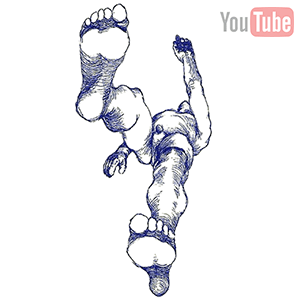
Ryan Larkin (1943 – 2007) was a Canadian animator who rose to fame with the psychedelic 1969 Oscar-nominated short ‘Walking’ and the acclaimed ‘Street Musique’ (1972). In later years Ryan was plagued by a downward spiral of drug abuse, alcoholism and homelessness, but towards the end of his life found himself back in the limelight when a 14-minute computer-animated documentary on his life, ‘Ryan’ by fellow Canadian animator, Chris Landreth, won the Academy Award for Animated Short Film and screened to acclaim at film festivals around the world. ‘Alter Egos’ (2004), directed by Laurence Green, is a documentary about the making of ‘Ryan’ that includes interviews with both Larkin and Chris Landreth as well as with various people who knew Ryan at the peak of his success.
Larkin studied under Arthur Lismer (a member of the Group of Seven, Canadian landscape painters in the 1920s) before starting to work at the National Film Board (NFB) of Canada in the early 1960s. At the NFB, Larkin learned animation techniques from the ground-breaking and award-winning animator, Norman McLaren. Larkin made two acclaimed short animated films, ‘Syrinx’ (1965) and ‘Cityscape’ (1966), before going on to create ‘Walking’ (1969). ‘Walking’ was nominated for an Academy Award in 1970 in the category Best Short Subject, Cartoon, but lost to ‘It’s Tough to Be a Bird’ by director Ward Kimball (one of Disney’s ‘Nine Old Men’). He went on to direct the award-winning short ‘Street Music,’ which premiered in 1972 and would be his last project.
Posted in Art, Drugs |
Leave a Comment »
September 26, 2011

Titanium rings are jewelry rings or bands which have been primarily constructed from titanium. The actual compositions of titanium can vary, such as ‘commercial pure’ (99.2% titanium) or ‘aircraft grade’ (90% titanium). Rings crafted from titanium are a modern phenomenon, becoming widely available on the market around the 1990s.
They offer several unique properties: they are biocompatible (hypoallergenic), lightweight, corrosion-resistant, and have the highest strength-to-weight ratio of any metal. Titanium was discovered in England in 1791 by William Gregor.
read more »
Posted in Art, Money, Technology |
Leave a Comment »
September 25, 2011
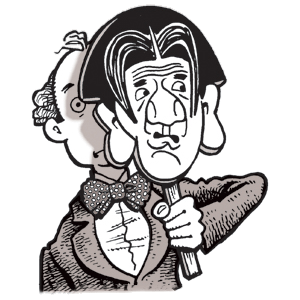
Fake Shemp is the term for someone who appears in a film under heavy make-up, filmed from the back, or perhaps only showing an arm or a foot.
In 1955, Shemp Howard of the ‘Three Stooges’ died suddenly of a heart attack. At the time, the Stooges still had four shorts left to deliver, according to the terms of their annual contract with Columbia Pictures.
read more »
Posted in Art, Language, Money |
1 Comment »
September 25, 2011

The Voyager Golden Records are phonograph records which were included aboard both Voyager spacecraft, which were launched in 1977. They contain sounds and images selected to portray the diversity of life and culture on Earth, and are intended for any intelligent extraterrestrial life form, or for future humans, who may find them. As the probes are extremely small compared to the vastness of interstellar space, the probability of a space faring civilization encountering them is very small, especially since the probes will eventually stop emitting any kind of electromagnetic radiation. If they are ever found by an alien species, it will most likely be far in the future as the nearest star on Voyager 1’s trajectory will only be reached in 40,000 years. Voyager 1 passed the orbit of Pluto in 1990, and left the solar system in 2004. In 2009, it was over 16.5 billion km from the Sun and traveling at a speed of 38,000 mph.
As Carl Sagan noted, ‘The spacecraft will be encountered and the record played only if there are advanced space-faring civilizations in interstellar space. But the launching of this ‘bottle’ into the cosmic ‘ocean’ says something very hopeful about life on this planet.’ Thus the record is best seen as a time capsule or a symbolic statement rather than a serious attempt to communicate with extraterrestrial life. The inscription, by President Jimmy Carter, reads: ‘This is a present from a small, distant world, a token of our sounds, our science, our images, our music, our thoughts and our feelings. We are attempting to survive our time so we may live into yours.’
read more »
Posted in Art, Language, Technology |
Leave a Comment »
September 25, 2011

‘Echoes‘ is a song by Pink Floyd including lengthy instrumental passages, sound effects, and musical improvisation. Written in 1970 by all four members of the group (credited as Roger Waters, Richard Wright, Nick Mason, David Gilmour on the original release), ‘Echoes’ provides the extended finale to Pink Floyd’s album ‘Meddle.’ The track has a running time of 23:31 and takes up the entire second side of the vinyl recording.
The composition uses many progressive and unconventional musical effects. The ping sound heard at the beginning of the song was created as the result of an experiment at the very beginning of the Meddle sessions. It was produced through amplifying a grand piano and sending the signal through a Leslie rotating speaker. At six minutes in, a funk progression in the tonic minor begins. Gilmour used the slide for certain sound effects on the studio recording.
read more »
Posted in Art |
Leave a Comment »
September 21, 2011

The Leslie speaker is a specially constructed amplifier/loudspeaker used to create special audio effects using the Doppler effect. Named after its inventor, Donald Leslie, it is particularly associated with the Hammond organ, an electric organ invented by Laurens Hammond in 1934 and manufactured by the Hammond Organ Company. While the Hammond organ was originally sold to churches as a lower-cost alternative to the wind-driven pipe organ, in the 1960s and 1970s it became a standard keyboard instrument for jazz, blues, rock music, church and gospel music. The Hammond/Leslie combination has become an element in many genres of music. Both brands are currently owned by Suzuki Musical Instrument Corporation.
Unlike a high fidelity loudspeaker, the Leslie is specifically designed, via reproduction of the Doppler effect, to alter or modify sound. Although there have been many variations over the years, the classic Leslie speaker consists of two driver units – a treble unit with horns, and a bass unit, and a crossover that divided the frequencies between the horn and the woofer. The key feature is that both the horns (in reality one working horn with a dummy to counter-balance it) and a sound baffle or scoop for the bass are electrically rotated to create ‘Doppler effect based’ vibrato, tremolo and chorus effects. The rotating elements can be stopped, switched between slow (chorale) and fast (tremolo), or transitioned between the two settings.
read more »
Posted in Art, Money, Technology |
Leave a Comment »
September 16, 2011

In photography, bokeh [boh-kay] is the blur, or the aesthetic quality of the blur, in out-of-focus areas of an image, or ‘the way the lens renders out-of-focus points of light.’ Differences in lens aberrations and aperture shape cause some lens designs to blur the image in a way that is pleasing to the eye, while others produce blurring that is unpleasant or distracting—’good’ and ‘bad’ bokeh, respectively. Bokeh occurs for parts of the scene that lie outside the depth of field. Photographers sometimes deliberately use a shallow focus technique to create images with prominent out-of-focus regions.
Bokeh is often most visible around small background highlights, such as specular reflections and light sources, which is why it is often associated with such areas. However, bokeh is not limited to highlights; blur occurs in all out-of-focus regions of the image.
read more »
Posted in Art, Language, Technology |
2 Comments »
September 13, 2011
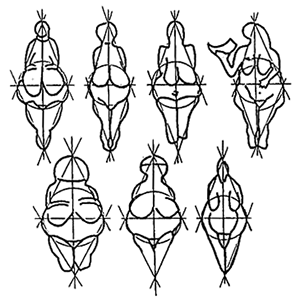
Venus figurines is an umbrella term for a number of prehistoric statuettes of women portrayed with similar physical attributes from the Upper Palaeolithic (between 40,000 and 10,000 years ago), mostly found in Europe, but with finds as far east as Siberia, extending their distribution to much of Eurasia.
These figurines were carved from soft stone (such as steatite, calcite or limestone), bone or ivory, or formed of clay and fired. The latter are among the oldest ceramics known. In total, over a hundred such figurines are known; virtually all of modest size, between 4 cm and 25 cm in height. They are some of the earliest works of prehistoric art.
read more »
Posted in Art, Sex, World |
Leave a Comment »