July 25, 2011

Wave Twisters (2001) is an animated film, also known as the first turntablism-based musical. It is based on DJ Q-Bert’s album of the same name. The film is entirely scripted to match the DJ Q-Bert recording. As such, it can seem a little disjointed at times. It was produced digitally using Adobe After Effects and a relatively small team of animators. Buckethead makes a short appearance in the film as well, near the beginning.
A crew of heroes is determined to save the lost arts of Hip Hop. Break Dancing, Graffiti, MCing, and DJing from total extinction. The lost arts are being oppressed throughout inner-space by lord Ook and his evil minions the Chinheads. The dental commander Dr. Julio Azul DDS, assumed to be secretary Honey Drips, Dental Hygienist/Robot Rubbish, and Grandpa have a series of adventures, synced to the music. Armed with the ancient relic known as the Wave Twister (a small turntable/wristwatch, the only weapon powerful enough to defeat their enemies), they travel to the far ends of inner-space for a final confrontation with the sinister army of oppressors. The film ends with the team teaching the liberated the lost fundamentals of hip hop.
Posted in Art, Humor, Technology |
Leave a Comment »
July 25, 2011

Idiocracy is a 2006 American film, a satirical science fiction comedy, directed by Mike Judge. The film tells the story of two ordinary people who are taken into a top-secret military hibernation experiment which goes awry, and awaken 500 years in the future. They discover that the world has degenerated into a dystopia where advertising, commercialism, and cultural anti-intellectualism run rampant and dysgenic pressure has resulted in a uniformly stupid human society devoid of intellectual curiosity, social responsibility and coherent notions of justice and human rights. Rather, this future society emphasizes popularity, sexual attraction, and hedonism.
During the prologue, a narrator explains that in our modern society, natural selection does not favor the intelligent (who are very selective and careful in how they have children) and that less-intelligent people procreate freely and easily out-breed the intelligent. This, combined with a general celebration of the cultural ‘lowest common denominator’ and general anti-intellectual cultural mores result in a world that has degenerated into a barely functioning society held together by a rapidly crumbling, mostly automated technological infrastructure that was created by intelligent individuals many years (perhaps centuries) earlier that few, if any, of the members of 26th Century society know how to operate or fix.
Posted in Art, Humor, Politics |
Leave a Comment »
July 25, 2011


Luigi Colani (b. 1928) is a German industrial designer. The prime characteristic of his designs are the rounded, organic forms, which he terms ‘biodynamic’ and claims are ergonomically superior to traditional designs. His ‘kitchen satellite’ from 1969 is the most prominent example of this school of thought. Many of his designs for small appliances are being mass-produced and marketed, but his larger designs have not been built, ‘a whole host of futuristic concepts that will have us living in pods and driving cars so flat that leg amputation is the only option.’
Colani responding to his critics said, ‘The earth is round, all the heavenly bodies are round; they all move on round or elliptical orbits. This same image of circular globe-shaped mini worlds orbiting around each other follows us right down to the microcosmos. We are even aroused by round forms in species propagation related eroticism. Why should I join the straying mass who want to make everything angular? I am going to pursue Galileo Galilei’s philosophy: my world is also round.’
Posted in Art, Money, Technology |
Leave a Comment »
July 24, 2011
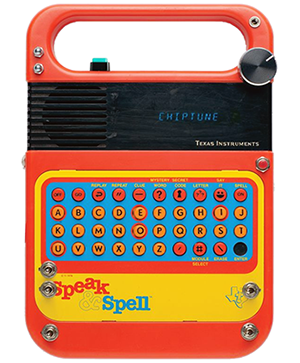
Circuit bending is the creative customization of the circuits within electronic devices such as low voltage, battery-powered guitar effects, children’s toys, and small digital synthesizers to create new musical or visual instruments and sound generators.
Emphasizing spontaneity and randomness, the techniques of circuit bending have been commonly associated with noise music, though many more conventional contemporary musicians and musical groups have been known to experiment with ‘bent’ instruments. Circuit bending usually involves dismantling the machine and adding components such as switches and potentiometers (control knobs) that alter the circuit.
read more »
Posted in Art, Games, Technology |
Leave a Comment »
July 23, 2011

Kid Carpet, real name Ed Patrick, is a musician from Bristol, England. His music has been described as ‘kiddy disco punk’ and ‘shit-hop,’ as it is recorded in his home studio using instruments such as samplers, Casio keyboards, and various children’s toys including plastic Fisher-Price guitars and Tamagotchi innards.
Posted in Art, Humor, Technology |
Leave a Comment »
July 23, 2011

Retrotronics is the making of electric circuits or appliances using older electric components, such as vacuum tubes, Nixie displays, relays, uniselectors, analog meters, etc. These are usually chosen for their aesthetic qualities, rather than their utility. Retrotronics is a popular strand within the steampunk movement. At the Oxford exhibition of Steampunk art, many of the works had a strong retrotronic influence, from light fittings of period components to computer keyboards and webcams of burnished copper and brass. Outside steampunk, similar influences are found amongst the retro-futurist scene.
A recent musical trend has sought to recapture early 1980s 8-bit game and synthesizer sounds, often referred to as Chiptune. Artists such as Kid Carpet perform entire sets on children’s toys or pocket synths of the period. Other artists, such as Nullsleep, perform using only period video game hardware. DJs offer dance music events built from samples of period games or gadgets.
read more »
Posted in Art, Money, Technology |
Leave a Comment »
July 23, 2011

Dieselpunk is a sub-genre of the pop surrealist art movement, as well as a budding subculture, that combines the aesthetics of the interbellum period through the early 1950s with postmodern technology and sensibilities. First coined in 2001 as a marketing term by game designer Lewis Pollak to describe his role-playing game ‘Children of the Sun,’ dieselpunk has grown to describe a distinct style.
The name ‘dieselpunk’ is a derivative of the 1980s science fiction genre cyberpunk, and is used to represent the time period – or ‘era’- when diesel-based locomotion was the main technological focus of Western culture. The ‘-punk’ suffix attached to the name is representative of the counterculture nature of the genre with regards to its opposition of contemporary aesthetics. The term also refers to the tongue-in-cheek name given to a similar cyberpunk derivative, ‘steampunk,’ which focuses on science fiction set within the Victorian era.
read more »
Posted in Art, Language, Technology |
2 Comments »
July 22, 2011

Steampunk is a sub-genre of science fiction, alternate history, and speculative fiction that came into prominence during the 1980s and early 1990s. It involves a setting where steam power is still widely used—usually the Victorian era Britain—that incorporates elements of either science fiction or fantasy.
Works of steampunk often feature anachronistic technology or futuristic innovations as Victorians may have envisioned them; based on a Victorian perspective on fashion, culture, architectural style, art, etc. This technology may include such fictional machines as those found in the works of H. G. Wells and Jules Verne.
read more »
Posted in Art, Language, Technology |
Leave a Comment »
July 22, 2011

Sexploitation describes a class of independently produced, low budget feature films generally associated with the 1960s, and serving largely as a vehicle for the exhibition of non-explicit sexual situations and gratuitous nudity. Sexploitation films were generally exhibited in urban grindhouse theatres, the precursor to the adult movie theaters of the 1970s and ’80s that featured hardcore content. The term soft-core is often used to designate non-explicit sexploitation films after the general legalization of hardcore content.
A series of United States Supreme Court rulings in the late 50s and 60s had enabled increasingly explicit sex films to be distributed.There were initially three broad types; ‘nudie cuties’ such as ‘The Immoral Mr. Teas’ (1959), films set in nudist camps like ‘Daughter of the Sun’ (1962), and somewhat more ‘artistic’ foreign pictures such as ‘The Twilight Girls’ (1961). Nudie cuties were popular in the early 60s, and were a development from the nudist camp films of the 50s.
read more »
Posted in Art, Politics, Sex |
Leave a Comment »
July 22, 2011

Corpsing is a British theatrical slang term used to describe when an actor breaks character during a scene by laughing or by causing another cast member to laugh. The term originated when a living actor played a corpse on stage; there was sometimes a temptation to try to make that actor laugh. Corpsing is not a term exclusive to the theatre, but is also used to describe actions designed to cause hysteria in live television or radio.
The ‘Saturday Night Live’ sketches featuring ‘Debbie Downer’ (Rachel Dratch) are also notable for corpsing, as well as the famous ‘Stefon’ (Bill Hader), who only went on one occasion without corpsing throughout his entire five-year stint. Jimmy Fallon is also known for breaking character by laughing.
Posted in Art, Humor, Language |
1 Comment »
July 22, 2011

Shel Silverstein (1930 – 1999), was an American poet, musician, cartoonist, and author of children’s books. He styled himself as Uncle Shelby in his children’s books.
Silverstein grew up in Chicago: ‘When I was a kid—12 to 14, around there—I would much rather have been a good baseball player or a hit with the girls, but I couldn’t play ball. I couldn’t dance. Luckily, the girls didn’t want me. Not much I could do about that. So I started to draw and to write. I was also lucky that I didn’t have anybody to copy, be impressed by. I had developed my own style; I was creating before I knew there was a Thurber, a Benchley, a Price and a Steinberg. I never saw their work till I was around 30. By the time I got to where I was attracting girls, I was already into work, and it was more important to me. Not that I wouldn’t rather make love, but the work has become a habit.’
read more »
Posted in Art, Humor, Language |
Leave a Comment »
July 21, 2011

Watch the Throne is a collaborative studio album by Jay-Z and Kanye West, set to be released August 1, 2011. Production began in Bath, England and continued during available times in Jay-Z’s and West’s respective schedules at recording locations in Australia, Paris, New York City, and Los Angeles. Parts of the album were recorded at the Mercer Hotel and Tribeca Grand Hotel in New York City.
In an interview, Jay-Z discussed their insistence on recording in person, stating ‘If we were gonna do it, we were gonna do it together. No mailing it in.’ The album features guest appearances by Beyoncé, Frank Ocean, and Mr Hudson, with production by Kanye West along with The Neptunes, The RZA, Q-Tip, Swizz Beatz, and others. The album’s cover and artwork were both designed by Italian fashion designer Riccardo Tisci.
Posted in Art, Money |
Leave a Comment »