January 29, 2018

A Mary Sue is an idealized and seemingly perfect fictional character. Typically, this character is recognized as an author insert or wish fulfillment. They can usually perform better at tasks than should be possible given the amount of training or experience, and usually are able through some means to upstage the protagonist of an established fictional setting, such as by saving the hero.
The term comes from the name of a character created by fan fiction writer Paula Smith in 1973 for her parody story ‘A Trekkie’s Tale’ published in her fanzine ‘Menagerie.’ The story starred Lieutenant Mary Sue (‘the youngest Lieutenant in the fleet — only fifteen and a half years old’), and satirized unrealistic characters in Star Trek fan fiction.
read more »
Posted in Art, Politics |
Leave a Comment »
January 12, 2018
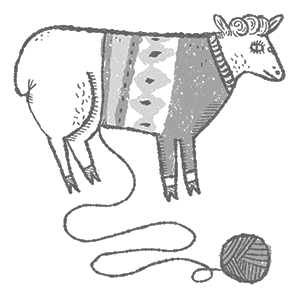
The sweater curse, or the ‘curse of the love sweater,’ is a knitting folktale which claims that if a knitter gives a hand-knit sweater to a significant other, it will lead to the recipient breaking up with them. In an alternative formulation, the relationship will end before the sweater is even completed. In a 2005 poll, 15% of active knitters said that they had experienced the sweater curse firsthand, and 41% considered it a possibility that should be taken seriously.
Despite its name, the ‘sweater curse’ is treated in knitting literature not as a superstition governed by paranormal forces, but rather as a real-world pitfall of knitting that has rational explanations. Several plausible mechanisms for the sweater curse have been proposed, but it has not been studied systematically.
read more »
Posted in Art, Humor, Sex |
1 Comment »
December 7, 2017

Tommy Wiseau is an American actor and filmmaker. He produced and directed ‘The Room’ (2003), which has been described by many critics as ‘one of the worst movies ever made’ and has gained cult film status. He also directed the 2004 documentary ‘Homeless in America’ and the 2015 sitcom ‘The Neighbors.’
Wiseau is secretive about his early life. In various interviews, he has claimed to have lived in France ‘a long time ago,’ asserted that he grew up in New Orleans, and described having ‘an entire family’ in Chalmette, Louisiana.
read more »
Posted in Art, Humor |
Leave a Comment »
November 30, 2017

Dick Proenneke [pren-uh-kee] (1916 – 2003) was a self-educated naturalist who lived alone for nearly thirty years in the mountains of Alaska in a log cabin he had constructed by hand near the shore of Twin Lakes.
Proenneke hunted, fished, raised and gathered his own food, and also had supplies flown in occasionally. He documented his activities in journals and on film, and also recorded valuable meteorological and natural data. The journals and film were later used by others to write books and produce documentaries about his time in the wilderness.
read more »
Posted in Art, Science |
Leave a Comment »
October 12, 2017

The Tramp (also known as ‘Charlot’ in several languages) was British actor Charlie Chaplin’s most memorable on-screen character and an icon in world cinema during the era of silent film. ‘The Tramp’ is also the title of a silent film starring Chaplin, which he wrote and directed in 1915.
The Tramp, as portrayed by Chaplin, is a childlike, bumbling but generally good-hearted character who is most famously portrayed as a vagrant who endeavors to behave with the manners and dignity of a gentleman despite his actual social status. However, while he is ready to take what paying work is available, he also uses his cunning to get what he needs to survive and escape the authority figures who will not tolerate his antics.
read more »
Posted in Art, Humor |
1 Comment »
October 6, 2017
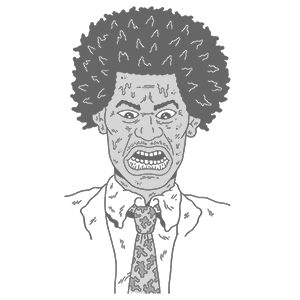
Eric Andre (b. 1983) is an American actor, comedian, and television host. He is the creator, host, and co-writer of ‘The Eric Andre Show,’ a surreal parody of low-budget public-access talk shows that airs on ‘Adult Swim’ (a nighttime programming block on ‘Cartoon Network’). Andre also played ‘Mike’ on the ‘FXX’ comedy series ‘Man Seeking Woman.’
‘The Eric Andre Show’ premiered in 2012. The series is hosted along with comedian Hannibal Buress, who serves as André’s sidekick. The show was influenced, in part, by surreal spoof talk show ‘Space Ghost Coast to Coast,’ a series that has previously aired on ‘Cartoon Network’ and later ‘Adult Swim.’
read more »
Posted in Art, Humor |
1 Comment »
July 20, 2017

In Greek mythology, Daedalus [ded-l-uhs] (lit. ‘cunningly wrought’) was a skillful craftsman and artist in Greek mythology associated with the island of Crete, especially the labyrinth he built there to contain the Minotaur (part man, part bull). He is the father of Icarus (who flew too close the sun on wings his father designed), the uncle of Perdix (the mythological inventor of the saw), and possibly also the father of Iapyx (an Apollonian healer who aided Troy in the Trojan War).
Daedalus’ parentage was supplied as a later addition to the mythos, with numerous figures reported as his mother and father. Athenians rewrote Cretan Daedalus to make him Athenian-born, the grandson of the ancient king Erechtheus, claiming that Daedalus fled to Crete after killing his nephew Talos.
read more »
Posted in Art, Philosophy, Technology |
Leave a Comment »
July 13, 2017
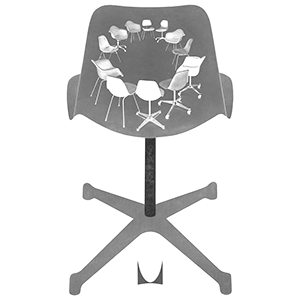
Herman Miller, Inc., based in Zeeland, Michigan, is a major American manufacturer of office furniture, equipment and home furnishings. It is notable as one of the first companies to produce modern furniture and, under the guidance of Design Director George Nelson, is likely the most prolific and influential producer of furniture of the modernist style. Among classic Herman Miller products are the Equa chair, Aeron chair, Noguchi table, Marshmallow sofa, and the Eames Lounge Chair.
Herman Miller is credited with the invention of the office cubicle (originally known as the ‘Action Office II’) in 1968 under then-director of research Robert Propst. Herman Miller holds a unique position among furniture manufacturers for having cultivated the talents of a large number of modernist designers, producing a significant number of pieces that are now considered icons of industrial design.
read more »
Posted in Art, Money, Technology |
Leave a Comment »
June 26, 2017

Charles (1907–1978) and Ray Eames (1912–1988) were husband and wife American designers who made significant historical contributions to the development of modern architecture and furniture. Among their most well-known designs is the ‘Eames Lounge Chair.’ They also worked in the fields of industrial and graphic design, fine art, and film.
Charles was an American designer, architect and filmmaker. He and his second wife Ray Kaiser are responsible for groundbreaking contributions in the field of architecture, furniture design, industrial design, manufacturing and the photographic arts.
read more »
Posted in Art, Money |
Leave a Comment »
June 20, 2017
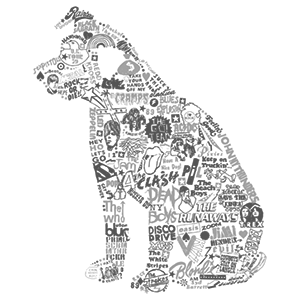
His Master’s Voice (HMV) is a famous trademark in the music and recording industry and was for many years the unofficial name of a large British record label. The name was coined in the 1890s as the title of a painting by English artist Francis Barraud of a dog named ‘Nipper,’ listening to a wind-up gramophone. In the original painting, the dog was listening to a cylinder phonograph. In the 1970s, a bronze statue of the dog and gramophone was awarded by the record company (EMI) to artists and or music producers and or composers as a Music Award and often only after selling more than 100,000 LP’s.
The original painting was acquired from the original artist in 1899 by the newly formed Gramophone Company and adopted by the Victor Talking Machine Company in the United States. According to contemporary Gramophone Company publicity material, the dog, a terrier, had originally belonged to Francis Barraud’s brother, Mark. When Mark Barraud died, Francis inherited Nipper, with a cylinder phonograph and recordings of Mark’s voice. Francis noted the peculiar interest that the dog took in the recorded voice of his late master emanating from the horn, and conceived the idea of committing the scene to canvas.
read more »
Posted in Art, Money |
Leave a Comment »
May 22, 2017

The phenakistiscope [fen-uh-kiss-tuh-skohp] was the first widespread animation device that created a fluent illusion of motion. The phenakistiscope is regarded as one of the first forms of moving media entertainment that paved the way for the future motion picture and film industry. It is sometimes compared to GIF animation since both show a short continuous loop.
A phenakisticope usually comes in the form of a spinning cardboard disc attached vertically to a handle. Arrayed radially around the disc’s center are a series of pictures showing sequential phases of the animation. Small rectangular apertures are spaced evenly around the rim of the disc. The user would spin the disc and look through the moving slits at the images reflected in a mirror. The scanning of the slits across the reflected images keeps them from simply blurring together, so that the user can see a rapid succession of images that appear to be a single moving picture.
read more »
Posted in Art, Science, Technology |
Leave a Comment »
April 24, 2017


Gary Anderson (b. 1947) is an influential graphic designer and architect. He is most well known as the designer of the ‘recycling symbol,’ one of the most readily recognizable logos in the world. His contribution to modern graphic design has been compared to those of early pioneering modernists such as Herbert Bayer. His design for a symbol to embody the concept of recycling has been compared to iconic trademarks such as those for Coca-Cola and Nike.
It has been called one of America’s ‘most important design icons’ and has helped to encourage global recycling. In some countries, such as the UK, the symbol carries such implicit meaning that it requires government permission to be used. Although the symbol is the most widely known of his accomplishments, Anderson has also made important contributions in the areas of urban planning and urban development.
read more »
Posted in Art, Politics, World |
Leave a Comment »


 The Daily Omnivore