July 12, 2011

Artist’s Shit (Italian: ‘Merda d’artista’) is a 1961 artwork by the Italian artist Piero Manzoni. The work consists of 90 tin cans, each 30 grams, with a label in Italian, English, French, and German stating: ‘Artist’s Shit; Freshly preserved; Produced and tinned in May 1961.’ At the time the piece was created Manzoni was producing works that explored the relationship between art production and human production, Artist’s Breath (‘Fiato d’artista’), a series of balloons filled with Manzoni’s breath, being an example.
A tin was sold for €124,000 at Sotheby’s in 2007. The cans were originally to be valued according to their equivalent weight in gold — $37 each in 1961 — with the price fluctuating according to the market. One of Manzoni’s collaborators, Agostino Bonalumi, claimed that the tins are full not of faeces but plaster; but some cans have leaked and confirmed they are indeed faeces — though whether human or animal has not been verified.
Posted in Art, Humor, Money |
Leave a Comment »
July 12, 2011
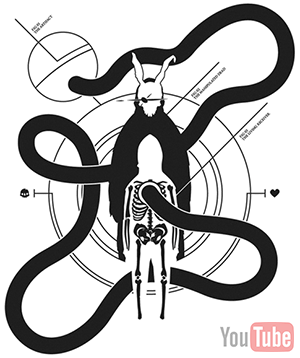
Donnie Darko is a 2001 American psychological thriller written and directed by Richard Kelly, starring Jake Gyllenhaal. The film depicts the reality-bending adventures of the title character as he seeks the meaning and significance behind his troubling Doomsday-related visions. In October 1988, teenager Donnie Darko has been seeing a psychiatrist because of his troubled history. Donnie sleepwalks, and he has visions of Frank, a menacing, demonic-looking rabbit. On October 2, Frank draws Donnie out of his room to tell him, in 28 days, 6 hours, 42 minutes, and 12 seconds, the world will end. While Donnie is outside, a jet engine crashes through his bedroom. The next morning, Donnie wakes up on a golf course. He returns home to find police and firemen inspecting the wreckage. No one knows where the jet engine has come from, since there were no planes flying in the vicinity, and no airline reported losing an engine.
Music is used heavily in the film. One continuous sequence involving an introduction of Donnie’s high school prominently features the song ‘Head over Heels’ by Tears for Fears, Donnie’s sister’s dance group, ‘Sparkle Motion,’ performs with the song ‘Notorious’ by Duran Duran, and ‘Under the Milky Way’ by The Church is played after Donnie and Gretchen emerge from his room during the party. ‘Love Will Tear Us Apart’ by Joy Division also appears in the film. The opening sequence is set to ‘The Killing Moon’ by Echo & the Bunnymen.
Posted in Art |
1 Comment »
July 12, 2011


Richard Kelly (b. 1975) is an American film director and writer. He won a scholarship to the University of Southern California to study at the USC School of Cinema-Television. He made two short films, ‘The Goodbye Place’ and ‘Visceral Matter,’ before graduating in 1997. His first feature film, ‘Donnie Darko’ (2001), a psychological thriller, was given a budget of just $4.5 million, received major critical acclaim. His fourth film, and second feature, ‘Southland Tales,’ (2006) is a science fiction dark comedy-drama, which was unsuccessful critically and financially. His most recent feature, ‘The Box’ (2009), is a psychological horror film.
Although Richard Kelly’s films differ considerably in setting and characters (‘Donnie Darko’ is about a suburban teenager, ‘Southland Tales’ is an L.A. epic, and ‘The Box’ is about a married couple in Richmond, Virginia), they share similar themes of time travel, existentialism, and spirituality. Kelly’s style is composed of Steadicam based tracking shots and camera movement in general, satirical elements (as seen sparsely in ‘Donnie Darko’ and much more prominently in ‘Southland Tales’), comedy, drama, and enigmatic plots. Music also plays a large role in Richard Kelly’s films; for example, the closing segment of ‘Donnie Darko’ is a montage of several characters awakening from their lucid dreams to Gary Jules’s version of the Tears for Fears song ‘Mad World.’
Posted in Art, Money |
1 Comment »
July 12, 2011

Southland Tales is a 2006 science fiction dark comedy-drama film, written and directed by Richard Kelly. The title refers to the Southland, a name used by locals to refer to Southern California and Greater Los Angeles. Set in the then near future of an alternate history, the film is a portrait of Los Angeles and a comment on the military-industrial news-tainment complex. The film features an ensemble cast. Original music for the film was provided by Moby. The film was a critical and financial failure.
The film opens on El Paso and Abilene, Texas, both of which fall victim to twin nuclear attacks on July 4, 2005—a catastrophe of unimaginable proportions which launches America into World War III. The PATRIOT Act has extended authority to a new agency known as US-IDent, which keeps constant tabs on citizens and heavily censors the media and the Internet.
read more »
Posted in Art, Humor, Politics |
Leave a Comment »
July 9, 2011
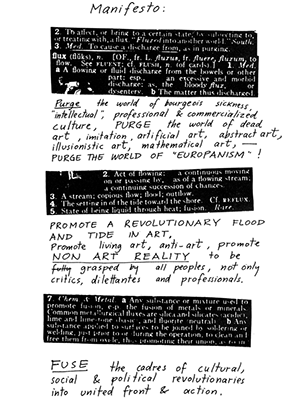
Fluxus—a name taken from a Latin word meaning ‘to flow’—is an international network of artists, composers and designers noted for blending different artistic media and disciplines in the 1960s. They have been active in Neo-Dada noise music and visual art as well as literature, urban planning, architecture, and design. Fluxus is sometimes described as intermedia.
The origins of Fluxus lie in many of the concepts explored by composer John Cage in his experimental music of the 1950s. Cage explored notions of indeterminacy in art, through works such as ‘4’ 33″,’ which influenced Lithuanian-born artist George Maciunas. Maciunas (1931–1978) organized the first Fluxus event in 1961 at the AG Gallery in New York City and the first Fluxus festivals in Europe in 1962.
read more »
Posted in Art, Language, Money |
Leave a Comment »
July 8, 2011

Max is a visual programming language for music and multimedia developed and maintained by San Francisco-based software company Cycling ’74. During its 20-year history, it has been widely used by composers, performers, software designers, researchers, and artists for creating innovative recordings, performances, and installations.
The Max program itself is highly modular, with most routines existing in the form of shared libraries. As a result, Max has a large userbase of programmers not affiliated with Cycling ’74 who enhance the software with commercial and non-commercial extensions to the program.
read more »
Posted in Art, Technology |
Leave a Comment »
July 8, 2011

Jean-Yves Prieur (b.1964), aka Kid Loco is a French electronic musician, DJ, remixer and producer. His style has been compared to Air and Dimitri from Paris. His best-known album is ‘A Grand Love Story’ (1997), and he has also compiled and mixed a DJ mix album for the ‘Another Late Night’ series on Azuli Records.
He has worked with Jarvis Cocker (of Pulp), with Italian band The Transistors (Maurizio Mansueti and Luca Cirillo) and Glasgow bands A Band Called Quinn and Mogwai, and produced the album ‘Too Late To Die Young’ by the British group, Departure Lounge.
Posted in Art, World |
Leave a Comment »
July 8, 2011

Dr. Octagon was a fictional character created by American rapper Keith Thornton, better known as Kool Keith. First appearing on Thornton’s 1996 debut solo album, ‘Dr. Octagonecologyst,’ Dr. Octagon is an extraterrestrial time traveling gynecologist and surgeon from the planet Jupiter. Thornton performed and released three albums under the alias. The character was murdered by another of his characters, Dr. Dooom on Thornton’s 1999 album ‘First Come, First Served,’ and was briefly revived before once again being killed on Thornton’s 2008 album ‘Dr. Dooom 2,’ in response to the release of ‘The Return of Dr. Octagon,’ an album largely produced without Thornton’s involvement.
In Dr. Octagonecologyst, Dr. Octagon is described as having yellow eyes, green skin, and a pink-and-white Afro. Further tracks detail a list of services offered by Octagon, who claims to treat chimpanzee acne and moosebumps, and relocate saliva glands. Octagon is described as being incompetent, as many of his surgery patients die as he conducts his rounds. He often engages in sexual intercourse with female patients and nurses. Octagon’s uncle, Mr. Gerbik, is described as being half shark, having the skin of an alligator, and is 208 years old.
read more »
Posted in Art, Humor |
1 Comment »
July 8, 2011
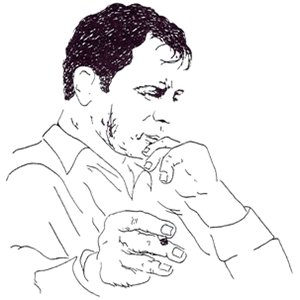
Moody Street Irregulars (subtitled ‘A Jack Kerouac Newsletter’) was an American publication dedicated to the history and the cultural influences of Jack Kerouac and the Beat Generation. Edited and published by Joy Walsh, it featured articles, memoirs, reviews and poetry. Published from Clarence Center, New York, it had a run of 28 issues from Winter 1978 to 1992. The title of the publication derives from the Baker Street Irregulars, a group of street urchins often employed by Sherlock Holmes in the novels by Sir Arthur Conan Doyle.
The magazine’s approach is indicated by the contents of issue number 9 (1981), a special ‘Vanity of Duluoz’ (Kerouac’s semi-autobiographical novel) issue including essays and articles by Gregory Stephenson, John Clellon Holmes, Carolyn Cassady, plus an interview with William S. Burroughs by Jennie Skerl. Issue number 11 (Spring/Summer 1982) was a special ‘French Connection’ issue, featuring articles and essays about Kerouac, his French-Canadian ancestry and his popularity in Quebec.
Posted in Art, Language |
Leave a Comment »
July 6, 2011

The EcoSphere is sealed blown-glass miniature aquarium produced by Ecosphere Associates, Inc., of Tucson, Arizona, United States. Spherical or ovoid, the aquaria range from roughly baseball-size to soccer-ball-size. They are sold worldwide as scientific novelties and decorative objects. The spheres are populated by tiny red-pink shrimp, which swim energetically around the aquarium, eat the brown bacterial and algal scum on the glass, consume the filamentous green algae which sometimes forms a globular pillow in the water, and perch on a fragment of coral.
Each EcoSphere is a materially closed ecological systems which is self-sustaining over a period of years. At room temperature, and with only low inputs of light, the algae produce oxygen which supports the shrimp and bacteria. Bacteria break down the shrimps’ wastes. The breakdown products provide nutrients to the algae and bacteria upon which the shrimp feed. The manufacturer states that shrimp live in the EcoSphere for an average of 2 to 3 years, and are known to live over 10 years.
read more »
Posted in Art, Science |
Leave a Comment »
July 5, 2011

Granny Takes a Trip was a boutique opened in 1966 in Chelsea, London. The shop remained open until the mid-70s and has been called the ‘first psychedelic boutique in the ‘Swinging London’ in the 1960s.” It was also the name of a Purple Gang song of the 1960s named after the store and banned by the BBC.
The boutique was the brainchild of two young Londoners, Nigel Waymouth and Sheila Cohen, who were looking for an outlet for Cohen’s ever-increasing collection of antique clothes. By the spring of 1966 the shop had achieved worldwide renown. They paved the way for many of the designer boutiques that followed, such as Mr. Freedom, Alkasura, Let It Rock, and later the more ambitious enterprises of Malcolm McLaren and Vivienne Westwood and Paul Smith.
read more »
Posted in Art, Money, World |
Leave a Comment »
July 5, 2011

The Maschinenmensch [muh-sheen-en-mench] (German: ‘machine-human’) from ‘Metropolis,’ is a gynoid played by German actress Brigitte Helm in both her robotic and human incarnations. The haunting blank face and pronounced female curves have been the subject of disgust and fascination alike. The Maschinenmensch has many names given her through the years : Parody, Ultima, Machina, Futura, and Robotrix. The Maschinenmensch’s back story is detailed in Thea von Harbou’s original 1927 novel. It is described as a very delicate, but faceless, transparent figure made of crystal flesh with silver bones and its eyes filled with an expression of calm madness. Futura is perfectly obedient and the ideal agent-provocateur, able to become any woman and tempt men to their doom.
The memorable transformation scene was an early miracle of special effects, using a series of matte cutouts of the robot’s silhouette and a number of circular neon lights. All effects were filmed directly into the camera rather than edited separately. As a result the film had to be rewound and exposed many tens of times over to include the plates showing the heart and circulatory systems as well as cuts between the robot form and Maria showing her gradual transformation. The Maschinenmensch is an archetypal example of the Frankenstein complex, where artificial creations turn against their creator and go on a rampage. Artificial beings with a malevolent nature were a popular theme at the time. Original designs by Ralph McQuarrie for C-3PO in Star Wars were largely based on the Maschinenmensch, albeit in a male version. The design was later refined, but retains clear Art Deco influences.
Posted in Art, Language, Technology |
1 Comment »