June 23, 2011

Helmholtz [helm-hohlts] resonance is the phenomenon of air resonance in a cavity, such as when one blows across the top of an empty bottle. The name comes from a device created in the 1850s by Hermann von Helmholtz, the ‘Helmholtz resonator,’ which he, the author of the classic study of acoustic science, used to identify the various frequencies or musical pitches present in music and other complex sounds.
When air is forced into a cavity, the pressure inside increases. When the external force pushing the air into the cavity is removed, the higher-pressure air inside will flow out. However, this surge of air flowing out will tend to over-compensate, due to the inertia of the air in the neck, and the cavity will be left at a pressure slightly lower than the outside, causing air to be drawn back in. This process repeats with the magnitude of the pressure changes decreasing each time.
read more »
Posted in Art, Science, Technology |
Leave a Comment »
June 22, 2011

Shutter Shades are a design of slatted sunglasses commercially available since the 1980s, designed by Alain Mikli, a French designer of high-end handmade eyeglasses and accessories. Instead lenses, the design is characterized by its ‘shutter’ motif, which is part of the frame, and are marketed as suitable for both men and women. Depending on the design, Shutter Shades may not function as sunglasses; although some models contain UV resistant lenses, many do not, and only feature a series of horizontal plastic ‘shades,’ which neither provide protection for the eye from UV light nor prevent a substantial amount of light from entering the eye.
First available in the 1980s, nicknamed ‘Venetian Blinders,’ a then-popular design of louvered eyewear were featured in the music videos for ‘Glittering Prize’ by Simple Minds in 1982 and ‘Obsession’ by Animotion in 1984. Alain Mikli made a contemporary custom design for Kanye West, again influenced by the fashion of the 1980s. West popularized the glasses in the music video for ‘Stronger’ in 2007.
Posted in Art |
Leave a Comment »
June 21, 2011

Rustic buses are old artisan modified buses used in rural Colombia and Ecuador where they are known as chivas (kid goats) or escaleras (ladders). They are used as public transport and more recently used as party buses in both countries. These are varied but characterized for being painted colorfully (usually with the yellow, blue, and red colors of the flags of Ecuador and Colombia) with local arabesques and figures.
Most have a ladder to the rack on the roof which is also used for carrying people, livestock and merchandise. They are built upon a bus chassis with a modified body made out either metal or wood. Seats are bench alike, made out of wood and with doors instead of windows.
read more »
Posted in Art, Technology, World |
Leave a Comment »
June 21, 2011

Commercial graffiti (also known as aerosol advertising or graffiti for hire) is the commercial practice of graffiti artists being paid for their work. In New York City in particular, commercial graffiti is big business and since the 1980s has manifested itself in many of the major cities of Europe such as London, Paris and Berlin.
Increasingly it has been used to promote video games and even feature prominently within them, reflecting a real life struggle between street artists and the law. Commercial graffiti has created significant controversy between those who view it as an effective medium of advertising amongst specific target audiences and those who believe that legal graffiti and advertising using it encourages illegal graffiti and crime.
read more »
Posted in Art, Money |
Leave a Comment »
June 21, 2011


Mr. Brainwash (‘MBW’) is a pseudonym for Thierry Guetta in the film ‘Exit Through the Gift Shop,’ directed by Banksy. Guetta is presented in the 2010 film as a French citizen who now lives in Los Angeles, having been a proprietor of a clothing store and videographer who evolved into a street artist and gallery artist, influenced by the street artists he documented through video over the years.
According to the film, Guetta was first introduced to street art by his cousin, the French street artist, Invader. The film includes authentic documentation of Space Invader, Shepard Fairey, Banksy, and other well-known street artists at work on the streets, and is directed by Banksy with significant participation from Fairey.
read more »
Posted in Art, Money |
1 Comment »
June 21, 2011

Four-on-the-floor is a rhythm pattern used in disco and electronic dance music. It is a steady, uniformly accented beat in 4/4 time in which the bass drum is hit on every beat (1, 2, 3, 4) in common time. This was popularized in the disco music of the 1970s and the term four-on-the-floor was widely used in that era: it originated with the pedal-operated drum-kit bass-drum.
Many styles of electronic dance music, particularly those that derived from house and techno, use this beat as an important part of the rhythmic structure. Sometimes the term is used to refer to a 4/4 uniform drumming pattern for any drum.
read more »
Posted in Art, Language |
Leave a Comment »
June 21, 2011

The Wall of Sound was an enormous public address system designed specifically for the Grateful Dead’s live performances by audio engineer Owsley ‘Bear’ Stanley. Used in 1974, the Wall of Sound fulfilled the band’s desire for a distortion-free sound system that could also serve as its own monitoring system. The Wall of Sound was the largest concert sound system built at that time.
As Stanley described it, ‘The Wall of Sound is the name some people gave to a super powerful, extremely accurate PA system that I designed and supervised the building of in 1973 for the Grateful Dead. It was a massive wall of speaker arrays set behind the musicians, which they themselves controlled without a front of house mixer. It did not need any delay towers to reach a distance of half a mile from the stage without degradation.’
read more »
Posted in Art, Money, Technology |
Leave a Comment »
June 21, 2011

Space art is a general term for art emerging from knowledge and ideas associated with outer space, both as a source of inspiration and as a means for visualizing and promoting space travel. Whatever the stylistic path, the artist is generally attempting to communicate ideas somehow related to space, often including appreciation of the infinite variety and vastness which surrounds us.
In some cases, artists who consider themselves space artists use more than illustration and painting to communicate scientific discoveries or works depicting space; a new breed of space artists work directly with space flight technology and scientists as an opportunity to expand the arts, humanities and cultural expression relative to space exploration.
read more »
Posted in Art, Technology |
Leave a Comment »
June 21, 2011

American artist, Frank Pietronigro, is co-founder of the Zero Gravity Arts Consortium. The organization was founded in 1999 by Laura Knott, Lorelei Lisowsky and Frank Pietronigro. Zero Gravity Arts Consortium (ZGAC) is an international space arts organization dedicated to fostering greater access for artists to space flight technology and zero gravity space through the creation of international partnerships with space agencies, space industry entrepreneurs, arts and science organizations and leading universities.
ZGAC is the first organization of its kind, based in the United States, that is facilitating parabolic flight projects that will help in the international effort to set the stage for teams of artists to have permanent access to space transportation systems including the International Space Station. ZGAC supports arts, humanities and culture in space education, international outreach and conference programs that are being organized as a way for artists, from all over the globe, to affiliate with us and experience the possibilities of collaborating with space flight technologists.
Posted in Art, Technology |
Leave a Comment »
June 21, 2011
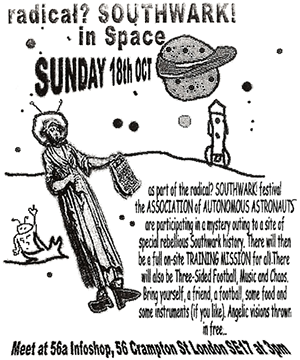
The Association of Autonomous Astronauts is a worldwide network of community based groups dedicated to building their own spaceships. The AAA was founded in 1995. Although many of their activities were reported as serious participation in conferences or protests against the militarization of space, some were also considered art pranks, media pranks, or just an elaborate spoof. The AAA had numerous local chapters which operated independently of one another, with the AAA effectively operating as a collective pseudonym along the lines of a nom de plume.
The Association’s ostensible five-year mission, a reference to Star Trek, was to ‘establish a planetary network to end the monopoly of corporations, governments and the military over travel in space.’ Artists who became involved were often connected to the zine scene or mail art movements. The five year mission’s completion was marked at the 2000 Fortean Times conference, although some chapters have continued activities to the present day. Several AAAers have experienced zero-gravity training flights.
read more »
Posted in Art, Politics, Technology |
Leave a Comment »
June 21, 2011

Clive Wearing (b. 1938) is a British musician and musicologist suffering from an acute and long-lasting case of anterograde and retrograde amnesia. Specifically, this means he lacks the ability to form new memories, dubbed the ‘memento’ syndrome by laypeople and the media, after a film of the same name based on the subject.
Clive Wearing is an accomplished musician, and is known for editing the works of composer, Orlande de Lassus. Wearing sang at Westminster Cathedral as a tenor lay clerk for many years and also had a successful career as a chorus master and worked as such at Covent Garden and the London Sinfonietta Chorus. In 1968 he founded the Europa Singers of London, an amateur choir specialising in music of the 17th, 18th and 20th centuries. It won critical approval especially for performances of the Monteverdi Vespers.
read more »
Posted in Art, Health |
Leave a Comment »
June 20, 2011

A Claude glass (or black mirror) is a small mirror, slightly convex in shape, with its surface tinted a dark color. Bound up like a pocket-book or in a carrying case, black mirrors were used by artists, travellers and connoisseurs of landscape and landscape painting.
Black Mirrors have the effect of abstracting the subject reflected in it from its surroundings, reducing and simplifying the colour and tonal range of scenes and scenery to give them a painterly quality.
read more »
Posted in Art, Technology |
Leave a Comment »




 The Daily Omnivore