March 19, 2011

In many computer operating systems a special type of error message will display onscreen when the system has experienced a fatal error. Computer users have dubbed these messages screens of death as they typically result in unsaved work being lost and often indicate serious problems with the system’s hardware or software.
Screens of death are usually the result of a ‘kernel panic’ (an action taken by an operating system upon detecting an internal fatal error from which it cannot safely recover), although the terms are frequently used interchangeably. Most screens of death are displayed on an even background color with a message advising the user to restart the computer.
Posted in Death, Humor, Technology |
Leave a Comment »
March 11, 2011

The Ides of March is a day on the Roman calendar that corresponds to March 15th. It was marked by several religious observances, and became notorious as the date of the assassination of Julius Caesar in 44 BCE. In Canada, the day is commemorated with the drinking of Bloody Caesar (a Bloody Mary made with Clamato). In the original Roman calendar, March was the first month of the year. The holidays observed by the Romans from the first through the Ides often reflect their origin as new year celebrations. The Romans did not number days of a month sequentially from the first through the last day.
Instead, they counted back from three fixed points of the month: the Nones (5th or 7th, depending on the length of the month), the Ides (13th or 15th), and the Kalends (1st) of the following month. The Ides occurred near the midpoint, on the 13th for most months, but on the 15th for March, May, July, and October. The Ides were supposed to be determined by the full moon, reflecting the lunar origin of the Roman calendar. On the earliest calendar, the Ides of March would have been the first full moon of the new year.
read more »
Posted in Death, Language, Philosophy |
Leave a Comment »
March 6, 2011

Murderabilia is a term identifying collectibles related to murders, murderers, or other violent crimes. ‘Serial killer art’ is defined as artwork created by serial killers while in prison. Often, this process is used as a therapy device, or for further understanding a particularly disturbed psyche. The artists usually vary dramatically in skill and themes covered. John Wayne Gacy, Richard Ramirez, and Henry Lee Lucas are a few of the better known American serial killer artists. Perry Smith, the mass murderer known from Truman Capote’s famous nonfiction work ‘In Cold Blood,’ was also a prolific artist.
Collectors typically must have direct contact to obtain and authenticate this art. The actual pieces can sell for large sums of money depending on the individual artist, and their notoriety through serial killing. Murderabilia is a controversial area of the collecting world, as evidenced by the public backlash to the idea of selling or profiting from violent crimes. In 2005, a serial killer’s artwork was sold online in Massachusetts. State lawmakers proposed to block the activity, setting off a debate on free speech rights of prisoners.
Posted in Death, Money, Politics |
Leave a Comment »
March 3, 2011

Frag is a video game term originating from the word fragging, a term indicating to kill an unpopular superior officer with a fragmentation grenade. A frag is roughly equivalent to ‘kill,’ with the typical main difference that the player being ‘”fragged’ can instantly respawn (play again) in most games, i.e. the ‘kill’ is only temporary. In games it is mainly used as a kill count and score system. The term is used in various first-person shooter games like Quake by software developer Id.
Posted in Death, Games, Technology |
Leave a Comment »
March 3, 2011
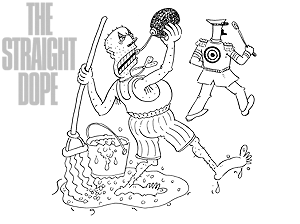

In the U.S. military, fragging refers to the act of attacking a superior officer in one’s chain of command with the intent to kill that officer. The term originated during the Vietnam War and was most commonly used to mean the assassination of an unpopular officer of one’s own fighting unit. Killing was often effected by means of a fragmentation grenade, hence the term.
The most common motive for choosing a fragmentation grenade or similar device is a perpetrator’s desire to avoid identification and the associated consequences at either the individual level (e.g., punishment by one’s superiors) or the collective level (e.g., dishonor brought to one’s unit): where a grenade is thrown in the heat of battle, soldiers can claim that the grenade landed too close to the person they ‘accidentally’ killed, that another member of the unit threw the grenade, or that an enemy soldier threw it back.
read more »
Posted in Death, Language, War |
Leave a Comment »
February 23, 2011
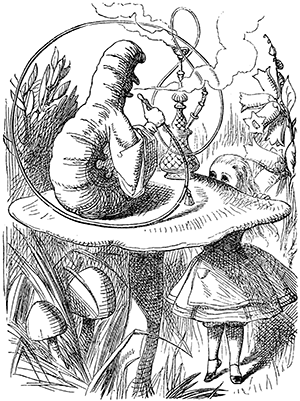
In Douglas Hofstadter’s book ‘Gödel, Escher, Bach,’ Tumbolia is ‘the land of dead hiccups and extinguished light bulbs,’ ‘where dormant software waits for its host hardware to come back up.’ The concept is introduced in the dialogue ‘Little Harmonic Labyrinth’ (based on the piece of the same name by Bach). In a later dialogue ‘A Mu Offering’ (named after Bach’s ‘Musical Offering’), a Tortoise gets rid of a knot in a string by tying a second one, and both disappear to Tumbolia; apparently, this is ‘The Law of Double Nodulation’ (a parody of the law of double negation).
The return of the two knots from Tumbolia prompts the speculation that some ‘layers of Tumbolia’ are more accessible than others. It is mentioned that ‘pushing’ or ‘popping’ potion can be used (drunk by the characters) to navigate up and down the various levels of Tumbolia. Tumbolia is compared to the Zen view of life after death, using the image of a snowflake, a self-contained subsystem of the universe, dissolving into ‘the larger system which once held it.’ Finally, in the book’s last dialogue, Hofstadter (himself appearing as a character) tells us that Tumbolia is where dreamed characters go when the dreamer wakes up.
Posted in Art, Death, Philosophy |
Leave a Comment »
February 10, 2011

Cat burning was a form of zoosadistic entertainment in 17th century Paris, France. People would gather dozens of cats in a net and hoist them high into the air from a special bundle onto a bonfire. Those assembled shrieked with laughter as the animals, howling with pain, were singed, roasted, and finally carbonized.
The people collected the embers and ashes of the fire and took them home, believing that they brought good luck. The French kings often witnessed these spectacles and even lit the bonfire with their own hands. In the medieval and early modern periods, cats, which were associated with vanity and witchcraft, were sometimes burned as symbols of the Devil.
Posted in Death, Philosophy, World |
1 Comment »
February 3, 2011

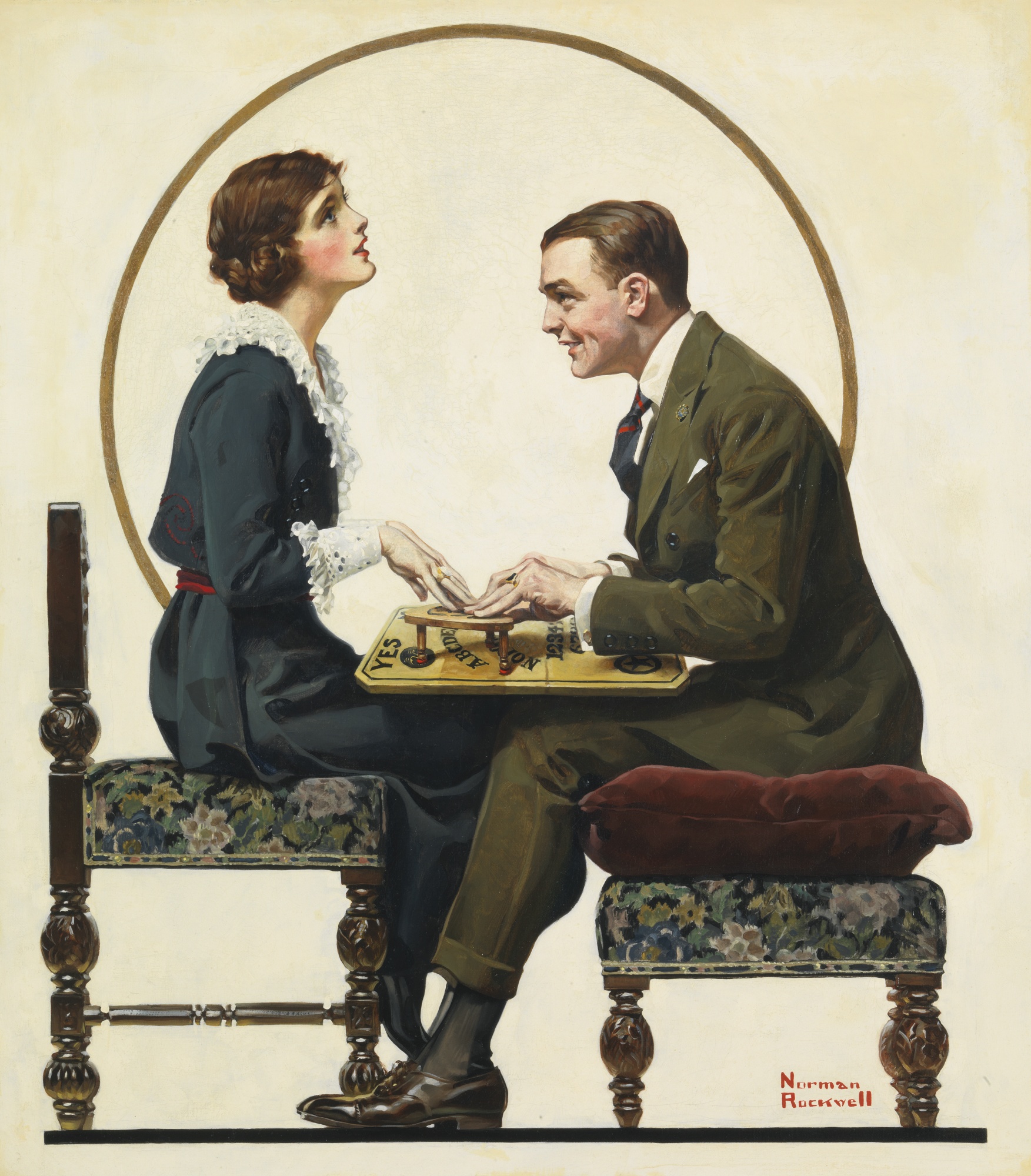
Ouija [wee-jee] is a commercial trademark for a ‘talking board,’ which is a device marked with letters, numbers, and other symbols, supposedly used to communicate with spirits. It uses a planchette (small heart-shaped piece of wood) to indicate the spirit’s message by spelling it out on the board during a séance. The fingers of the séance participants are placed on the planchette, which then moves about the board to spell out words or become physically manifested as a result of the ideomotor effect (a psychological phenomenon wherein a subject makes motions unconsciously).
Following its commercial introduction by businessman Elijah Bond in the late 1890s, the Ouija board was regarded as a harmless parlor game unrelated to the occult until American Spiritualist Pearl Curran popularized its use as a divining tool during World War I. Some mainstream Christian religions have associated use of the Ouija board with the threat of demonic possession, as have certain Occultist movements.
Posted in Death, Games, Humor |
Leave a Comment »
February 2, 2011
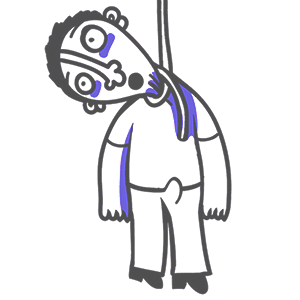
A death erection, angel lust, or terminal erection is a post-mortem erection, technically a priapism (prolonged involuntary erection), observed in the corpses of human males who have been executed, particularly by hanging. The phenomenon has been attributed to pressure on the cerebellum created by the noose. Spinal cord injuries are known to be associated with priapism. Other causes of death may also result in these effects, including fatal gunshot wounds to the brain, damage to major blood vessels, and violent death by poisoning. A postmortem priapism is an indicator that death was likely swift and violent.
Death by hanging, whether an execution or a suicide, has been observed to affect the genitals of both men and women. In women, the labia and clitoris will become engorged and there may be a discharge of blood from the vagina. In men, a more or less complete state of erection of the penis, with discharge of urine, mucus or prostatic fluid is a frequent occurrence – present in one case in three.
Posted in Death, Health, Sex |
Leave a Comment »
February 2, 2011
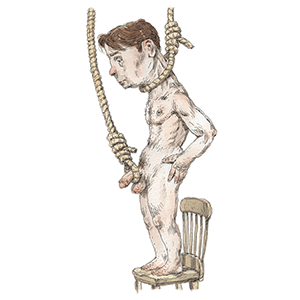
Erotic asphyxiation is the intentional restriction of oxygen to the brain for sexual arousal. It is also called asphyxiophilia, hypoxyphilia, or breath control play. Colloquially, a person engaging in the activity is sometimes called a ‘gasper.’
The carotid arteries (on either side of the neck) carry oxygen-rich blood from the heart to the brain. When these are compressed, as in strangulation or hanging, the sudden loss of oxygen to the brain and the accumulation of carbon dioxide can increase feelings of giddiness, lightheadedness, and pleasure, all of which will heighten sexual sensations.
read more »
Posted in Death, Health, Sex |
1 Comment »
January 30, 2011
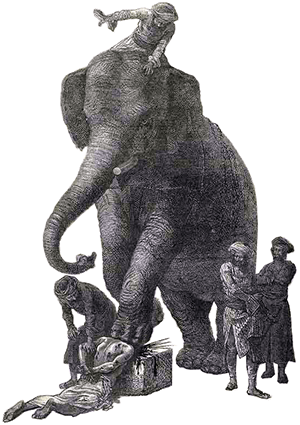
Execution by elephant was, for thousands of years, a common method of capital punishment in South and Southeast Asia, and particularly in India. Asian Elephants were used to crush, dismember, or torture captives in public executions. The animals were trained and versatile, both able to kill victims immediately or to torture them slowly over a prolonged period. Employed by royalty, the elephants were used to signify both the ruler’s absolute power and his ability to control wild animals.
The sight of elephants executing captives attracted the interest of usually horrified European travellers, and was recorded in numerous contemporary journals and accounts of life in Asia. The practice was eventually suppressed by the European empires that colonised the region in the 18th and 19th centuries. While primarily confined to Asia, the practice was occasionally adopted by Western powers, such as Rome and Carthage, particularly to deal with mutinous soldiers.
Posted in Death, War, World |
Leave a Comment »
January 20, 2011

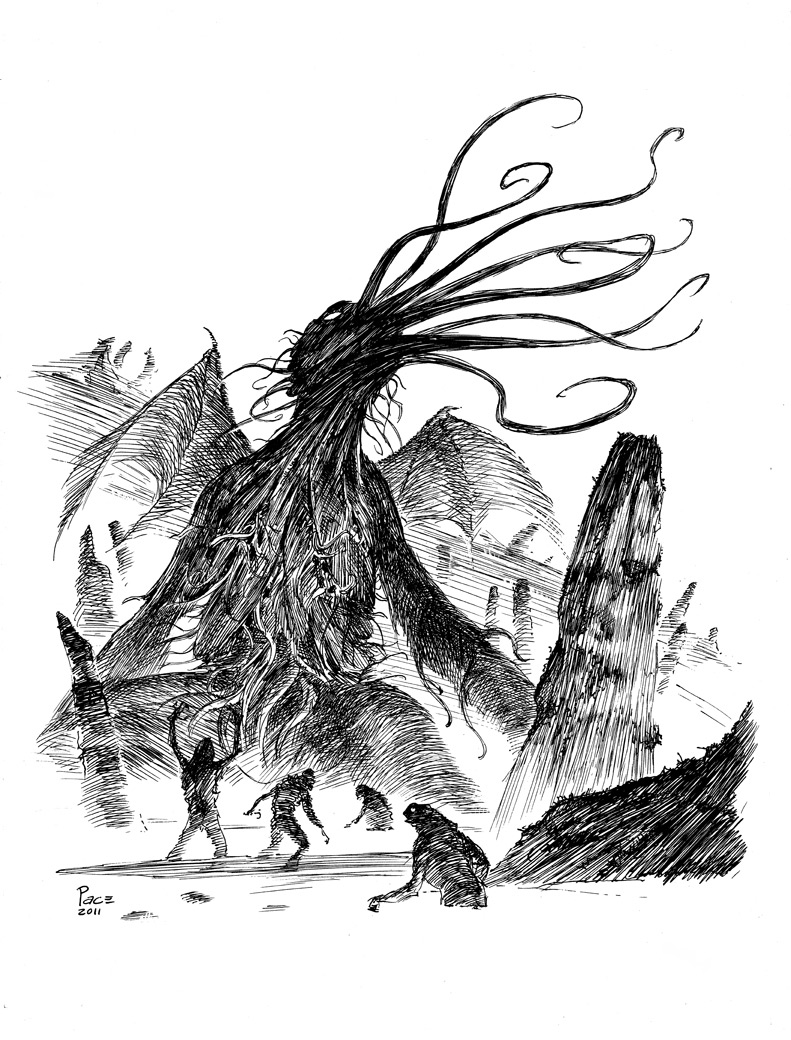
Cthulhu [kuh-thool-hoo] is a fictional cosmic entity created by horror author H. P. Lovecraft in 1926. Cthulhu is the high priest to the Great Old Ones and one of the central figures of the Lovecraft Mythos. It is often cited for the extreme descriptions given of its hideous appearance, its gargantuan size, and the abject terror that it evokes. Cthulhu is depicted as having a worldwide doomsday cult centered in Arabia, with followers in regions as far-flung as Greenland and Louisiana.
Posted in Art, Death |
Leave a Comment »




 The Daily Omnivore