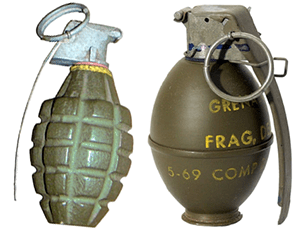
In the U.S. military, fragging refers to the act of attacking a superior officer in one’s chain of command with the intent to kill that officer. The term originated during the Vietnam War and was most commonly used to mean the assassination of an unpopular officer of one’s own fighting unit. Killing was often effected by means of a fragmentation grenade, hence the term.
The most common motive for choosing a fragmentation grenade or similar device is a perpetrator’s desire to avoid identification and the associated consequences at either the individual level (e.g., punishment by one’s superiors) or the collective level (e.g., dishonor brought to one’s unit): where a grenade is thrown in the heat of battle, soldiers can claim that the grenade landed too close to the person they ‘accidentally’ killed, that another member of the unit threw the grenade, or that an enemy soldier threw it back.
Unlike a firearm projectile, an exploded hand grenade cannot be readily traced to anyone, whether by using ballistics forensics or by any other means. The grenade itself is destroyed in the explosion, and the characteristics of the remaining shrapnel are not distinctive enough to permit tracing to a specific grenade or soldier.
Fragging most often involved the murder of a commanding officer (C.O.) or a senior noncommissioned officer perceived as unpopular, harsh, inept or overzealous. As the war became more unpopular, soldiers became less keen to go into harm’s way and preferred leaders with a similar sense of self-preservation. If a C.O. was incompetent, fragging the officer was considered a means to the end of self-preservation for the men serving under him.
Fragging might also occur if a commander freely took on dangerous or suicidal missions, especially if he was deemed to be seeking glory for himself. The motive of individual self-preservation was often obstructive to the goals of the overall war effort. Fragging in the military was not a total secret in the lower enlisted-rank soldiers. Sometimes warnings would be given beforehand to the unpopular officer by placing a grenade pin on his bed.
The very idea of fragging served to warn junior officers to avoid the ire of their enlisted men through recklessness, cowardice or lack of leadership. Junior officers in turn could arrange the murder of senior officers when finding them incompetent or wasting their men’s lives needlessly. Underground GI newspapers sometimes listed bounties offered by units for the fragging of unpopular commanding officers.
There are documented cases of at least 230 American officers killed by their own troops in the Vietnam War, and as many as 1,400 other officers’ deaths could not be explained. Between 1970 and 1971 alone, there were 363 cases of ‘assault with explosive devices’ against officers. Incidents of fragging have been recorded as far back as the 18th century Battle of Blenheim in 1704. An unpopular major was shot in the head by his own men after the battle had been won.



Leave a Reply