April 10, 2012
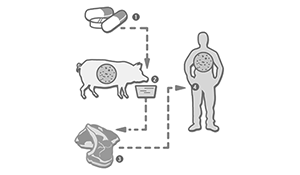

Antibiotic overuse is a contributing factor to the creation of multidrug-resistant bacteria, informally called ‘super bugs’: relatively harmless bacteria can develop resistance to multiple antibiotics and cause life-threatening infections. Though antibiotics are required to treat severe bacterial infections, misuse has contributed to a rise in bacterial resistance. The overuse of fluoroquinolone (a family of antibiotics) and other antibiotics fuels antibiotic resistance in bacteria, which can inhibit the treatment antibiotic-resistant infections. Their excessive use in children with otitis media (ear infection) has given rise to a breed of bacteria resistant to antibiotics entirely.
Widespread use of fluoroquinolones as a first-line antibiotic has led to decreased antibiotic sensitivity, with negative implications for serious bacterial infections such as those associated with cystic fibrosis, where quinolones are among the few viable antibiotics. Antibiotics have no effect on viral infections such as the common cold. They are also ineffective against sore throats, which are usually viral and self-resolving. Most cases of bronchitis (90–95%) are viral as well, passing after a few weeks—the use of antibiotics such as ofloxacin against bronchitis is superfluous and can put the patient at risk of suffering adverse reactions.
read more »
Posted in Drugs, Food, Health |
Leave a Comment »
April 9, 2012

Orgasm Inc. (2009) is the first feature documentary by award-winning director Liz Canner. It premiered at the Hot Docs Documentary Film Festival. In the documentary, filmmaker Liz Canner takes a job editing erotic movies for a drug trial for a pharmaceutical company called Vivus. Her employer is developing what they hope will be the first Viagra drug for women that wins FDA approval to treat a new disease: female sexual arousal disorder (FSD). Initially, she plans to create a movie about science and pleasure but she soon begins to suspect that her employer, along with a cadre of other medical companies, might be trying to take advantage of women (and potentially endanger their health) in pursuit of billion dollar profits.
The film continues from Vivus onto the more general question of whether there is a solid scientific foundation to medical industry claims about what constitutes ‘healthy’ female sexuality and whether drugs and surgery are a suitable first-line approach to obtaining it. The film documents an emerging medical industry intent on convincing women that they have medical problems, and that those problems are best solved by expensive and dangerous medical treatments.
Posted in Drugs, Money, Sex |
1 Comment »
April 9, 2012

In sexuality, the refractory period is the recovery phase after (normally male) orgasm during which it is physiologically impossible for an individual to have additional orgasms. Most men are unable to maintain or achieve an erection during this time, and many perceive a psychological feeling of ‘satiation’ and are temporarily uninterested in further sexual activity. The penis may be hypersensitive and further sexual stimulation may even feel painful during this time frame.
The refractory period varies widely among individuals and across species, ranging from minutes to days. An increased infusion of the hormone oxytocin during ejaculation is believed to be chiefly responsible for the refractory period and the amount by which oxytocin is increased may affect the length of each refractory period. Another chemical which is considered to be responsible for this effect is prolactin, which represses dopamine, which is responsible for sexual arousal.
read more »
Posted in Drugs, Health, Sex |
Leave a Comment »
April 6, 2012

‘Minnie the Moocher‘ is a jazz song first recorded in 1931 by Cab Calloway and His Orchestra, famous for its nonsensical ad libbed (‘scat’) lyrics. In performances, Calloway would have the audience participate by repeating each scat phrase in a form of call and response. Eventually Calloway’s phrases would become so long and complex that the audience would laugh at their own failed attempts to repeat them. The song is based both musically and lyrically on Frankie ‘Half-Pint’ Jaxon’s 1927 ‘Willie the Weeper’ (Bette Davis sings this version in ‘The Cabin in the Cotton’).
The lyrics are heavily laden with drug references. The character ‘Smokey’ is described as ‘cokey’ meaning a user of cocaine; the phrase ‘kicking the gong around’ was a slang reference to smoking opium. It was followed two years later by Lonnie Johnson’s ‘Winnie the Wailer.’
read more »
Posted in Art, Drugs |
Leave a Comment »
April 6, 2012

Bromo-DragonFLY is a psychedelic hallucinogenic drug related to phenethylamine (a chemical found in chocolate, which like amphetamine, causes the release of norepinephrine and dopamine in the brain). It is considered an extremely potent hallucinogen, only slightly less potent than LSD, with a normal dose in the region of 200 μg to 800 μg, and it has an extremely long duration (up to several days).
It is explicitly illegal only in Finland, Sweden, Norway, and Denmark, although it may be considered a controlled substance analogue under US and Australian drug laws. The compound was first synthesized in the lab of American pharmacologist David E. Nichols in 1998. As with the earlier and less potent dihydrofuran series of compounds nicknamed FLY, Bromo-DragonFLY was named after its superficial structural resemblance to a dragonfly.
read more »
Posted in Drugs, Health, Politics |
Leave a Comment »
April 6, 2012

Erowid is an online library of information about psychoactive plants and chemicals and other topics on altered states of consciousness such as meditation and lucid dreaming. It provides information about legal and illegal substances, including their desired and adverse effects. The site is organized by substance, ranging from well-known substances like alcohol, to obscure ones such as Bromo-DragonFLY (a hallacuinogen only slightly less potent than LSD, but which lasts for several days).
The information on the site is gathered from diverse sources including published literature, experts in related fields, and the experiences of the general public. Erowid acts as a publisher of new information as well as a library for the collection of documents and images published elsewhere.
read more »
Posted in Drugs, Health, Politics |
Leave a Comment »
April 4, 2012

Cataplexy [kat-uh-plek-see] is a sudden and transient episode of loss of muscle tone, often triggered by emotions. It is a rare disease (prevalence of fewer than 5 per 10,000 in the community), but affects roughly 70% of people who have narcolepsy. Cataplexy can also be present as a side effect of SSRI Discontinuation Syndrome. The term cataplexy originates from the Greek ‘kata’ (‘downwards’), and ‘plexis’ (‘hitting’). Cataplexy manifests itself as muscular weakness which may range from a barely perceptible slackening of the facial muscles to the dropping of the jaw or head, weakness at the knees, or a total collapse. Usually the speech is slurred, vision is impaired (double vision, inability to focus), but hearing and awareness remain normal.
These attacks are triggered by strong emotions such as exhilaration, anger, fear, surprise, orgasm, awe, embarrassment, and laughter. A person’s efforts to stave off cataplectic attacks by avoiding these emotions may greatly diminish their quality of life, and they may become severely restricted emotionally if diagnosis and treatment is not begun as soon as possible. Cataplexy may be partial or complete, affecting a range of muscle groups, from those controlling facial features to (less commonly) those controlling the entire body.
Posted in Drugs, Health |
Leave a Comment »
April 1, 2012
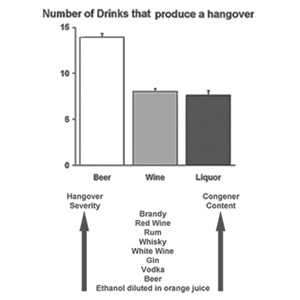
Congener [kon-juh-ner] (from Latin for ‘of the same race or kind’) has several different meanings depending on the field in which it is used. Colloquially, it is used to mean a person or thing like another, in character or action. In biology, congeners are organisms within the same genus. In chemistry, congeners are related chemicals, e.g., elements in the same group of the periodic table, or derivatives thereof. In genetics, congenic organisms are those with very similar genomes, except for a small fraction. For example, recombinant congenic mice strains are produced in laboratories as a tool to study genetic disease.
In the alcoholic beverages industry, congeners, also known as fusel oils, are substances produced during fermentation. These substances include small amounts of chemicals such as acetone, acetaldehyde, and other higher alcohols, esters, and aldehydes (e.g. propanol, glycols, ethyl acetate). Congeners are responsible for most of the taste and aroma of distilled alcoholic beverages, and contribute to the taste of non-distilled drinks. It has been suggested that these substances contribute to the symptoms of a hangover.
Posted in Drugs, Health, Science |
Leave a Comment »
April 1, 2012

A hangover is the experience of various unpleasant physiological effects following heavy consumption of alcoholic beverages. An alcohol hangover is associated with a variety of symptoms that may include dehydration, fatigue, headache, body aches, vomiting, diarrhea, flatulence, weakness, elevated body temperature and heart rate, hypersalivation, difficulty concentrating, sweating, anxiety, dysphoria, irritability, sensitivity to light and noise, erratic motor functions (including tremor), trouble sleeping, severe hunger, halitosis, and lack of depth perception. Many people will also be repulsed by the thought, taste or smell of alcohol during a hangover.
While a hangover can be experienced at any time, generally speaking it is experienced the morning after a night of heavy drinking. Hypoglycemia, dehydration, acetaldehyde intoxication, and glutamine rebound are all theorized causes of hangover symptoms. Hangover symptoms may persist for several days after alcohol was last consumed. Approximately 25-30% of drinkers may be resistant to hangover symptoms.
read more »
Posted in Drugs, Health, Science |
Leave a Comment »
March 27, 2012

Verlan [veyr-lahn] is a French argot (secret language) featuring inversion of syllables in a word, and is common in slang and youth language. It rests on a long French tradition of transposing syllables of individual words to create slang words.
The name verlan is an example: it is derived from inverting the syllables in ‘l’envers’ [lan-ver](‘the inverse’). Different rules apply for one-syllable words, and words with more than one syllable may be verlanized in more than one way. For example, ‘cigarette’ may yield ‘garetsi’ or ‘retsiga.’
read more »
Posted in Drugs, Language, Sex |
Leave a Comment »
March 24, 2012
Route 36 is an illegal after-hours lounge in La Paz, Bolivia, and, according to ‘The Guardian,’ the world’s first cocaine bar. Although cocaine, an addictive stimulant derived from the coca plant, is illegal in Bolivia, political corruption and affordability of locally produced cocaine have resulted in Route 36 becoming a popular destination for thousands of drug tourists each year.
Many customers learn about the bar’s existence through travel websites and by word of mouth promotion. To avoid complaints from nearby business owners or residents, Route 36 does not operate in the same location for more than a few weeks at a time. Its location can only be found by word of mouth information.
Posted in Drugs, Money, World |
Leave a Comment »
March 16, 2012

‘Pass the Dutchie‘ was a song recorded by the British group Musical Youth from their 1982 album ‘The Youth of Today.’ It was a major hit, holding the number one position on the UK singles charts for three weeks in 1982 and selling 5 million copies worldwide. The song was a cover version of the song ‘Pass the Kouchie’ by The Mighty Diamonds, which deals with the recreational use of cannabis, ‘kouchie’ being slang for a cannabis pipe.
For the cover version, the song’s title was bowdlerized to ‘Pass the Dutchie,’ and all obvious drug references were removed from the lyrics; e. g., when the original croons ‘How does it feel when you got no herb?,’ the cover version refers to ‘food’ instead. ‘Dutchie’ is used as a slang term to refer to a food cooking pot such as a Dutch oven in Jamaica and the Caribbean. It has since become a drug reference in itself, denoting a blunt stuffed with marijuana and rolled in a wrapper from a Dutch Masters cigar.
Posted in Art, Drugs |
Leave a Comment »


 The Daily Omnivore