January 28, 2013

Charles Wheelan is the author of ‘Naked Economics: Undressing the Dismal Science,’ a 2002 book that attempts to translate basic economic issues into a format that can be easily read by people with little or no previous knowledge of economics. In 2013, he published a follow-up called ‘Naked Statistics: Stripping the Dread from the Data.’
In 2009, he was an unsuccessful Democratic candidate in the special election for Illinois’s 5th congressional district, the seat vacated by Rahm Emanuel. Wheelan graduated from Dartmouth College, where he was a member of Alpha Delta fraternity. From 1997 to 2002, he was the Midwest correspondent for ‘The Economist.’ Wheelan is a regular contributor to the ‘Motley Fool Radio Show’ on National Public Radio and to the ‘Eight Forty-Eight’ program on WBEZ, Chicago Public Radio.
Posted in Education, Language, Money |
Leave a Comment »
January 28, 2013

The Centre for the Study of Existential Risk (CSER) is a proposed research centre at the University of Cambridge, intended to study possible catastrophic threats posed by present or future technology. The co-founders of the project to establish the center are Huw Price (a philosophy professor at Cambridge), Martin Rees (cosmology and astrophysics professor and former President of the Royal Society) and Jaan Tallinn (a computer programmer and co-founder of Skype).
Among the risks to be studied by the proposed center are those that might arise from developments in artificial intelligence, a risk likened in some press coverage to that of a robot uprising à la ‘The Terminator.’ Speaking about this case, Professor Price said, ‘It seems a reasonable prediction that some time in this or the next century intelligence will escape from the constraints of biology.’ He added that when this happens ‘we’re no longer the smartest things around,’ and will risk being at the mercy of ‘machines that are not malicious, but machines whose interests don’t include us.’
Posted in Death, Education, Technology |
2 Comments »
January 28, 2013

‘The little boy’s mother was off to market. She worried about her boy, who was always up to some mischief. She sternly admonished him, ‘Be good. Don’t get into trouble. Don’t eat all the cabbage. Don’t spill all the milk. Don’t throw stones at the cow. Don’t fall down the well.’ The boy had done all of these things on other market days. Hoping to head off new trouble, she added, ‘And don’t stuff beans up your nose!’
This was a new idea for the boy, who promptly tried it out.’ In our zeal to head off others’ unwise action, we may put forth ideas they have not entertained before. It may be wise not to caution against such possibilities. Prophylactic admonition may trigger novel mischief. As the popular saying goes, ‘don’t give ’em any ideas.’
Posted in Education, Humor |
Leave a Comment »
January 21, 2013

JSTOR (short for Journal Storage) is a digital library founded in 1995. Originally containing digitized back issues of academic journals, it now also includes books and primary sources, and current issues of journals. It provides full-text searches of more than a thousand journals. More than 7,000 institutions in more than 150 countries have access to JSTOR. Most access is by subscription, but some old public domain content is freely available to anyone, and in 2012 JSTOR launched a program providing limited no-cost access to old articles for individual scholars and researchers who register.
JSTOR’s founder was William G. Bowen the president of Princeton University from 1972 to 1988. JSTOR was originally conceived as a solution to one of the problems faced by libraries, especially research and university libraries, due to the increasing number of academic journals in existence. Most libraries found it prohibitively expensive in terms of cost and space to maintain a comprehensive collection of journals. By digitizing many journal titles, JSTOR allowed libraries to outsource the storage of these journals with the confidence that they would remain available for the long term. Online access and full-text search ability improved access dramatically.
read more »
Posted in Education, Language, Technology |
Leave a Comment »
January 19, 2013

Stuff You Should Know, often abbreviated as SYSK, is a free podcast published by Discovery Communications via its HowStuffWorks website and hosted by Josh Clark and Chuck Bryant, both writers at HowStuffWorks. Clark has been a mainstay on the podcast since it began in 2008. The podcast, released every Tuesday and Thursday, educates listeners on a wide variety of topics, often using popular culture as a reference giving the podcast comedic value.
Episodes are normally around 30 minutes in length, although for more in-depth topics the show has run as long as an hour. Initial episodes were much shorter in duration, often less than 10 minutes. The podcast covers a variety of odd questions and topics, like ‘How Twinkies Work,’ ‘Do Zombies Exist?,’ ‘How Tickling works,’ and ‘How Albert Einstein’s Brain Worked.’
read more »
Posted in Education, Humor, Language |
Leave a Comment »
January 16, 2013

Common misconceptions are widely held, erroneous ideas and beliefs about notable topics which have been reported by reliable sources. Each has been discussed in published literature, as has its topic area and the facts concerning it. For example, in ancient Rome, the architectural feature called a ‘vomitorium’ was the entranceway through which crowds entered and exited a stadium, not a special room used for purging food during meals. Vomiting was not a regular part of Roman dining customs.
Also, Nero did not ‘fiddle’ during the Great Fire of Rome (violins had not yet been invented, nor was he playing the lyre). In fact, according to Roman historian Tacitus, upon hearing news of the fire, Nero rushed back to Rome to organize a relief effort, which he paid for from his own funds, and he also opened his palaces to provide shelter for the homeless, arranging for food supplies to be delivered in order to prevent starvation among the survivors. Finally, he made a new urban development plan that attempted to make it more difficult for fires to spread.
read more »
Posted in Education |
Leave a Comment »
January 10, 2013

The half-life of knowledge is the amount of time that has to elapse before half of the knowledge in a particular area is superseded or shown to be untrue. The concept is attributed to Fritz Machlup (1962). For example, Donald Hebb estimated the half-life of psychology to be five years.
The half-life of knowledge differs from the concept of half-life in physics in that there is no guarantee that the truth of knowledge in a particular area of study is declining exponentially. In addition, knowledge can not be quantified and falsification of a doctrine is hardly comparable to exponential decay process that atomic nuclei go through.
Posted in Education, Science |
Leave a Comment »
January 10, 2013

Piphilology [pahy-fi-lol-uh-jee] comprises the creation and use of mnemonic techniques to remember a span of digits of the mathematical constant π. The word is a play on the word ‘pi’ itself and of the linguistic field of philology (the study of written language).
There are many ways to memorize π, including the use of piems (a portmanteau, formed by combining pi and poem), which are poems that represent π in a way such that the length of each word (in letters) represents a digit.
read more »
Posted in Education, Games, Language |
Leave a Comment »
January 10, 2013


Memory sport, sometimes referred to as competitive memory or the mind sport of memory, is a competition in which participants attempt to memorize the most information that they can then present back, under certain guidelines. The sport has been formally developed since 1991, and features regional and international championships.
One common type of competition involves memorizing the order of randomized cards in as little time as possible, after which the competitor is required to arrange new decks of cards in the same order. Mnemonic techniques are generally considered to be a necessary part of competition, and are improved through extensive practice. These can include the method of loci (referred to as the journey method, which uses visualization to aid recall), the use of mnemonic linking and chunking, or other techniques for storage and retrieval of information.
read more »
Posted in Education, Games |
Leave a Comment »
January 10, 2013

‘Moonwalking with Einstein: The Art and Science of Remembering Everything’ is a nonfiction book by Joshua Foer, first published in 2011. Foer describes his book as participatory journalism in the world of competitive memorization and attempts to delineate the capacity of the human mind. He sets out to investigate the underpinnings of those with enhanced memory, soon finding himself at the 2005 U.S. Memory Championship.
He covers the scientific basis of memory creation and historical attitudes towards memory, including its negative reputation in the Western educational system, a perception which Foer is largely opposed to. He explores common mnemonic tools for improving memory: the techniques of Roman rhetoricians and the tannaim (‘reciters’) of Sri Lanka, the Major System and the PAO System for memorizing numbers and cards, and Mind Mapping, a note-taking technique developed by educational consultant Tony Buzan. These methods are all a form of the method of loci, in which data is stored in a sequence of memorable images that are decomposable into their original form.
read more »
Posted in Education, Games, Language |
Leave a Comment »
January 10, 2013

The method of loci [loh-sahy] (plural of Latin ‘locus’ for ‘place’ or ‘location’), also called the ‘memory palace,’ is a mnemonic device introduced in ancient Roman and Greek rhetorical treatises. The items to be remembered in this mnemonic system are mentally associated with specific physical locations. It relies on memorized spatial relationships to establish, order and recollect memorial content.
The method of loci is also commonly referred to as the journey method. In basic terms, it is a method of memory enhancement which uses visualization to organize and recall information. Many memory contest champions claim to use this technique in order to recall faces, digits, and lists of words. These champions’ successes have little to do with brain structure or intelligence, but more to do with their technique of using regions of their brain that have to do with spatial learning. Those parts of the brain that contribute most significantly to this technique include the medial parietal cortex, retrosplenial cortex, and the right posterior hippocampus.
read more »
Posted in Education, Health |
1 Comment »
January 9, 2013
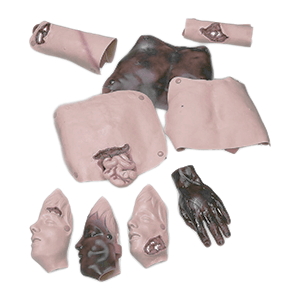
Moulage [moo-lahzh] (French: ‘casting/moulding’) is the art of applying mock injuries for the purpose of training Emergency Response Teams and other medical and military personnel. Moulage may be as simple as applying pre-made rubber or latex ‘wounds’ to a healthy ‘patient’s’ limbs, chest, head, etc., or as complex as using complicated makeup and theater techniques to provide elements of realism (such as blood, vomitus, open fractures, etc.) to the training simulation. The practice dates to at least the Renaissance, when wax figures were used for this purpose.
The history of wax models is ancient. Wax anatomical models were first made by Gaetano Giulio Zummo (1656–1701) who first worked in Naples, then Florence, and finally Paris, where he was granted monopoly right by Louis XIV. Later, Jules Baretta (1834–1923) made more than 2000 splendid wax models in Hospital Saint-Louis, Paris. While wax models were being made, he made pleasant conversations with the patients, sang songs or at times played the piano.
Posted in Education, Health |
Leave a Comment »


 The Daily Omnivore